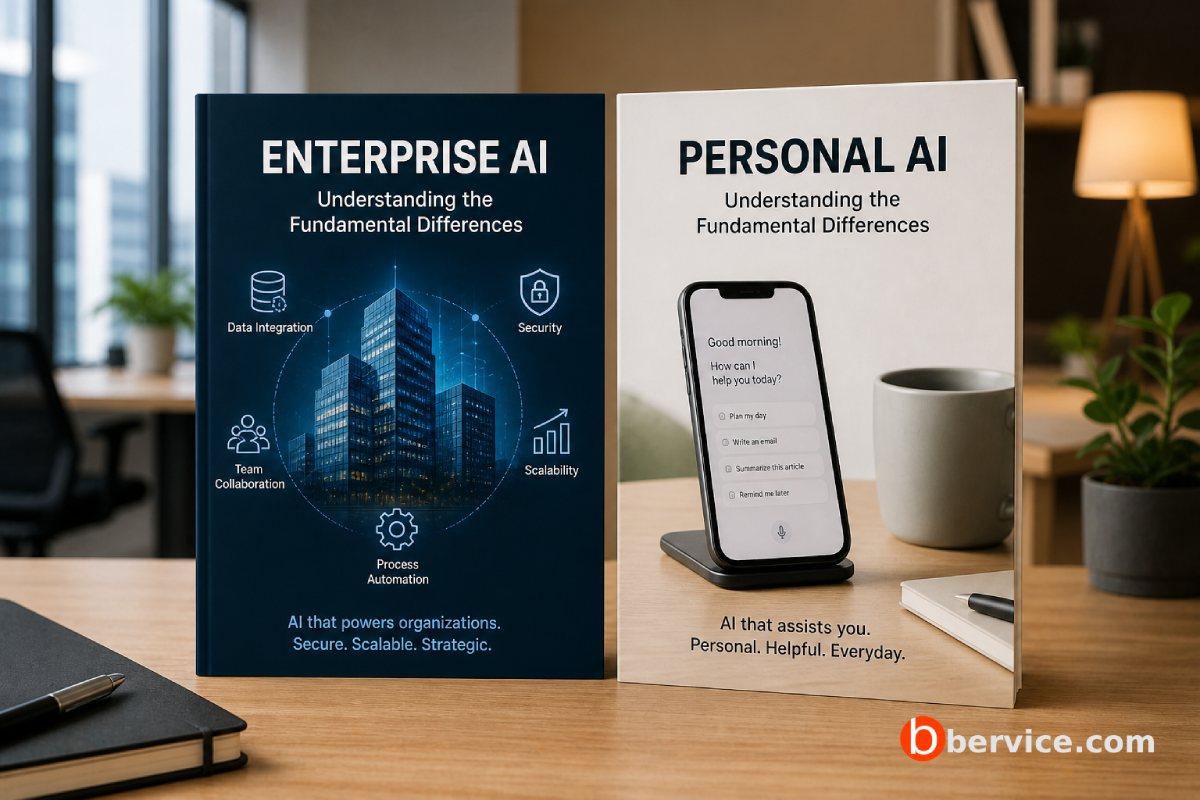
Understanding the Fundamental Differences
Introduction
Artificial Intelligence is no longer a single category of technology. It has evolved into two distinct paradigms: Enterprise AI and Personal AI. While both rely on similar underlying advances in machine learning and large language models, their purpose, architecture, and impact differ significantly. Understanding this distinction is essential for businesses, developers, and individuals navigating the AI-driven future.
Defining Personal AI
Personal AI refers to systems designed to assist individuals in their daily lives. These tools prioritize usability, accessibility, and personalization. Examples include voice assistants, writing tools, and productivity copilots.
The core idea behind personal AI is individual augmentation. It helps a single user perform tasks faster, make decisions more easily, and automate repetitive work. Personal AI systems typically rely on user-specific data such as preferences, habits, and past interactions to improve over time.
They are often cloud-based, lightweight, and optimized for responsiveness rather than deep organizational integration.
Defining Enterprise AI
Enterprise AI, on the other hand, is built for organizations. Its purpose is not just to assist individuals, but to optimize entire systems, processes, and decision-making structures within a company.
These systems integrate with multiple data sources such as internal databases, communication tools, CRM systems, and operational workflows. Enterprise AI focuses on generating insights, automating complex processes, and improving strategic outcomes across teams.
Unlike personal AI, enterprise AI must operate under strict requirements including scalability, security, compliance, and governance.
Key Differences in Purpose
The most fundamental difference lies in intent.
Personal AI is designed to help you. It enhances individual productivity and creativity.
Enterprise AI is designed to help the organization. It enhances coordination, efficiency, and decision-making at scale.
This difference leads to entirely different system designs and priorities.
Data Scope and Complexity
Personal AI typically works with narrow, user-centric data. This might include messages, notes, or browsing behavior.
Enterprise AI operates on massive, multi-source datasets. These include structured and unstructured data from across the organization: emails, code repositories, financial records, customer interactions, and more.
This introduces challenges such as data normalization, identity resolution, and cross-system consistency that do not exist at the personal level.
Architecture and Integration
Personal AI systems are usually standalone or loosely integrated with consumer applications.
Enterprise AI systems require deep integration with existing infrastructure. They often connect to tools like CRMs, project management systems, internal APIs, and data warehouses. This creates a complex architecture involving pipelines, orchestration layers, and governance mechanisms.
In many cases, enterprise AI becomes part of the company’s core infrastructure rather than an optional tool.
Security and Privacy Requirements
Security expectations differ sharply.
Personal AI focuses on user privacy, but often operates within shared cloud environments. The risk is primarily at the individual level.
Enterprise AI must handle sensitive organizational data, including intellectual property, financial information, and customer records. This requires strict access controls, audit trails, encryption, and sometimes fully local or on-premise deployment.
The consequences of failure are significantly higher.
Decision-Making Role
Personal AI typically provides suggestions or assistance. The final decision almost always remains with the user.
Enterprise AI can play a central role in decision-making systems. It may influence hiring decisions, risk assessments, operational planning, and customer strategies. In some cases, it automates decisions entirely within predefined boundaries.
This elevates the need for explainability and accountability.
Scalability and Performance
Personal AI is optimized for individual responsiveness.
Enterprise AI must scale across teams, departments, and sometimes global operations. It needs to handle concurrent users, large datasets, and real-time processing demands. Performance is not just about speed, but also reliability and consistency under load.
Customization vs Standardization
Personal AI is highly personalized but relatively simple in structure.
Enterprise AI requires a balance between customization and standardization. It must adapt to company-specific workflows while maintaining consistency across the organization. This often leads to modular architectures and configurable systems.
Cost and Value Model
Personal AI tools are often low-cost or subscription-based for individuals.
Enterprise AI involves significant investment in infrastructure, integration, and maintenance. However, its value is measured in terms of operational efficiency, cost reduction, and strategic advantage at scale.
Convergence: The Future Direction
The boundary between personal and enterprise AI is beginning to blur. Employees increasingly use personal AI tools within enterprise environments, while organizations aim to provide personalized AI experiences internally.
This convergence suggests a future where AI systems combine personal-level adaptability with enterprise-level intelligence.
Conclusion
Enterprise AI and Personal AI are built on similar technologies, but they serve fundamentally different roles.
Personal AI enhances individuals.
Enterprise AI transforms organizations.
Understanding this distinction is not just theoretical. It shapes how systems are designed, how data is handled, and how value is created. As AI continues to evolve, the most impactful solutions will likely emerge at the intersection of these two paradigms, combining the strengths of both.
Connect with us : https://linktr.ee/bervice
Website : https://bervice.com