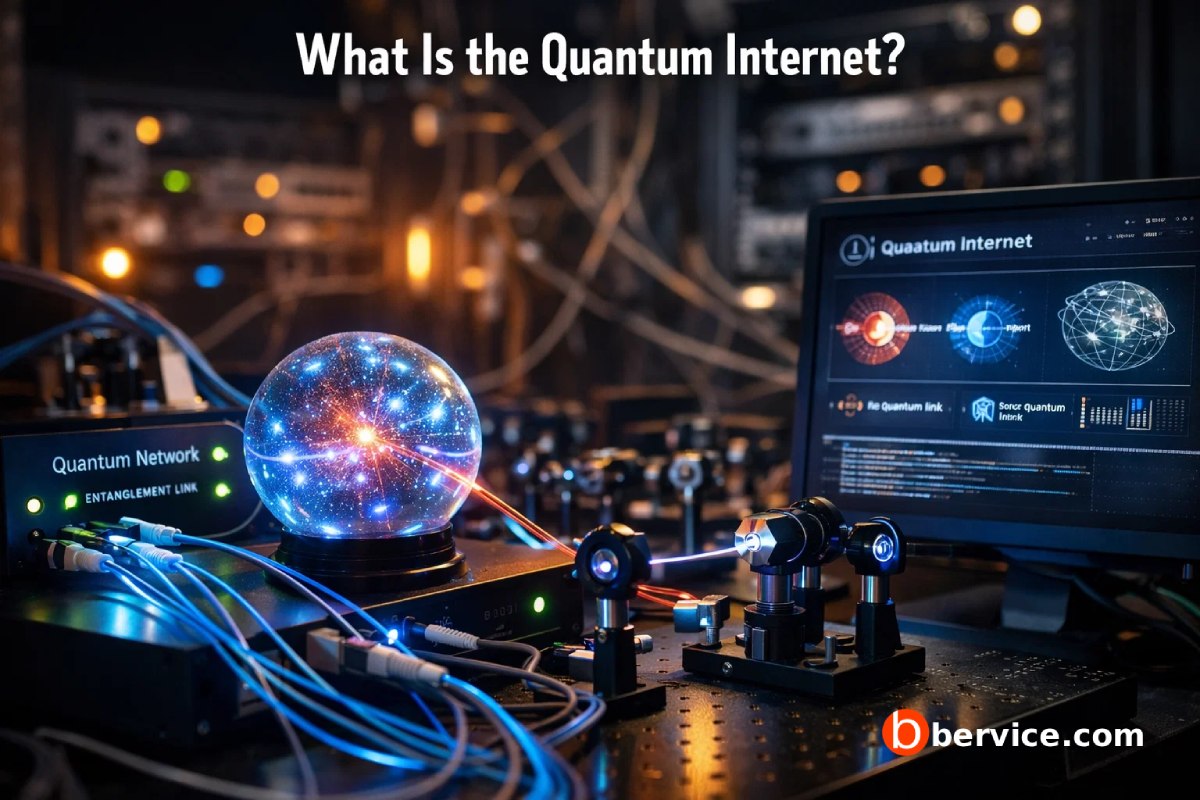
The Quantum Internet is a next generation communication network that uses the laws of quantum physics to transmit information in fundamentally new ways. Unlike the classical internet, which sends bits as 0s and 1s, the quantum internet relies on quantum bits or qubits, which can exist in superposition and can be linked through quantum entanglement.
This is not simply a faster version of today’s internet. It is a different paradigm altogether. The quantum internet enables tasks that are either impossible or insecure using classical networks, especially in the areas of cryptography, distributed computing, and scientific collaboration.
At its core, the quantum internet is designed to securely transmit quantum states between distant nodes without copying them, something forbidden by quantum mechanics itself. This constraint, known as the no cloning theorem, is precisely what gives the quantum internet its extraordinary security properties.
Core Principles Behind the Quantum Internet
1. Qubits Instead of Classical Bits
A qubit can represent 0 and 1 simultaneously until measured. This allows quantum systems to encode and process information in ways that classical systems cannot.
2. Quantum Entanglement
Entangled particles share a correlated quantum state, regardless of the distance between them. When one particle is measured, the state of the other is instantly defined. This phenomenon is central to quantum networking.
3. Quantum Teleportation
Quantum information can be transferred from one location to another without physically moving the particle itself. This process uses entanglement plus classical communication and is a foundational protocol for the quantum internet.
4. Measurement Changes the State
Any attempt to intercept or observe a quantum transmission alters it. This property makes undetected eavesdropping physically impossible.
How the Quantum Internet Works
A quantum internet is composed of several key components:
- Quantum Nodes
These are quantum computers or quantum processors capable of generating, storing, and measuring qubits. - Quantum Channels
Physical media such as fiber optic cables or free space links that carry quantum states, often using single photons. - Quantum Repeaters
Devices that extend the range of quantum communication by distributing entanglement across long distances without measuring the qubits. - Classical Channels
Traditional internet links used alongside quantum channels to coordinate protocols and exchange measurement results.
A crucial distinction is that quantum data itself is never amplified or copied. Instead, entanglement is extended step by step across the network.
Quantum Internet vs Classical Internet
| Aspect | Classical Internet | Quantum Internet |
|---|---|---|
| Information Unit | Bit (0 or 1) | Qubit (superposition) |
| Security Model | Computational | Physical |
| Copying Data | Allowed | Forbidden |
| Eavesdropping | Detectable only by software | Detectable by physics |
| Key Distribution | Vulnerable long term | Provably secure |
The quantum internet does not replace the classical internet. It complements it by enabling secure layers and new capabilities on top of existing infrastructure.
Key Applications of the Quantum Internet
1. Unbreakable Communication
Quantum Key Distribution allows two parties to generate shared encryption keys with security guaranteed by physics, not mathematical assumptions.
2. Secure Government and Military Networks
Critical infrastructure communications can be protected even against future quantum computers capable of breaking today’s encryption.
3. Distributed Quantum Computing
Multiple quantum computers can work together as a single system, sharing entanglement to solve problems beyond the reach of individual machines.
4. Scientific Experiments
Researchers can link quantum sensors and clocks across continents, enabling ultra precise measurements in physics and astronomy.
5. Financial and Healthcare Data Protection
Long term confidentiality becomes possible for sensitive data that must remain secure for decades.
Relationship to Post Quantum Cryptography
It is important to distinguish the quantum internet from Post Quantum Cryptography. Post quantum cryptography adapts classical algorithms to resist quantum attacks, while the quantum internet uses quantum physics itself to secure communication.
In practice, future systems are expected to combine both approaches. Quantum networks for key exchange and classical networks protected by quantum resistant algorithms.
Current State of Development
The quantum internet is still in an experimental phase, but progress is rapid. Research institutions and governments around the world are building prototype networks.
Major contributors include organizations such as IBM, Google, Microsoft, and national research programs supported by agencies like DARPA.
Several countries have already demonstrated quantum communication over hundreds or even thousands of kilometers using fiber and satellites. However, scalable, fault tolerant quantum repeaters remain the primary technical bottleneck.
Technical Challenges
- Decoherence
Quantum states are extremely fragile and easily disrupted by environmental noise. - Distance Limitations
Photons are lost over long distances, and quantum signals cannot be amplified like classical ones. - Hardware Complexity
Quantum memory, repeaters, and error correction require highly controlled conditions. - Standardization
There is no global standard yet for quantum networking protocols.
When Will the Quantum Internet Become Reality?
Early stage quantum networks are already operational in controlled environments. Broader adoption is likely to occur in phases:
- Short term: Secure quantum links for governments and research institutions
- Mid term: Regional quantum networks connected to classical infrastructure
- Long term: A global quantum internet enabling new forms of computation and communication
Widespread consumer access is not imminent, but its impact on security and infrastructure planning is already significant.
Conclusion
The quantum internet represents a fundamental shift in how information can be transmitted and protected. By leveraging the laws of quantum mechanics, it offers security guarantees that no classical system can match.
Rather than replacing today’s internet, it will form a parallel layer for the most sensitive and demanding applications. As quantum technologies mature, the quantum internet is expected to become a cornerstone of future digital infrastructure, redefining trust, privacy, and connectivity in the quantum age.
Connect with us : https://linktr.ee/bervice
Website : https://bervice.com