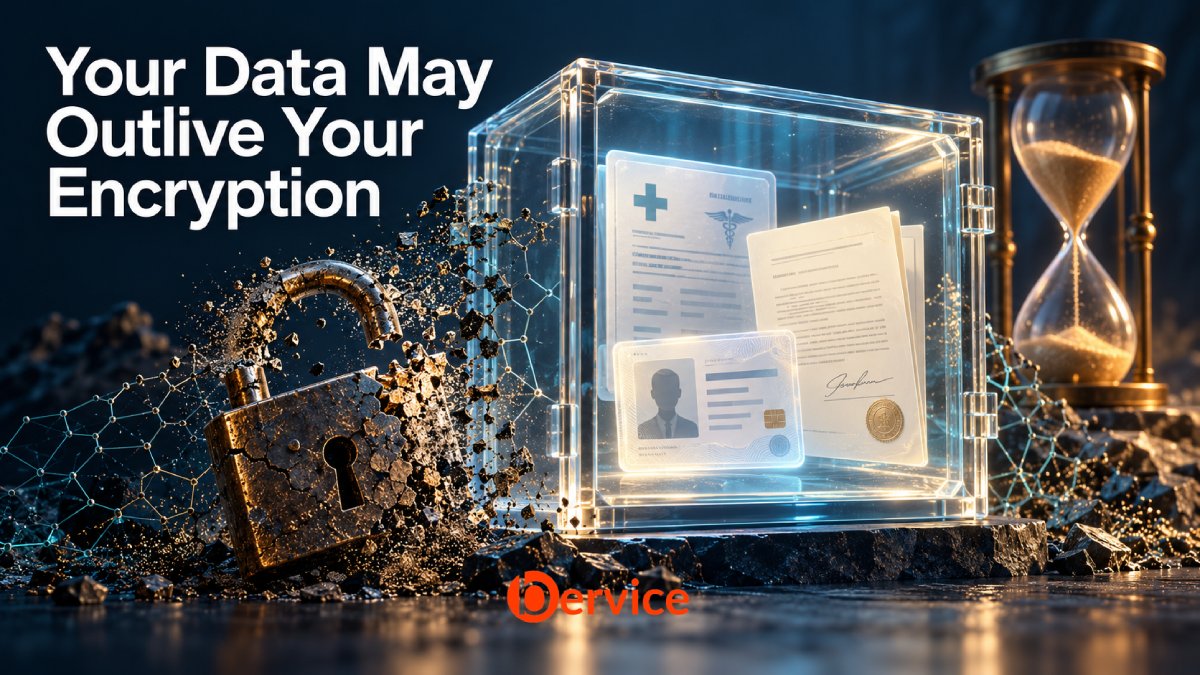
Medical records, contracts, and identity documents can remain sensitive for decades. Their protection needs to account for that entire lifetime.
A password can be changed. A medical history cannot.
A contract may expire while its confidential terms remain commercially valuable. An identity document may become invalid while the personal details it contains remain useful for impersonation.
These differences expose a weakness in how we often think about digital security: we assess whether information is protected today without asking how long that protection needs to last.
Encryption is essential, but choosing an encryption method is only the beginning. Algorithms, software, keys, and the systems surrounding them all have lifecycles. The information they protect may remain sensitive long after those systems have been replaced.
The important question is not simply, “Is this file encrypted?” It is, “Can we maintain its confidentiality for as long as disclosure could cause harm?”
Every Sensitive File Has More Than One Clock
To make sensible protection decisions, organizations need to distinguish three timelines.
Retention lifetime is how long the organization keeps the information.
Confidentiality lifetime is how long disclosure could harm a person or organization.
Protection lifetime is how long the security mechanisms can reasonably be relied upon, with appropriate maintenance and reassessment.
These timelines do not necessarily match.
An organization might delete an identity scan after a short verification process. That reduces what remains in its possession, but a copy stolen before deletion could still expose enduring personal information.
Likewise, an old medical record may become less relevant to current treatment while remaining deeply private.
The following examples illustrate the distinction. They are not legal retention schedules.
| Data type | Why sensitivity may persist | What protection planning should consider |
|---|---|---|
| Medical records | Diagnoses, treatment, and genetic information may remain personal throughout someone’s life | Long confidentiality periods, restricted access, and protection of every retained copy |
| Contracts | Pricing, obligations, negotiations, and trade secrets may matter after the agreement ends | The sensitivity of individual clauses and supporting documents |
| Identity documents | Names, dates of birth, photographs, and identifying details can remain useful after expiry | Minimizing collection, limiting copies, and controlling disclosure |
| Research and designs | Unreleased findings and proprietary methods may retain strategic value | Long development cycles and access across partners |
| Financial records | Transaction history can reveal relationships, behavior, and business strategy | Archive security, key management, and justified retention |
A retention policy answers how long a file should exist. A confidentiality policy answers how long its exposure could matter.
Both are necessary.
Encryption Can Become Vulnerable After the Data Is Collected
Future exposure does not always require a future breach.
An attacker may obtain encrypted information today and store it until a way to decrypt it becomes available. This is known as “harvest now, decrypt later.” NIST identifies it as a reason to prepare for post-quantum cryptography before sufficiently capable quantum computers exist. NIST
For a short-lived secret, delayed decryption may have little value. For a medical archive, identity collection, or long-term commercial secret, the information may still matter when decryption becomes possible.
However, this does not mean that all encryption faces the same quantum threat.
A sufficiently capable quantum computer could undermine widely used public-key techniques, including RSA and elliptic-curve cryptography. Symmetric encryption is affected differently; appropriately sized symmetric algorithms can continue to be used, according to the UK’s National Cyber Security Centre. National Cyber Security Centre
That distinction matters because file protection often involves several mechanisms. One encrypts the content, while others establish, wrap, distribute, or protect the keys.
A reassuring claim about the file’s encryption algorithm does not establish that the entire protection system will remain suitable for decades.
The Deadline Begins With the Data
Organizations often frame cryptographic migration around a predicted technological breakthrough.
But no organization can safely base decades of confidentiality on a precise forecast of when encryption-breaking quantum computing will arrive.
A more useful planning question is:
How long must this information remain confidential, and how long will it take us to upgrade every system protecting it?
Consider an illustrative archive whose records need another 25 years of confidentiality. If replacing its storage, transfer, and key-management arrangements takes several years, delaying preparation increases the period during which new records may be exposed through vulnerable mechanisms.
This is a planning scenario, not a prediction of a quantum breakthrough.
The NCSC’s migration guidance explicitly includes recording data’s expected lifetime and value to an adversary. Its roadmap targets completion of migration by 2035, with earlier discovery and priority migration stages. An organization still needs to assess which information and systems warrant earlier attention. National Cyber Security Centre
Protect the Whole Journey
A sensitive document rarely stays in one place.
It may move from an upload form to application storage, then into backups, exports, support workflows, and another organization’s systems.
Every movement can create another copy. Every copy can introduce another access path or protection mechanism.
A meaningful assessment therefore follows the document through:
- Collection and transmission.
- Processing and authorized access.
- Primary storage and key management.
- Backups, archives, and recovery systems.
- Sharing, exports, and third-party handling.
- Retention expiry and disposal.
This prevents a common mistake: treating one secure component as evidence that the entire lifecycle is secure.
For example, improving the connection used to upload a document does not automatically improve an old backup. Encrypting the main archive does not protect a plaintext export held elsewhere.
Long-term confidentiality depends on the complete path.
Re-Encryption Cannot Recall a Stolen Copy
Updating encryption can improve protection for information that remains under your control.
It cannot change ciphertext an attacker already possesses.
Imagine that an encrypted archive is copied during a breach. Years later, its owner migrates the legitimate archive to stronger protection. The stolen version still exists under its original protection.
This is why long-term security requires both preventing collection and maintaining protection. Migration is valuable, but it cannot erase earlier exposure.
The same limitation applies to deletion. Removing a file from your own systems reduces future exposure there; it does not withdraw copies already obtained by someone else.
Key Management Must Last as Long as the Archive
An encrypted archive is useful only if authorized people can recover it.
Over decades, employees leave, vendors change, applications become obsolete, and recovery procedures may stop working.
Poor key management creates two opposite risks: unauthorized access and permanent loss of legitimate access.
Organizations therefore need to understand who controls the keys, how recovery works, how access is revoked, and how historical backups remain readable after changes.
Rotation also needs precise language. Changing an active key does not necessarily re-encrypt historical data or replace every older wrapped key. The actual behavior depends on the system’s design.
Long-term protection must preserve confidentiality and recoverability together.
Build the Ability to Change
No cryptographic choice should be treated as a permanent guarantee.
A durable system needs cryptographic agility: the ability to identify its cryptographic dependencies and replace them without rebuilding everything around them.
NIST finalized three principal post-quantum standards in 2024: ML-KEM for key establishment, and ML-DSA and SLH-DSA for digital signatures. Their roles differ, so adoption must match the function being protected. CSRC
For buyers, the practical issue extends beyond whether a vendor advertises post-quantum support. Relevant questions include:
- Which connections and operations use it?
- How are stored data keys protected?
- What happens to existing archives and backups?
- Can the implementation be upgraded again?
- How are compatibility, performance, and recovery validated?
A migration can introduce operational failures if implemented carelessly. Supported implementations, staged testing, and verified recovery are part of protecting the data.
Collect Less, Protect What Matters
Some of the strongest long-term protection decisions happen before encryption.
Does the organization need the complete document? Could it retain a verification result instead? Are duplicate copies necessary? Does the original collection purpose still justify keeping the information?
Reducing unnecessary data reduces what can later be exposed. Where retention is required, access restrictions and protection should follow the remaining sensitivity.
A practical starting point is to inventory sensitive information, estimate its confidentiality lifetime, map its copies and cryptographic dependencies, and prioritize the combination of lasting harm, exposure, and migration difficulty.
That assessment needs periodic review. Business needs change, new uses emerge, and previously separate records can become more revealing when combined.
Security Is a Commitment Across Time
A person submitting a medical record is trusting an organization with more than today’s appointment. A customer uploading an identity document is exposing details that may remain personal for a lifetime.
Their information does not become harmless when the organization replaces its software.
For businesses such as Bervice, this makes long-term confidentiality a question of stewardship: knowing what is held, why it remains necessary, where its copies exist, and how its protection will evolve.
Your data may outlive your encryption. The responsibility to protect it lasts as long as the harm its disclosure could cause.
Connect with us : https://linktr.ee/bervice
Website : https://bervice.com