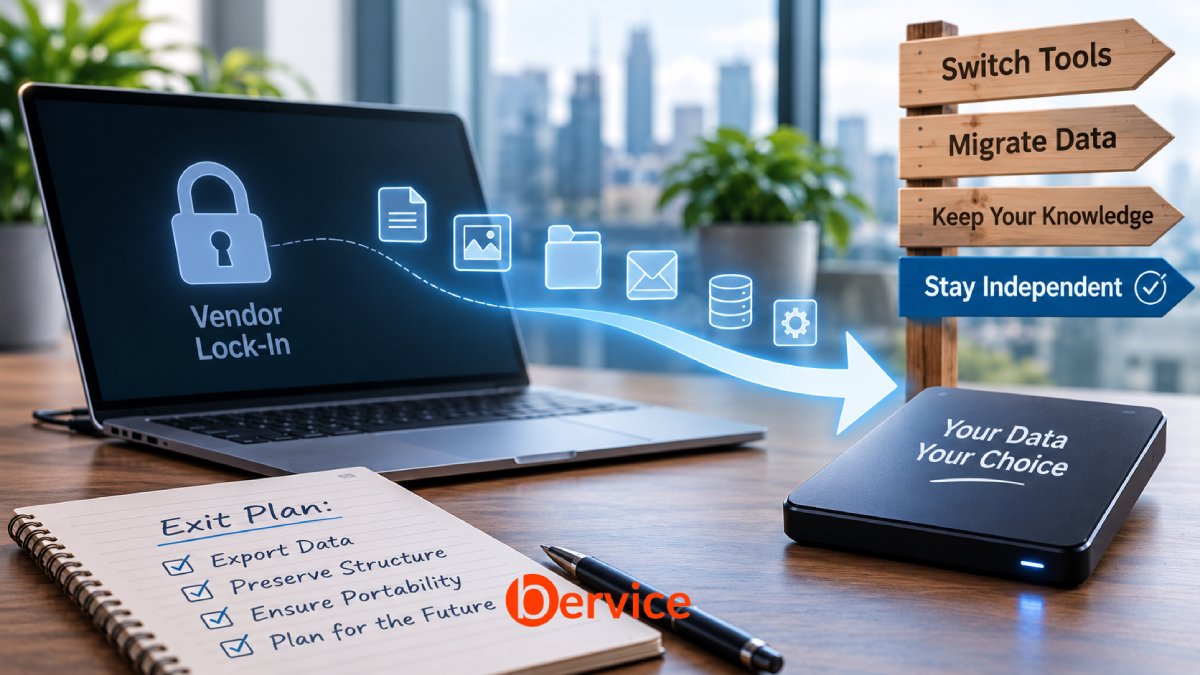
Why You Should Evaluate How to Leave a Tool Before Deciding to Use It
We spend a lot of time choosing the right software. We compare features, pricing, integrations, performance, security, and user experience. We ask whether a tool can solve today’s problems and whether it can support tomorrow’s growth.
But there is one question that rarely receives the attention it deserves:
If we decide to leave this tool tomorrow, what happens to our data?
It sounds like a simple question. In reality, it can determine how much control an organization has over its information, operations, and future technology decisions.
Every tool we adopt creates a relationship with our data. Some make it easy to move information elsewhere. Others make exporting difficult, incomplete, or dependent on proprietary formats. Over time, the difference between these approaches can become extremely expensive.
Choosing software is not just about deciding where your data will live. It is also about understanding whether you can take it with you.
1. The Hidden Cost of Choosing the Wrong Tool
Most software decisions are made based on immediate benefits.
A project management platform promises better collaboration. A cloud storage service offers convenient file sharing. A customer relationship management system organizes customer information. An AI platform promises to make internal knowledge more accessible.
Everything looks efficient until the organization needs to change direction.
Perhaps the subscription becomes too expensive. A better alternative enters the market. The provider changes its pricing model, discontinues a feature, or introduces limitations that no longer fit the business.
At that moment, an important question appears: How difficult is it to leave?
Some organizations discover that their documents can be downloaded, but their folder structures cannot be preserved. Others can export customer records but lose relationships between contacts, activities, attachments, and historical conversations.
The information technically exists, but the context that makes it useful has disappeared.
This is the hidden cost of software dependency. It is not always visible in monthly subscription fees. Sometimes, it only becomes apparent when leaving becomes necessary.
2. Exporting Data Is Not the Same as Owning It
Many platforms advertise data export capabilities. However, the existence of an export button does not necessarily mean that your information is portable.
Consider a company using a cloud-based business management platform.
It may contain:
- Documents and attachments.
- Structured databases.
- Folder hierarchies.
- User permissions and access records.
- Project relationships and dependencies.
- Comments and historical activities.
- Metadata and timestamps.
- Automated workflows and configuration settings.
A basic export might provide documents and spreadsheets while leaving everything else behind.
The company receives its files, but not necessarily the system of information it originally built.
True data portability requires more than downloading individual files. It means preserving enough structure, context, and relationships to make the information usable in another environment.
A successful export should allow you to continue working, not simply give you a collection of files.
3. Your Folder Structure Is Part of Your Business Knowledge
Folders are often treated as a simple organizational feature. In reality, they can represent years of accumulated operational knowledge.
Think about a construction company managing projects across multiple locations.
Its folder structure might contain:
- Clients and subcontractors.
- Individual construction projects.
- Contracts and variations.
- Health and safety documentation.
- Financial records.
- Inspection reports.
- Site photographs.
- Project completion documents.
The structure communicates how the organization thinks about its operations.
If a platform exports all files into a single directory without preserving their original hierarchy, important relationships can become difficult to reconstruct.
The same problem exists in engineering teams, legal firms, research organizations, and businesses with complex documentation requirements.
Preserving file names is important. Preserving directory paths, relationships, and metadata can be equally important.
A portable data strategy should consider the entire information structure, not just the files themselves.
4. The Problem With Proprietary Formats
Not every file format creates the same level of independence.
Some formats are widely supported and can be opened by many applications. Others depend heavily on a particular platform or software ecosystem.
For example, exporting a document into a standard format such as PDF, CSV, JSON, or Markdown may make it easier to reuse in another environment.
However, proprietary formats are not automatically bad. They can preserve advanced functionality that generic formats cannot represent.
The important question is whether the organization has a practical way to access and reuse its information without remaining permanently dependent on one provider.
A sensible strategy includes understanding:
- Which formats are supported for export.
- Whether exported files remain readable without the original application.
- Whether metadata and relationships survive conversion.
- Whether APIs provide access to information that the standard export omits.
- Whether proprietary data can be converted into documented, reusable structures.
The goal is not to eliminate every proprietary format. It is to avoid allowing proprietary formats to become an unavoidable barrier to leaving.
5. AI Tools Make Data Portability Even More Important
The growing adoption of AI introduces another layer of complexity.
Businesses are increasingly using AI platforms to analyze documents, summarize conversations, generate reports, automate workflows, and build organizational knowledge systems.
But these systems often create additional information beyond the original files.
Consider what an AI-powered platform might accumulate:
- Conversation histories.
- Custom instructions.
- Knowledge bases.
- Document embeddings.
- Vector databases.
- Retrieval indexes.
- Agent configurations.
- Workflow definitions.
- Contextual relationships between information sources.
What happens when a company changes its AI provider?
Can it export its conversation history? Can it preserve its knowledge base? Can another system reconstruct the relationships between documents? Can its workflows be transferred?
There is an important distinction here.
Exporting original documents does not necessarily mean exporting the intelligence built around those documents.
For example, a vector database may contain representations of documents that are not directly reusable by another AI model. Embeddings can be model-specific, and even when they can technically be transferred, compatibility and retrieval quality may differ.
This means businesses should think about AI portability at multiple levels:
Data portability: Can the original information be exported?
Knowledge portability: Can relationships, context, and organizational knowledge be preserved?
Workflow portability: Can instructions, automations, and agent configurations be reconstructed?
Model independence: Can another AI provider or locally hosted model work with the same underlying information?
AI should make organizational knowledge more accessible, not create another layer of dependency.
6. Questions to Ask Before Adopting Any Software
Before committing to a new platform, organizations should evaluate its exit strategy as carefully as its onboarding process.
Here are some practical questions worth asking.
1. Can I export all my data?
Do not rely on general marketing statements. Understand exactly which categories of information are included and excluded.
2. Can I preserve my folder structure?
Check whether the original hierarchy, file names, and relationships remain intact after export.
3. Are the exported formats reusable?
Determine whether the data can be opened, processed, and imported into alternative systems.
4. Can I export metadata and historical information?
Dates, permissions, comments, ownership, and activity records may be essential for understanding the information later.
5. Is there a documented API?
An API can provide additional flexibility, although it does not automatically guarantee complete data portability.
6. What happens when my subscription ends?
Understand the provider’s data retention policies, export windows, deletion procedures, and any additional fees.
7. Can I migrate without depending on the original provider?
A genuinely independent exit strategy should not require indefinite access to the platform you are trying to leave.
8. Can another system reconstruct my workflows?
For complex business platforms, information alone may not be enough. Operational configurations and dependencies may also need to be preserved.
These questions should be answered before significant amounts of business information accumulate inside a platform.
7. Build an Exit Strategy Before You Need One
A practical exit strategy does not need to be complicated.
Organizations can reduce their dependency on individual vendors through a few deliberate practices.
Maintain Independent Backups
Keep appropriate copies of important information in storage that is not entirely dependent on the same software provider.
Backups should be tested regularly. A backup that cannot be restored is not a reliable exit strategy.
Prefer Open and Documented Formats
Use widely supported formats whenever practical. For structured information, formats such as CSV and JSON can make future migration easier.
Document Your Data Architecture
Understand where information lives, how it is organized, and which systems depend on it.
Test the Export Process
Do not wait until the organization needs to migrate. Perform sample exports and verify that files, metadata, and relationships are preserved.
Separate Data From Application Logic
Where practical, avoid storing essential business knowledge exclusively inside application-specific configurations.
Review Vendor Dependency Regularly
Software changes. Pricing, ownership, APIs, export policies, and product capabilities can evolve. Review these conditions periodically.
The most important principle is simple: portability should be an ongoing requirement, not an emergency project.
8. Data Independence Is a Business Strategy
Data portability is often discussed as a technical feature. But its impact extends far beyond IT departments.
It affects business continuity, negotiation power, financial planning, security, and long-term organizational independence.
When a company can move its information freely, it has more freedom to evaluate new technologies.
It can replace an expensive provider, adopt a more secure architecture, experiment with local AI, or integrate specialized systems without rebuilding everything from scratch.
It also changes the relationship between the business and its software vendors.
Instead of staying because leaving is too difficult, the organization stays because the platform continues to deliver value.
That is a much healthier relationship.
Vendor independence does not mean avoiding long-term partnerships. It means entering those partnerships without surrendering control over the information that makes the business valuable.
9. The Bervice Perspective: Your Business Knowledge Should Remain Yours
At Bervice, we believe that technology should increase organizational independence rather than create unnecessary dependency.
Business information is more than a collection of documents. It includes decisions, conversations, processes, relationships, historical context, and accumulated knowledge.
As organizations adopt more AI-powered tools, protecting this information becomes increasingly important.
An effective business intelligence environment should not force companies to choose between powerful AI capabilities and control over their own data.
This is why local-first architectures, transparent data structures, independent storage, and the ability to work with different AI models deserve greater attention.
The long-term objective should be an environment where organizational knowledge remains accessible and useful, even when individual tools, providers, or technologies change.
Your business should be able to evolve without losing its memory.
Conclusion: Never Choose a Tool Without Understanding How to Leave It
The best software is not necessarily the platform with the most features, the most integrations, or the most advanced AI capabilities.
It is also the platform that gives your organization enough control to change direction when necessary.
Before adopting your next tool, ask one additional question:
If we stop using this platform tomorrow, can we take everything important with us and continue operating somewhere else?
If the answer is unclear, that uncertainty deserves attention before the commitment begins.
Technology should make your business more capable, not more dependent.
Your data has value beyond the lifetime of any single application. Treat it accordingly.
Your data should have an exit plan. And that plan should exist before you need it.
Bervice | Building a More Independent Digital Future
Connect with us : https://linktr.ee/bervice
Website : https://bervice.com