Bervice | Trust, Digital Identity & The Future of Technology
Introduction: The End of Seeing as Proof
For centuries, humans have relied on their senses to understand the world. If we saw something happen, we believed it. If we heard someone’s voice, we assumed it was really theirs. If we watched a video of an event, we considered it evidence.
That assumption is rapidly becoming outdated.
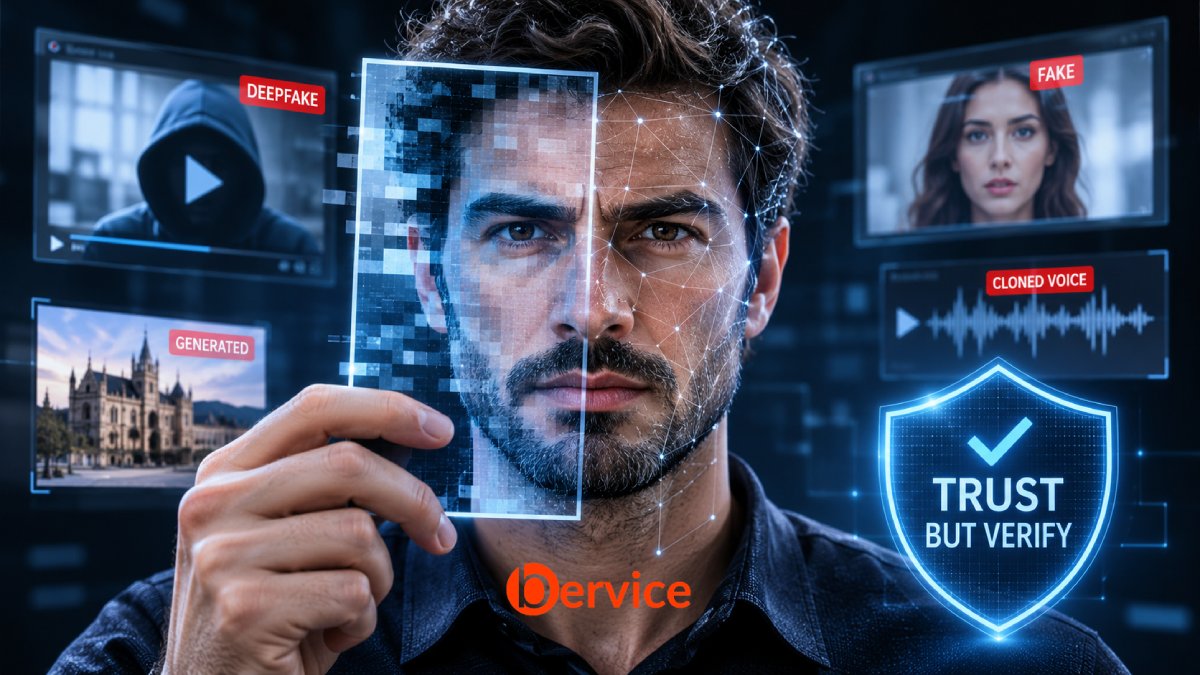
Artificial intelligence has transformed the way digital content is created. Today, realistic images can be generated from simple text prompts, voices can be replicated from short audio samples, and videos can depict people doing or saying things that never happened.
A convincing photograph is no longer necessarily proof of an event. A familiar voice is no longer guaranteed to belong to the person we recognize. Even a video showing an apparently real person speaking directly to a camera can be entirely artificial.
We are entering an era in which seeing is no longer believing.
But this raises a much bigger question than whether AI-generated content is dangerous:
How can society establish trust when the evidence we have traditionally relied on can no longer be trusted?
The answer will require more than better detection tools. It will require a fundamental shift in how we establish identity, verify information, and define digital trust.
1. Reality Has Become Easier to Manufacture
The ability to manipulate images, audio, and video is not new. Photography has been edited for decades, audio recordings have been manipulated, and visual effects have existed since the early days of cinema.
What has changed is accessibility, speed, and realism.
Generative AI has dramatically reduced the technical knowledge required to produce convincing synthetic media. Tasks that previously required professional equipment, specialized software, and considerable expertise can now be performed using widely available tools.
Consider what this means:
- Images: A photograph of an event, location, or person can be generated without the event ever taking place.
- Voices: AI can reproduce someone’s speaking style and vocal characteristics, creating convincing audio messages.
- Videos: Deepfake technology can simulate facial expressions, lip movements, and body language.
- Documents: Artificially generated screenshots, certificates, and digital records can appear legitimate.
- Live interactions: Real-time synthetic representations are increasingly capable of making digital impersonation more convincing.
The challenge is not simply that fake content exists. It is that the cost of creating convincing fake content is falling while the ability to distinguish it from authentic material remains uneven.
This creates a fundamental problem: the visual quality of evidence is becoming disconnected from its authenticity.
2. The Deepfake Problem Is Really an Identity Problem
Deepfakes are often discussed as a technology problem. However, their most serious consequences may be related to identity and trust.
Imagine receiving a video call from your company director requesting an urgent financial transfer. The person’s face, voice, expressions, and communication style appear completely familiar.
How do you know the person on the other side is actually your director?
Or imagine receiving an audio message from a family member asking for emergency financial assistance. The voice sounds authentic, the situation seems urgent, and the emotional pressure is real.
Traditional identity recognition relies heavily on familiarity. We recognize faces, remember voices, and associate particular communication patterns with specific individuals.
But these signals are becoming easier to reproduce.
This means we need to reconsider a fundamental assumption:
Recognizing someone’s appearance is not the same as verifying their identity.
Digital identity must move beyond appearance and familiarity. It needs to incorporate stronger forms of authentication, cryptographic verification, trusted credentials, and independently verifiable evidence.
In other words, we need to prove who is communicating, not simply recognize who they appear to be.
3. The Collapse of Visual Evidence
One of the most concerning consequences of synthetic media is the weakening of visual evidence.
For a long time, photographs and videos played an important role in journalism, legal proceedings, business communication, and public accountability.
They helped establish what happened, when it happened, and who was involved.
Now, the same formats can be manufactured or manipulated at scale.
This creates two equally dangerous possibilities.
The first is believing something false.
A fabricated video can spread misinformation, damage someone’s reputation, manipulate public opinion, or influence financial decisions before its authenticity is questioned.
The second is rejecting something real.
If people become aware that almost any image or recording could be generated by AI, they may begin questioning authentic evidence simply because it is inconvenient or damaging.
This second problem is particularly important.
The danger is not only that fake information becomes believable. It is also that genuine information becomes easier to dismiss.
When every piece of evidence can be challenged, accountability becomes more difficult.
We could eventually reach a point where the question is no longer whether something happened, but whether anyone can establish that it happened at all.
4. Why AI Detection Alone Cannot Solve the Problem
An obvious response to synthetic media is to develop better AI detection systems.
These tools attempt to identify patterns associated with generated or manipulated content, including unusual visual details, inconsistent lighting, unnatural movements, and audio irregularities.
They can be useful, but they have important limitations.
AI generation technologies continue to evolve. Techniques that expose one generation of synthetic content may become less effective as newer models improve.
Content can also be compressed, edited, resized, or redistributed through different platforms, potentially removing or changing the signals that detection systems rely on.
There is another important issue: a detection system does not necessarily prove authenticity.
If a tool cannot identify signs of manipulation, that does not automatically mean the content is genuine.
The absence of detected manipulation is not proof of authenticity.
This distinction matters.
Instead of relying entirely on systems that attempt to identify fake content after it has been created, we should develop systems that establish authenticity at the moment content is captured or produced.
That is a fundamentally different approach.
5. The Future of Digital Trust: Proof Over Appearance
If visual appearance can be manipulated, trust must come from something more reliable than appearance.
This is where cryptographic verification and digital provenance become increasingly important.
Imagine a photograph captured by a device capable of securely recording information about its origin.
Alongside the image, the device creates a cryptographically signed record containing relevant information about the capture process.
That record could help establish:
- Which device created the original content.
- When the content was captured.
- Whether the original file has been modified.
- Whether the associated credentials can be verified.
- What transformations or edits occurred after capture, if they were recorded.
Technologies such as digital signatures, secure hardware, cryptographic hashes, and content provenance standards can help build this infrastructure.
For example, the Coalition for Content Provenance and Authenticity (C2PA) is developing technical standards for recording the origin and history of digital content.
Its approach demonstrates an important shift: instead of asking an algorithm to guess whether content is real, we can examine verifiable information about where that content came from and how it was handled.
However, provenance is not a universal truth detector.
A cryptographic signature can establish that a particular credential signed a file and that the signed content has not been altered. It cannot independently prove that the original scene was truthful, that the camera was pointed at the right subject, or that the person holding the device was authorized to record the event.
That distinction is essential.
The future of trust will depend on combining cryptographic proof with reliable identity systems, secure capture mechanisms, and independent verification.
6. Blockchain and Decentralized Verification: Building Trust Without a Single Gatekeeper
Another important part of the conversation is decentralization.
Today, digital identity and content verification often depend on centralized platforms, institutions, and service providers.
These organizations may control authentication systems, verification databases, and the information users depend on to establish trust.
Although centralized systems can be effective, they also introduce challenges around data ownership, transparency, accessibility, and single points of failure.
Blockchain technology offers an alternative approach.
By using decentralized networks and cryptographic mechanisms, it becomes possible to create records that can be independently verified without relying entirely on one central authority.
Potential applications include:
- Verifiable digital identities: Cryptographically signed credentials that can be checked independently.
- Content integrity records: Hashes that help verify whether a digital file has changed since a particular point in time.
- Credential verification: Records that allow organizations to confirm the validity and issuer of digital qualifications.
- Transparent audit trails: Tamper-evident records of important digital events and verification activities.
- Decentralized trust infrastructure: Systems that allow multiple independent organizations to participate in verification.
However, blockchain does not automatically make information truthful.
Recording a false statement on an immutable ledger does not transform it into a fact. Blockchain can help protect the integrity of records, but the accuracy of the original information still depends on how it was collected and verified.
Its real value lies in providing a stronger foundation for transparency, integrity, and independent verification.
The objective should not be to put everything on a blockchain. It should be to use decentralized infrastructure where it meaningfully improves trust.
7. The New Responsibility of Businesses: Verify Before You Trust
The impact of synthetic media extends far beyond social media.
Businesses are becoming increasingly exposed to identity-based attacks and manipulated digital evidence.
Consider some practical scenarios:
Recruitment and hiring
An employer receives a video interview from a candidate. The person appears genuine, communicates professionally, and answers technical questions. But how can the employer establish that the person participating is actually the individual applying for the position?
Financial transactions
An employee receives an urgent voice message from a senior executive requesting a payment. Familiarity with the executive’s voice is no longer sufficient authentication.
Customer verification
A service provider receives identity documents, selfies, and video recordings. If these materials can be artificially generated or manipulated, traditional verification processes may become less reliable.
Legal and compliance processes
Organizations increasingly need to establish the origin, integrity, and history of digital records before relying on them for important decisions.
These scenarios demonstrate that trust can no longer be treated as a simple assumption.
Organizations need verification processes that distinguish between what appears authentic and what can actually be proven.
This means combining identity authentication, access controls, cryptographic verification, human review, and clear audit trails.
The organizations that adapt early will be better positioned to operate in an environment where digital impersonation becomes increasingly sophisticated.
8. Privacy and Verification Must Evolve Together
There is another challenge that deserves attention.
If society responds to synthetic media by demanding more identity verification everywhere, we could unintentionally create a world of excessive surveillance.
People should not have to disclose their entire identity, personal history, or private information every time they want to prove a single fact.
For example, an organization may need to verify that someone is over a particular age. It does not necessarily need access to that person’s complete identity profile.
Similarly, an employer may need to confirm that a professional qualification is legitimate without collecting unrelated personal information.
This is where privacy-preserving technologies become important.
Zero-knowledge proofs, selective disclosure credentials, and decentralized identity systems can help individuals demonstrate specific claims without exposing unnecessary information.
The objective is to create a system in which verification does not automatically mean sacrificing privacy.
Trust should not require total visibility into someone’s life.
A sustainable digital trust infrastructure must protect both authenticity and individual privacy.
9. A New Digital Literacy: Learning to Question What We See
Technology alone cannot solve the problem.
Even the most sophisticated verification infrastructure will be ineffective if people do not understand how to evaluate digital information.
Digital literacy must evolve.
For decades, media literacy focused on identifying unreliable websites, recognizing biased reporting, and evaluating information sources.
Now, it must also address synthetic media.
People need to develop new habits:
- Verify the original source before sharing emotionally charged content.
- Confirm unusual financial requests through an independent communication channel.
- Be cautious of urgent messages involving money, passwords, or sensitive information.
- Look for provenance information when available.
- Understand that AI detection results are not absolute proof.
- Distinguish between a verified identity, a verified file, and a verified real-world event.
Perhaps the most important lesson is that confidence should not replace evidence.
A video can look convincing and still be false. A voice can sound familiar and still belong to an artificial reproduction.
Healthy skepticism is no longer optional. It is becoming an essential digital skill.
10. The Future Belongs to Verifiable Digital Experiences
We are approaching a turning point in the relationship between humans and technology.
For years, digital innovation focused on making information easier to create, distribute, and access.
Now, as artificial intelligence makes content generation increasingly accessible, the next major challenge is establishing which information deserves our trust.
The internet does not simply need more content. It needs better ways to establish the origin, integrity, and credibility of that content.
This shift could transform several industries:
- Journalism may increasingly rely on verified content provenance.
- Financial services may adopt stronger identity and transaction authentication.
- Recruitment platforms may prioritize verifiable professional credentials.
- Social networks may provide more transparent content authenticity information.
- Governments may develop stronger standards for digital evidence.
- Businesses may adopt decentralized verification infrastructure to reduce dependence on centralized trust providers.
The important distinction is that the future will not be built around proving that everything is real through a single technology.
It will be built around making claims, identities, and digital records independently verifiable.
That is a much more powerful foundation for trust.
Conclusion: Trust Must Be Proven, Not Assumed
For most of human history, seeing something was often enough to believe it.
That world is changing.
Artificial intelligence has made it possible to create convincing representations of people, events, and experiences that never existed. As these technologies become more accessible, the traditional relationship between appearance and authenticity will continue to weaken.
But this does not mean we must accept a future where nothing can be trusted.
It means we need to build better foundations for trust.
Cryptographic verification, secure digital identity, content provenance, decentralized infrastructure, and privacy-preserving technologies can help establish a more reliable digital environment.
Yet technology alone is not enough. We also need better standards, responsible organizations, informed users, and a willingness to question what appears obvious.
The next generation of digital infrastructure will not be defined only by how intelligently machines can generate information.
It will also be defined by how reliably humans can verify it.
When seeing is no longer believing, proof becomes the foundation of trust.
And in the future of the digital world, the most valuable information may not be the information that looks the most convincing, but the information whose authenticity can actually be verified.
Bervice Perspective: Building a More Trustworthy Digital Future
At Bervice, we believe the future of digital technology must be built on more than intelligence, speed, and convenience.
It must be built on trust.
As AI-generated content becomes increasingly difficult to distinguish from authentic information, the need for secure identity, verifiable data, privacy-first systems, and decentralized infrastructure becomes more important.
The goal should not be to force people to trust technology blindly. It should be to give them the tools to verify what they interact with.
We believe the next evolution of the internet will be shaped by a simple principle:
Don’t just show me. Prove it.
Because in a world where almost anything can be generated, authenticity will become one of the most valuable digital assets.
Connect with us : https://linktr.ee/bervice
Website : https://bervice.com