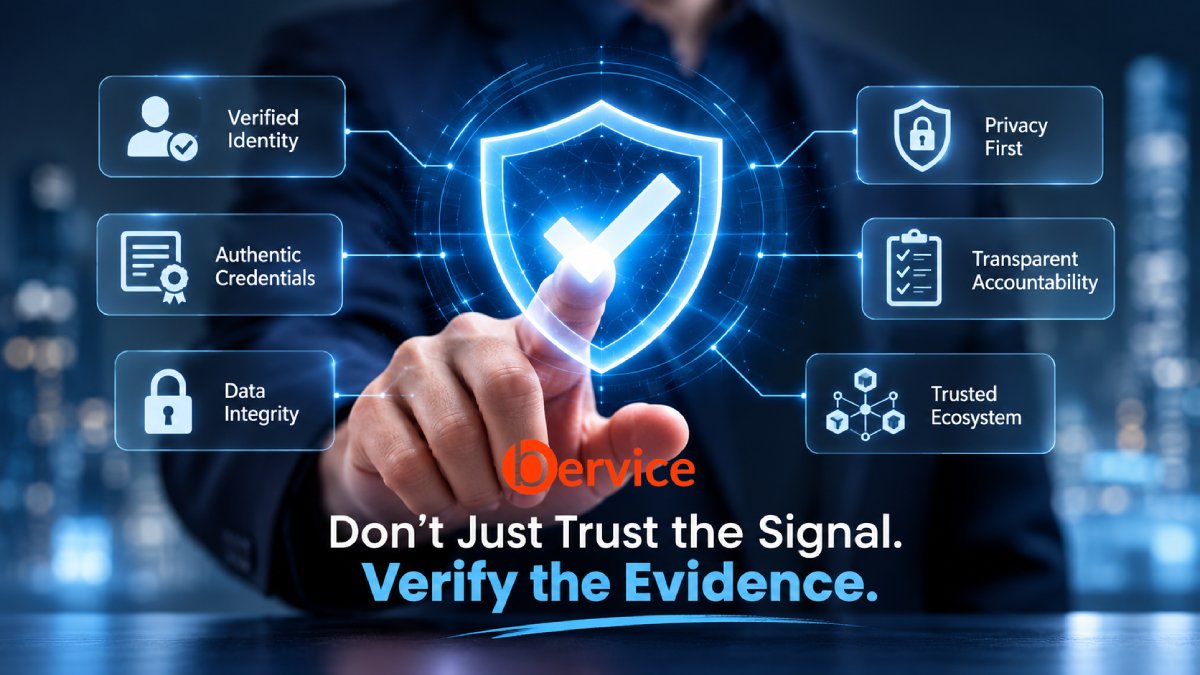
Why Digital Trust Must Be Built on Evidence, Not Promises
We live in a world where almost everything happens digitally. We communicate, work, make payments, share information, sign agreements, hire employees, and build professional relationships through platforms that often connect people who have never met in person.
Yet, behind this growing digital economy lies a fundamental question:
How do we know who or what we can actually trust?
For years, digital trust has largely depended on familiar signals: usernames, passwords, profile pictures, verified badges, company logos, online reviews, and institutional reputation. These signals help create confidence, but they do not necessarily prove that someone is who they claim to be, that information is accurate, or that an action is legitimate.
As digital interactions become more sophisticated, especially with artificial intelligence making it easier to generate convincing identities, documents, messages, and content, the limitations of assumption-based trust are becoming increasingly visible.
The future of digital trust cannot depend on how convincing something looks. It must depend on what can be independently verified.
The Problem with Trusting What We See
Traditional digital systems were designed around a relatively simple assumption: if someone can successfully authenticate, they are probably the person they claim to be.
A username and password confirm access to an account. A verified badge may indicate that a platform has completed a particular verification process. A professional profile communicates someone’s claimed experience and qualifications.
But none of these signals automatically establishes the full truth.
An account can be compromised. A verified profile can become outdated. A certificate can be fabricated. A professional history can contain exaggerated claims. Even a legitimate company email address can be used in a sophisticated impersonation attack.
The problem is not that these systems have no value. The problem is that people often interpret limited verification as complete trustworthiness.
Authentication is not the same as trust.
Knowing that someone controls an account does not necessarily prove their identity, qualifications, intentions, or authority to perform a particular action.
Digital trust requires a deeper approach that separates what is claimed from what has actually been demonstrated.
Artificial Intelligence Is Changing the Trust Equation
Artificial intelligence is making digital communication faster, more accessible, and more productive. However, it is also changing the economics of deception.
Today, creating a realistic professional profile, generating convincing business correspondence, imitating someone’s communication style, or producing seemingly authentic documents requires significantly less effort than it once did.
Deepfakes and AI-generated voices introduce another layer of complexity. A familiar face or recognizable voice can no longer be treated as sufficient evidence of identity.
Consider a simple business scenario.
An employee receives a voice message that sounds exactly like their CEO, requesting an urgent financial transfer. The voice is familiar. The request appears reasonable. The communication seems authentic.
But what happens if the voice was artificially generated?
The employee is no longer evaluating only the message. They must evaluate the evidence behind the identity and authority of the person making the request.
This illustrates a much larger shift:
When digital content becomes easy to imitate, verification becomes more valuable than appearance.
Organizations must move beyond trusting familiar communication patterns and establish independent verification processes for sensitive decisions.
Digital Trust Needs Evidence, Not Just Identity
Identity verification is an important foundation, but digital trust extends far beyond knowing who someone is.
A trustworthy digital interaction may require several independent elements:
1. Verified Identity
Can the person or organization establish that they are who they claim to be?
Identity verification helps reduce impersonation, fraudulent accounts, and unauthorized access.
2. Verified Credentials
Are the qualifications, licenses, certifications, or professional achievements supported by legitimate sources?
A person claiming to be an experienced engineer should be able to provide evidence of relevant qualifications and experience.
3. Verifiable Authority
Does the individual actually have permission to perform the requested action?
A real employee is not automatically authorized to approve payments, access sensitive information, or make decisions on behalf of an organization.
4. Verifiable Actions
Can important activities be traced, reviewed, and attributed to the appropriate person or system?
Reliable records help organizations establish accountability and investigate suspicious activity.
5. Evidence Integrity
Can the evidence itself be checked for authenticity, origin, and potential modification?
A document is not automatically trustworthy simply because it looks official.
Together, these elements create a stronger foundation for digital trust. Instead of relying on a single signal, organizations can evaluate multiple pieces of evidence relevant to a specific interaction.
From Reputation-Based Trust to Evidence-Based Trust
For decades, reputation has played a major role in establishing trust.
We trust people because of their professional history, organizations because of their brand recognition, and services because of recommendations from others.
Reputation remains important, but it has limitations.
It can be subjective, difficult to measure, outdated, manipulated, or disconnected from current performance.
Someone may have an impressive professional profile but lack the practical ability required for a particular role. A company may have an established reputation but operate with outdated security practices. A digital service may have thousands of positive reviews without providing sufficient transparency about how it handles user data.
Evidence-based trust introduces a more reliable way to evaluate these relationships.
Instead of asking only whether someone has a good reputation, we can ask:
- What can they actually demonstrate?
- Where did the evidence originate?
- Who verified it?
- Is the verification still valid?
- Can another party independently confirm it?
- Does the evidence support the specific claim being made?
This does not mean eliminating reputation or human judgment. It means strengthening them with verifiable information.
Trust becomes more meaningful when confidence is supported by evidence.
The Role of Cryptography and Verifiable Credentials
Technology already provides several tools that can help establish stronger digital trust.
Cryptography enables systems to verify the integrity and authenticity of information without necessarily exposing all the underlying data.
Digital signatures, for example, can help establish whether a document was signed using a particular cryptographic key and whether its contents have been modified after signing.
Verifiable credentials provide another important building block.
They allow trusted issuers to create digitally verifiable statements about individuals or organizations. Depending on the implementation, a recipient can verify a credential’s issuer, integrity, and validity without having to contact the issuer every time.
This approach can support:
- Professional qualifications and certifications.
- Employment and organizational credentials.
- Membership and access permissions.
- Educational achievements.
- Business identity verification.
- Compliance and authorization processes.
Zero-knowledge proofs can take this concept further by allowing someone to demonstrate that a particular statement is true without revealing unnecessary personal information.
For example, an individual may be able to prove that they meet an age requirement without disclosing their full date of birth.
However, cryptography alone does not guarantee that information is true. It can establish that a credential was issued by a particular source and has not been altered, but the credibility of the original issuer and the accuracy of the information still matter.
A digitally signed false statement remains false.
The real objective is to combine reliable sources, strong cryptographic verification, appropriate permissions, and transparent processes.
Privacy Must Be Part of Digital Trust
There is an important distinction between making information verifiable and making all information publicly accessible.
A trustworthy digital environment should not require people to expose their entire identity, personal history, or private information simply to establish credibility.
Excessive data collection can create additional risks, including identity theft, unauthorized profiling, data breaches, and misuse of personal information.
The challenge is to prove what is necessary while protecting everything else.
For example, a business may need to confirm that a contractor holds a valid professional certification. It does not necessarily need access to the contractor’s complete personal records.
This is where privacy-preserving verification becomes essential.
A better digital trust architecture should follow several principles:
- Verify only the information required for a specific purpose.
- Minimize unnecessary data collection.
- Protect sensitive information through encryption.
- Provide clear consent and permission controls.
- Allow credentials to be revoked or updated when necessary.
- Maintain accountability without creating unnecessary surveillance.
Trust should not come at the expense of privacy.
In fact, systems that respect privacy while providing meaningful verification are more likely to support sustainable digital relationships.
Why Businesses Must Rethink Their Approach to Trust
For businesses, digital trust is no longer simply an IT security concern. It affects operations, financial decisions, recruitment, customer relationships, partnerships, and long-term competitiveness.
Consider how many important decisions depend on digital information:
A company hires someone based on their professional credentials. A finance department approves a payment based on an email. A supplier receives access to internal systems. A customer shares personal information with an online platform.
Every one of these interactions involves an element of trust.
When trust is based on incomplete or unreliable information, organizations become vulnerable to financial losses, operational disruption, reputational damage, and regulatory consequences.
Businesses should begin treating verification as an operational requirement rather than an optional security feature.
This means implementing stronger identity and access management, establishing independent verification procedures for sensitive requests, validating professional credentials, maintaining reliable audit trails, and reviewing permissions regularly.
It also means recognizing that trust is contextual.
A person may be a legitimate employee but not authorized to access financial records. A supplier may be a verified business but not approved for a particular transaction.
Being verified should never automatically mean being trusted with everything.
Trust should be proportional to the evidence, the context, and the potential consequences of an action.
The Future: A More Verifiable Digital Economy
As digital interactions continue to expand, the need for verifiable information will become increasingly important.
Imagine a digital economy where individuals can carry credentials that demonstrate their qualifications, professional experience, and achievements across different platforms.
Imagine businesses being able to verify the legitimacy of suppliers, partners, and representatives without relying entirely on manual documentation.
Imagine digital transactions where identities, permissions, and important actions can be independently validated.
In this environment, trust would become less dependent on the reputation of a single platform or the appearance of a digital profile.
Instead, it would be supported by interoperable verification systems, cryptographic evidence, trusted issuers, transparent permissions, and accountable processes.
This transition will not happen overnight. Technical standards, legal frameworks, governance models, and user adoption must evolve together.
Not every claim needs a complex verification system, and not every interaction requires the same level of assurance.
The objective is not to eliminate trust between people. It is to reduce unnecessary uncertainty in the systems that connect them.
Bervice Perspective: Trust Should Be Designed Into Digital Infrastructure
At Bervice, we believe that digital trust should be supported by architecture, not simply promised through policies or interfaces.
As organizations become increasingly dependent on interconnected platforms, AI systems, digital identities, and distributed workflows, the ability to verify information and maintain control over sensitive data becomes fundamental.
A stronger approach to digital trust requires more than authentication.
It requires systems that protect information, establish integrity, enforce permissions, preserve accountability, and allow critical claims and actions to be independently examined.
This philosophy also highlights the importance of privacy-conscious infrastructure.
Sensitive business information should not become unnecessarily exposed simply because organizations want to benefit from digital intelligence and automation.
Trustworthy systems should give organizations greater visibility and control over their information while minimizing unnecessary exposure and unauthorized access.
The future of digital infrastructure must be built around a simple principle: security, privacy, and verifiability should work together.
Final Thoughts: Don’t Just Trust the Signal. Verify the Evidence.
The digital world is entering an era where appearances can be manufactured, identities can be imitated, and information can be manipulated at unprecedented speed.
In such an environment, assuming that something is trustworthy because it looks legitimate is becoming increasingly risky.
A verified badge, professional profile, familiar voice, or official-looking document may provide an initial signal. But meaningful trust requires stronger foundations.
We need to know where information came from, who stands behind it, whether it remains valid, and whether its integrity can be independently confirmed.
The next generation of digital systems will not be defined simply by how securely they store information or how conveniently they connect people.
They will also be judged by how effectively they help people establish what is real, what is authorized, and what can be trusted.
Digital trust should not be something we are asked to believe. It should be something we can verify.
Bervice | Building a More Secure and Verifiable Digital Future
Connect with us : https://linktr.ee/bervice
Website : https://bervice.com