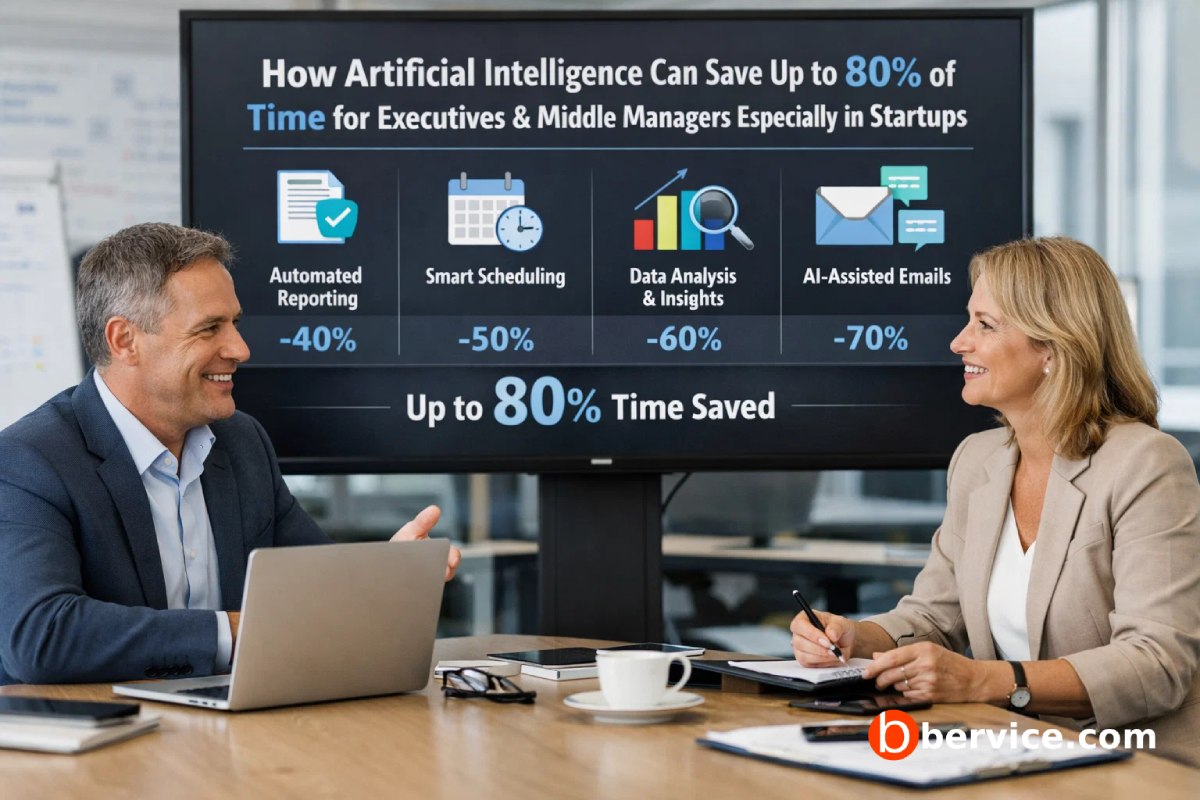
Introduction: The Hidden Cost of Managerial Time
In startups, time is not just a resource, it is the core currency of survival. Founders, executives, and middle managers constantly operate under pressure, juggling decision-making, coordination, communication, hiring, and execution. Unlike large enterprises, startups cannot afford inefficiency. Every hour wasted compounds into delayed growth, missed opportunities, and operational friction.
Artificial Intelligence (AI) has emerged not simply as a productivity tool, but as a structural transformation layer. When implemented correctly, AI can reduce managerial workload by up to 80%, not by accelerating isolated tasks, but by eliminating entire categories of work.
1. Eliminating Operational Noise
A significant portion of a manager’s time is consumed by what can be called “operational noise”:
- Status updates
- Repetitive meetings
- Manual reporting
- Follow-ups and reminders
AI systems can automatically collect, analyze, and present real-time operational data from tools such as Slack, GitHub, ClickUp, and email systems.
Instead of asking:
“What is the status of this project?”
Managers receive:
- Real-time dashboards
- AI-generated summaries
- Risk alerts and delays
This removes the need for constant check-ins and status meetings, saving dozens of hours per week.
2. Automating Decision Preparation (Not Just Execution)
Managers rarely spend most of their time making decisions. They spend it preparing to make decisions.
This includes:
- Gathering data
- Comparing options
- Identifying risks
- Aligning stakeholders
AI can compress this entire process into minutes.
For example, an AI system can:
- Analyze project progress
- Detect bottlenecks
- Suggest corrective actions
- Simulate possible outcomes
Instead of spending hours analyzing spreadsheets and reports, managers receive structured insights like:
- “Delivery risk increased by 23% due to backend dependency delays.”
- “Recommended action: allocate 2 additional engineers for 3 days.”
This transforms decision-making from reactive to proactive.
3. Replacing Coordination Overhead
Coordination is one of the biggest hidden costs in startups.
Managers constantly:
- Align teams
- Clarify responsibilities
- Track dependencies
- Resolve misunderstandings
AI can act as a coordination layer by:
- Mapping tasks to owners automatically
- Detecting misalignment between teams
- Highlighting unassigned or stalled work
- Connecting discussions to actual tasks
For example, if a decision is made in Slack but no task is created, AI can flag it instantly.
This eliminates the need for manual coordination and reduces communication loops significantly.
4. Reducing Meetings by Up to 70–90%
Meetings are often used as a substitute for clarity.
AI changes this dynamic by:
- Generating automatic meeting summaries
- Extracting action items
- Tracking decisions
- Providing asynchronous updates
Instead of daily stand-ups and long sync meetings, teams can rely on:
- AI-generated daily briefings
- Personalized updates for each manager
Only critical meetings remain, reducing meeting time drastically.
5. Automating Hiring and Talent Evaluation
Hiring is one of the most time-consuming responsibilities for managers.
AI can:
- Screen candidates
- Match skills to job requirements
- Analyze past experience
- Rank candidates objectively
More importantly, AI can evaluate real-world evidence of skills (projects, contributions, outputs), not just resumes.
This reduces:
- Resume review time
- Interview cycles
- Hiring errors
In startups, where a wrong hire is extremely costly, this alone can save hundreds of hours.
6. Turning Communication into Structured Knowledge
Most organizational knowledge is buried in:
- Chats
- Emails
- Meetings
AI can convert unstructured communication into structured knowledge by:
- Extracting key decisions
- Linking discussions to projects
- Building a searchable knowledge graph
Managers no longer need to ask:
“Why was this decision made?”
They can instantly access:
- Context
- Participants
- Reasoning
- Outcomes
This reduces repeated discussions and institutional memory loss.
7. Predicting Risks Before They Happen
Traditional management is reactive.
AI enables predictive management by:
- Identifying patterns in delays
- Detecting overloaded team members
- Highlighting hidden dependencies
- Forecasting project risks
For example:
- “Frontend tasks are consistently delayed when dependent on API changes.”
- “Team X is operating at 140% workload capacity.”
Managers can act before problems escalate, eliminating crisis management time.
8. Creating Executive-Level Insights Automatically
Executives spend significant time preparing reports for stakeholders.
AI can generate:
- Weekly executive summaries
- KPI dashboards
- Strategic insights
- Recommended actions
Instead of compiling data manually, executives receive:
- Narrative reports
- Visual analytics
- Decision-ready insights
This alone can save 10–20 hours per week for leadership teams.
9. Enabling Asynchronous Organizations
Startups often struggle with time zones and distributed teams.
AI enables asynchronous operations by:
- Providing continuous updates
- Answering operational questions
- Acting as a knowledge interface
Managers no longer need to be present for everything.
This reduces:
- Interruptions
- Context switching
- Dependency on real-time communication
10. From Managers to System Designers
The most profound impact of AI is not just time savings.
It changes the role of managers.
Instead of:
- Tracking tasks
- Following up
- Managing communication
Managers become:
- System designers
- Decision-makers
- Strategy drivers
AI handles execution visibility and coordination, allowing managers to focus on high-leverage activities.
Conclusion: The 80% Time Reduction Is Structural, Not Incremental
The claim that AI can save 80% of managerial time may seem exaggerated at first glance.
However, this reduction is not achieved by making existing processes faster.
It is achieved by:
- Eliminating unnecessary processes
- Automating coordination
- Replacing manual analysis
- Converting chaos into structured systems
In startups, where speed and clarity define success, AI is not optional.
It is the difference between:
- Scaling efficiently
- Or drowning in operational complexity
The future of management is not about working harder or even smarter.
It is about building systems where most of the work no longer needs to be done by humans.
Connect with us : https://linktr.ee/bervice
Website : https://bervice.com