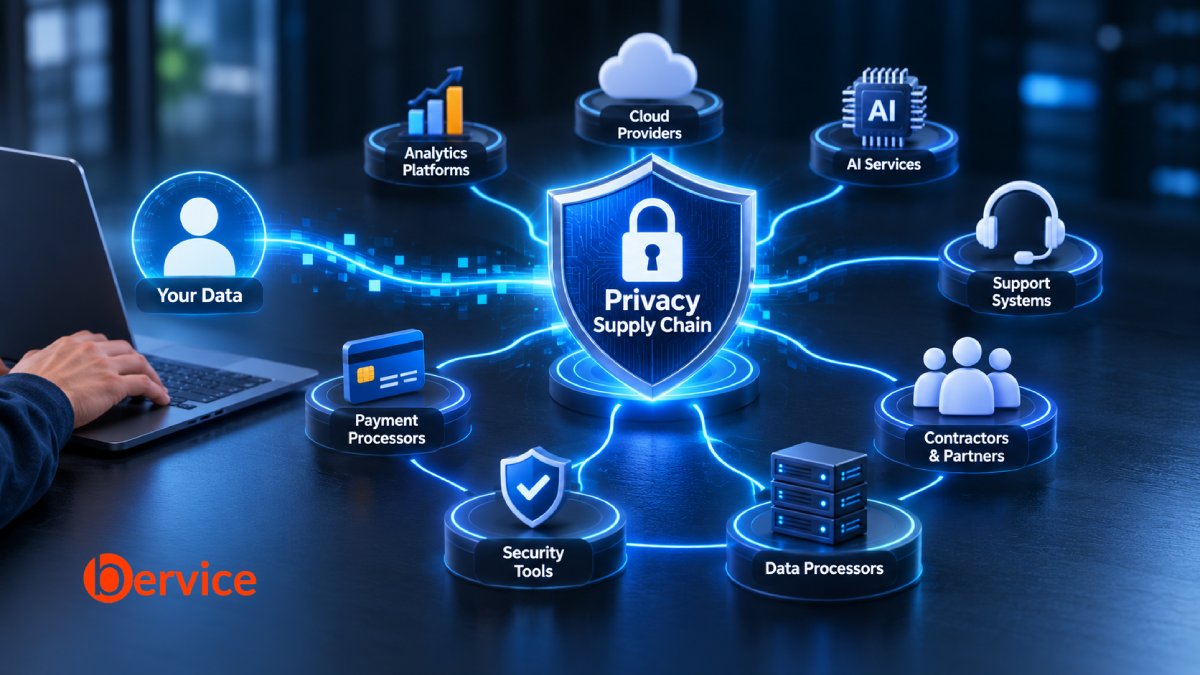
Your Data Does Not Stop at the Service You Trust
We often think of privacy as a relationship between ourselves and the companies we choose to trust.
We sign up for a service. We read its privacy policy, accept its terms, and assume that our information remains within the boundaries of that organization.
But the modern digital world does not work that way.
The service you use may rely on dozens of external systems to operate. Your information could move from the primary application to analytics platforms, customer support systems, cloud infrastructure providers, security vendors, data processors, and external contractors.
Each connection introduces another potential point of access.
The company you trust may not be the only organization capable of seeing your information. In some cases, it may not even have complete visibility into where your data travels.
Privacy is no longer just about who collects your data. It is about understanding the entire supply chain of access.
The Hidden Network Behind Every Digital Service
Modern software is rarely built or operated in isolation.
A seemingly simple application may depend on an extensive network of third-party services:
- Cloud hosting providers that store and process information.
- Analytics platforms that track user behavior.
- Customer support systems that receive account details and conversation histories.
- Monitoring tools that collect application logs and error reports.
- Identity providers that manage authentication.
- Payment processors that handle financial information.
- AI services that analyze submitted content.
- External contractors who maintain, troubleshoot, or improve the system.
These dependencies are often invisible to the end user.
When you upload a document, submit a support request, or interact with an AI-powered feature, your information may pass through multiple systems before the operation is complete.
The challenge is that each system may operate under a different security model, retention policy, access structure, and legal jurisdiction.
A privacy policy may explain that information is shared with service providers. However, it may not provide a practical understanding of the complete access chain.
This creates a fundamental problem:
The user sees one service. The data sees an ecosystem.
Privacy Is a Supply Chain Problem
Traditional supply chain security focuses on the movement of physical goods, components, and materials between suppliers.
Digital privacy has a similar structure.
Information moves through a series of interconnected organizations and technical systems. Each participant may receive, process, store, or access a portion of that information.
Consider a business using a cloud-based productivity platform.
An employee creates a confidential document. The document is stored by the primary provider. An analytics system records activity. A support platform may receive a screenshot during troubleshooting. A backup provider creates another copy. A third-party integration synchronizes selected information with another application.
The original document may now exist across multiple environments, each with its own permissions and security controls.
The privacy boundary is no longer a single server, application, or organization. It is the entire chain of systems that can access the information.
This is why evaluating a service based solely on its primary provider is insufficient.
A secure company can still expose information through an insecure integration. A trustworthy application can still create unnecessary access through an external support tool. A carefully designed platform can still inherit risks from its vendors.
Privacy must be evaluated across the entire ecosystem.
The Four Layers of Data Access
To understand how information moves, it helps to distinguish between four different layers of access.
1. The Primary Service
This is the application or platform that directly interacts with the user.
Examples include:
- Email platforms.
- AI assistants.
- Cloud storage applications.
- Business management systems.
- Password managers.
The primary service is usually the most visible participant in the relationship.
However, its access controls represent only the first layer of the privacy model.
2. Infrastructure Providers
These organizations provide the technical foundation of the service.
They may operate:
- Cloud servers.
- Databases.
- Storage systems.
- Backup infrastructure.
- Content delivery networks.
- Managed security services.
Infrastructure providers may not routinely inspect customer content. Their potential access depends on architecture, encryption, operational permissions, and contractual arrangements.
The important distinction is between having the technical capability to access information and actually exercising that capability.
3. Operational and Analytical Services
These systems help organizations understand, maintain, and improve their products.
Examples include:
- Application performance monitoring.
- Analytics dashboards.
- Error tracking.
- Customer relationship management.
- Technical support platforms.
- AI-powered processing tools.
These services can unintentionally become secondary repositories of sensitive information.
An error log might contain a session token. A support ticket might include a confidential attachment. An analytics event might reveal a user’s behavior or business activity.
The original application may have strong security controls, but those controls do not automatically extend to every external system.
4. Human and Organizational Access
The final layer includes people who may access information through their professional responsibilities.
This could include:
- Customer support employees.
- System administrators.
- Developers.
- Security engineers.
- External consultants.
- Contractors.
- Vendor personnel.
Human access is often necessary for maintaining reliable systems.
The problem is not that human access exists. The problem is when access is excessive, permanent, poorly monitored, or unrelated to a legitimate operational requirement.
A privacy-conscious organization should be able to explain not only which systems can access information, but also which people can access it, under what conditions, and for how long.
The Difference Between Data Sharing and Data Access
One of the most important distinctions in privacy is that information does not need to be formally shared to become accessible.
A company may never intentionally send a confidential document to a third party.
Yet a third-party monitoring agent installed within its infrastructure could potentially collect information from application logs.
A support contractor may not receive a document directly, but could have access to a system containing that document.
A cloud provider may not use customer information for its own purposes, while still possessing technical capabilities that allow certain forms of access.
These situations demonstrate why privacy assessments should consider both data flows and access capabilities.
There are several questions worth asking:
- Is information transmitted to another organization?
- Is information stored in another organization’s environment?
- Can another organization access the information remotely?
- Can the information be reconstructed from logs or metadata?
- Does the external provider have access to encryption keys?
- Can employees or contractors access customer data?
- Is access temporary, permanent, or conditional?
A complete privacy assessment must answer these questions separately.
The Invisible Risk of Metadata
Even when the content of a message or document is encrypted, metadata may still reveal meaningful information.
Metadata can include:
- The time a user accesses a service.
- The frequency of interactions.
- The size of uploaded files.
- The identities of communicating systems.
- IP addresses and connection patterns.
- The type of device being used.
- The duration of a session.
Individually, these details may appear harmless.
Collectively, they can reveal behavioral patterns, business relationships, operational schedules, or sensitive activities.
For example, the timing and frequency of interactions between two organizations could provide insights into a confidential business relationship without exposing the content of a single message.
Privacy therefore requires more than protecting the contents of information.
It also requires understanding what can be inferred from the surrounding data.
How to Map Your Data Access Chain
Organizations cannot effectively manage a risk they cannot see.
Mapping the data access chain is one of the most practical steps toward improving privacy and security.
The process does not need to begin with an expensive enterprise platform. It can start with a structured inventory.
Step 1: Identify the Data
Determine what information the organization collects and processes.
Classify it according to sensitivity.
For example:
- Public information.
- Internal operational information.
- Confidential business information.
- Personal information.
- Highly sensitive information, such as authentication credentials or financial records.
Different categories should have different access requirements.
Step 2: Identify Every System That Touches the Data
Document the applications, infrastructure, integrations, and external services involved.
Do not limit the inventory to systems directly purchased by the organization.
Include services introduced by developers, departments, contractors, and automated integrations.
Shadow IT can create data access paths that are absent from official documentation.
Step 3: Trace the Data Flow
For each important category of information, identify:
- Where the data originates.
- Where it is transmitted.
- Where it is stored.
- Which systems process it.
- Which organizations receive it.
- Where copies and backups are created.
- When the data is deleted.
This creates a practical representation of the information lifecycle.
Step 4: Review Access Permissions
For every system, determine who or what can access the information.
Review:
- User permissions.
- Administrative privileges.
- API access.
- Service accounts.
- Integration permissions.
- Contractor access.
- Emergency access procedures.
The objective is to identify unnecessary or excessive permissions.
Step 5: Evaluate External Providers
Third-party relationships should be reviewed based on the sensitivity of the information they handle.
Important considerations include:
- Data processing agreements.
- Security certifications and independent assessments.
- Encryption practices.
- Data retention policies.
- Breach notification procedures.
- Subprocessor transparency.
- Access logging.
- Data deletion capabilities.
- Geographic data storage and processing.
Certifications can provide useful evidence, but they do not automatically guarantee that a specific integration is configured securely.
Step 6: Identify Uncontrolled Copies
Information often remains in places that are not immediately obvious.
Examples include:
- Application logs.
- Support tickets.
- Exported reports.
- Temporary files.
- Backups.
- AI conversation histories.
- Developer testing environments.
These secondary copies can become long-term privacy risks.
A strong data governance strategy should define how such copies are created, protected, retained, and removed.
The Principle of Least Privilege
A central principle of modern security is that every system and individual should receive only the access necessary to perform their assigned function.
This principle becomes especially important when dealing with third-party services.
An analytics platform may need aggregated usage statistics, but it may not need access to document contents.
A support team may need to troubleshoot an account, but it may not need permanent access to every file belonging to that user.
A contractor may require temporary access to a production environment, but that access should not remain active after the task is completed.
Least privilege reduces the number of possible paths through which information can be exposed.
It also limits the consequences of a compromised account or external service.
Privacy by Architecture, Not by Promise
Privacy is often presented as a policy commitment.
But policies cannot replace technical architecture.
A company may promise that customer information is protected. The more meaningful question is whether its infrastructure makes unnecessary access technically difficult or impossible.
Several architectural approaches can help.
Data minimization
Collect only the information necessary to provide the service.
Information that is never collected does not need to be protected, retained, or shared.
Encrypt information during transmission and at rest.
Where appropriate, use architectures in which the service provider does not possess the keys required to decrypt customer content.
However, encryption at rest does not prevent access by a service that can decrypt the information during normal operation.
Local processing
Process sensitive information on the user’s own device when practical.
Local processing can reduce the number of external systems that receive raw information.
It does not eliminate all privacy risks, but it can significantly reduce the external access chain.
Federated and privacy-preserving analytics
Use techniques that reduce the need to collect individual-level information centrally.
Depending on the application, this may include aggregation, differential privacy, or federated approaches.
Granular permissions
Give users and administrators control over which integrations can access which categories of information.
Permissions should be specific, understandable, and revocable.
Short-lived access
Use temporary credentials and time-limited privileges instead of permanent access wherever possible.
These approaches transform privacy from a statement of intent into an engineering property.
The Third-Party AI Problem
AI services introduce another important dimension to the privacy supply chain.
When an organization integrates an AI model into its workflow, information may pass through additional layers:
The application.
The AI orchestration platform.
The model provider.
The hosting infrastructure.
External logging or monitoring services.
Depending on the implementation, confidential information may be transmitted to an external model provider for processing.
The relevant questions are not simply whether the AI provider is trustworthy.
Organizations should also understand:
- What information is transmitted to the model?
- Is the data retained after processing?
- Is it used for model training?
- Are prompts or responses logged?
- Can external personnel access the information?
- Are additional subprocessors involved?
- Can sensitive information be processed locally?
A model operating locally may reduce dependence on external data processors, but local deployment alone does not guarantee privacy.
The surrounding application, storage, permissions, and telemetry must also be designed carefully.
The AI model is only one component of the privacy architecture.
What a Privacy-Conscious Organization Should Demand
Organizations should move beyond generic assurances and ask vendors for concrete evidence.
A meaningful privacy review should establish:
- A documented list of subprocessors.
- Clear data flow diagrams.
- Defined data retention periods.
- Transparent access control policies.
- Auditable administrative activity.
- Documented incident response procedures.
- Explicit rules governing AI data processing.
- The ability to revoke integrations and access.
- Clear data deletion and export procedures.
- Contractual boundaries on secondary data use.
These requirements should be proportionate to the sensitivity of the information and the role of the vendor.
The goal is not to eliminate every external dependency.
Modern digital infrastructure depends on interconnected services.
The goal is to ensure that every dependency is understood, justified, and controlled.
Privacy Is a Question of Control
The digital economy has created an extraordinary ability to process, store, and transfer information.
But this capability has also made privacy more complex.
The traditional question was:
Who owns the data?
The more important question today is:
Who can access the data, through which systems, under what conditions, and with what level of control?
Ownership without visibility is incomplete.
Encryption without access governance is incomplete.
Privacy policies without architectural enforcement are incomplete.
A trustworthy digital environment should make the information lifecycle understandable to the people and organizations responsible for it.
This is especially important for businesses managing confidential strategies, customer records, internal communications, intellectual property, and operational intelligence.
The Bervice Perspective: Build Trust Around the Entire Information Lifecycle
At Bervice, we believe that the future of digital privacy should be shaped by architecture, visibility, and control.
A secure environment should not merely protect the primary application.
It should help organizations understand how information moves, identify unnecessary access, and reduce their dependence on uncontrolled external processing.
This requires a different way of thinking about enterprise technology.
Instead of treating every integration as an isolated convenience, organizations should evaluate each connection as part of a broader trust architecture.
Every system should have a purpose.
Every access permission should have a justification.
Every external dependency should be understood.
And every sensitive information flow should be governed.
The future of privacy will not be determined solely by the promises made by individual companies.
It will be determined by how effectively we control the entire chain.
Because your data does not have a privacy boundary at the point where you click “Accept.”
It has a supply chain.
And every link matters.
Final Thought
Privacy is not simply the absence of data collection.
It is the ability to understand, govern, and control the journey of information throughout its lifecycle.
In a world where every application depends on an ecosystem of external services, trust must extend beyond the brand on the screen.
The real question is no longer whether a company protects your data.
It is whether you can see, understand, and control every path through which your data can be accessed.
Privacy. Security. Control.
Connect with us : https://linktr.ee/bervice
Website : https://bervice.com