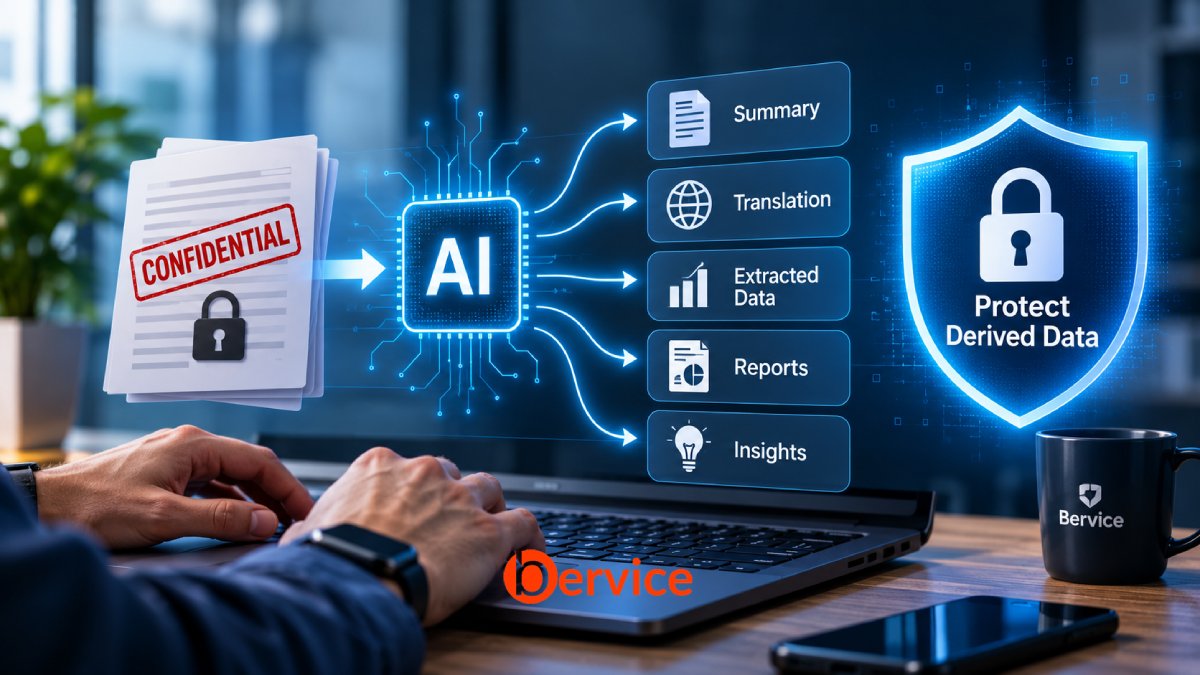
The Hidden Security Risk of AI-Generated Documents, Summaries, and Extracted Information
Introduction: When the Original Document Is No Longer the Only Risk
Imagine that your company receives a confidential business contract. It contains pricing agreements, customer information, intellectual property, financial commitments, and details about future projects.
To save time, an employee uploads it to an AI assistant and asks for a summary.
Within seconds, the AI produces a two-page document highlighting the most important clauses, financial obligations, risks, and business decisions.
The original contract remains protected in the company’s document management system. But what about the summary?
What if that summary is downloaded, forwarded, copied into another application, or stored in an AI conversation history? What if someone who does not have permission to access the original contract receives the AI-generated version?
This creates a security problem that many organizations are only beginning to recognize:
Protecting the original information is not enough. Organizations must also protect everything generated from it.
As AI becomes deeply integrated into everyday business operations, summaries, translations, reports, extracted data, and analytical insights can become just as sensitive as the documents from which they were created.
1. The Original Document Is Only the Beginning
Traditional information security has largely focused on protecting primary data.
Organizations classify documents, assign access permissions, encrypt files, and establish policies governing who can view or modify sensitive information.
However, AI introduces a new layer of information creation.
A single confidential document can generate dozens of new artifacts:
- Executive summaries.
- Translated versions.
- Extracted tables and financial figures.
- Contractual risk assessments.
- Meeting preparation notes.
- AI-generated recommendations.
- Searchable knowledge base entries.
- Structured JSON or database records.
- Email drafts containing confidential details.
Each of these outputs may preserve some or all of the sensitive information contained in the original.
Consider a contract containing a confidential acquisition price.
An AI assistant might generate a summary that removes the legal language but explicitly mentions the acquisition value.
The summary is shorter, easier to understand, and potentially easier to share. Yet the most sensitive information remains.
In some cases, the derived document may even expose information more directly than the original.
2. Information Does Not Become Less Sensitive When It Is Transformed
One of the most dangerous assumptions in AI-assisted workflows is that transforming information somehow reduces its confidentiality.
It does not.
Translation does not remove confidentiality.
Summarization does not automatically anonymize information.
Extracting data does not eliminate its sensitivity.
Changing a PDF into a spreadsheet does not change the underlying security requirements.
The format may change, the structure may become simpler, and the language may become more accessible, but the information itself can retain its original sensitivity.
For example:
A confidential employment agreement might be transformed into a simple table containing:
- Employee name.
- Annual compensation.
- Bonus structure.
- Contract termination conditions.
- Performance requirements.
The resulting spreadsheet may look like an ordinary business report. Nevertheless, it contains personal and commercially sensitive information.
Sensitivity belongs to the information, not merely to the file format in which it exists.
This principle should become a fundamental part of modern data security.
3. The Hidden Problem of Data Lineage
To protect derived information properly, organizations need to understand where it came from.
This is known as data lineage.
Data lineage establishes the relationship between an original information source and the materials subsequently generated from it.
For example:
<escape>Confidential Contract
|
v
AI-Generated Summary
|
+——> Executive Report
|
+——> Translated Document
|
+——> Financial Data Extraction
|
+——> Internal Knowledge Base</escape>
Without this relationship, an organization may protect the original contract while losing control over the information distributed through its derived documents.
Imagine that a contract is later updated, restricted, or deleted.
Do the AI-generated summaries still exist?
Are the extracted financial figures still accessible?
Have translations been copied into other systems?
Can the organization identify every document derived from the original?
Without reliable lineage, answering these questions becomes difficult.
A mature information security architecture should maintain relationships between source documents, derived artifacts, and subsequent versions.
This makes it possible to understand not only where information is stored, but also how it has evolved and where it has travelled.
4. Access Permissions Must Follow the Information
Traditional access control often operates at the file or application level.
A user may have permission to access a particular document, while another user does not.
However, AI-generated content introduces a more complicated question:
What happens when someone creates a new document from information they are authorized to access, but shares that document with someone who is not?
For example, an executive assistant may have access to a confidential acquisition agreement and ask an AI assistant to prepare a summary.
The summary is then placed in a general company workspace.
Other employees can access it, even though they do not have permission to view the original agreement.
This is a form of information leakage through derived content.
A stronger approach is to make security classifications and access restrictions travel with the information.
If an output contains sensitive information from a restricted source, its classification should reflect that sensitivity.
This does not necessarily mean every derived document must inherit every restriction automatically. A carefully reviewed and genuinely anonymized output may qualify for a different classification.
However, any reduction in protection should be based on an explicit assessment, not an assumption that summarization makes information safe.
5. AI Memory Creates Another Layer of Exposure
The problem becomes even more complex when AI systems retain information across conversations.
Many modern AI tools offer persistent memory, conversation history, retrieval systems, or organizational knowledge bases.
These capabilities make AI more useful because users do not need to repeatedly provide the same context.
But they also introduce additional questions:
- Does the AI retain information from confidential documents?
- Can information from one conversation influence another?
- Who can access stored conversation histories?
- Are extracted details indexed in a searchable knowledge base?
- Can sensitive information appear in responses to users who should not have access to it?
- What happens when the original document is deleted or its permissions change?
An organization may carefully manage access to its document storage while overlooking the separate systems where AI-generated information is retained.
This creates multiple potential locations for sensitive information to exist.
AI security must therefore extend beyond the moment a document is uploaded or processed.
It must also consider what happens before, during, and after AI interaction.
6. Deletion Must Include Derived Information
Deleting an original document does not necessarily eliminate every copy or representation of its contents.
A confidential report might have already produced:
- Several AI summaries.
- Extracted financial records.
- Internal reports.
- Cached search results.
- Conversation histories.
- Embeddings in a vector database.
- Copies stored in external applications.
Even if the original file disappears, its information may remain accessible through these secondary artifacts.
This creates an important distinction between deleting a document and eliminating the information derived from it.
Organizations need policies that address the lifecycle of derived data.
These policies should consider:
Identification: Can the organization locate outputs derived from a particular source?
Retention: How long should derived information remain available?
Deletion: When should derived artifacts be deleted, updated, or restricted?
Verification: Can the organization establish that relevant copies and indexed representations have been addressed?
There is an important technical limitation here.
Deleting a source document does not always mean that every derived representation can be reliably identified or removed automatically. This is especially challenging when information has been copied into independent systems.
That is precisely why lineage and lifecycle management should be designed into AI workflows from the beginning.
7. Encryption Alone Cannot Solve the Problem
Encryption remains essential, but it does not address every risk associated with AI-generated information.
An encrypted original document may be securely stored.
However, once its contents are processed by an AI system, the resulting summary might be stored elsewhere, exported as a document, or transmitted through an application with different security controls.
The protection of the original file does not automatically extend to every output.
A more complete security architecture should combine several mechanisms:
- Data classification: Identify the sensitivity of original and derived information.
- Access control: Enforce appropriate permissions across AI outputs and storage systems.
- Encryption: Protect information at rest and in transit.
- Data lineage: Maintain relationships between source documents and derived artifacts.
- Audit trails: Record relevant processing, access, and sharing activities.
- Retention policies: Define how long original and derived information can exist.
- Output inspection: Detect sensitive information before AI-generated content is distributed.
- Local processing: Where appropriate, reduce exposure by processing sensitive information within controlled local environments.
The objective is not simply to secure files.
It is to maintain control over information throughout its entire lifecycle.
8. A New Security Principle: Derived Data Inherits Responsibility
The next generation of information security needs a broader way of thinking.
Instead of asking only whether a document is protected, organizations should ask whether every representation of its information is protected.
Consider a practical example.
A law firm uses AI to analyze confidential client agreements.
The original contracts are encrypted and accessible only to authorized lawyers.
The AI generates summaries for internal use.
A secure workflow should consider:
- Whether the AI processing environment is authorized to handle the contracts.
- Whether generated summaries retain appropriate confidentiality labels.
- Whether access permissions are enforced when summaries are shared.
- Whether exported files preserve relevant security metadata.
- Whether derived information is included in retention and deletion policies.
- Whether access and distribution can be audited.
The same principles apply to financial institutions, healthcare providers, technology companies, government agencies, and any organization handling sensitive information.
The underlying idea is straightforward:
Every transformation of sensitive information creates a new security responsibility.
This should become a standard design principle for AI-enabled businesses.
9. The Future: Security That Understands Information, Not Just Files
Traditional security systems often understand files, folders, users, devices, and permissions.
But AI is changing the nature of digital information.
Information is becoming increasingly fluid.
A single source can be transformed into text, structured data, reports, recommendations, searchable knowledge, and automated decisions.
These outputs may move across different applications and storage systems without maintaining an obvious connection to their original source.
Future security architectures will need to understand these relationships.
Imagine a system in which every AI-generated artifact maintains information about:
- Its original data sources.
- Its confidentiality classification.
- Its creation and transformation history.
- Its authorized audience.
- Its retention requirements.
- Its applicable security restrictions.
Such a system could help organizations identify sensitive derived information, detect unauthorized distribution, and manage the lifecycle of information more consistently.
This is an important evolution from traditional document security toward information lifecycle security.
It also creates an opportunity for privacy-focused, decentralized, and locally controlled architectures that minimize unnecessary exposure of confidential business data.
10. The Bervice Perspective: Protecting the Entire Information Lifecycle
At Bervice, we believe that information security should not stop at the original file.
As AI becomes an integral part of business operations, organizations need to rethink how they protect information that is continuously transformed, interpreted, and redistributed.
The next generation of secure digital environments should consider the entire information lifecycle:
Create → Process → Transform → Store → Share → Retain → Delete
Every stage introduces potential exposure.
A confidential document should not become an uncontrolled source of information simply because an AI system has summarized it.
A translated contract, extracted financial record, or generated executive report should not lose its security context merely because it exists in a different format.
The challenge is to build systems where security follows information, rather than depending entirely on the location of the original file.
This is particularly important for organizations adopting AI while maintaining strict requirements around privacy, intellectual property, regulatory compliance, and operational confidentiality.
The goal should be simple: make AI more useful without making sensitive information harder to control.
Conclusion: The Real Unit of Security Is Information
The rise of AI is forcing organizations to reconsider one of their oldest security assumptions: that protecting the original document is sufficient.
It is no longer sufficient.
A confidential document can generate dozens of new information assets, each with its own storage location, access permissions, and potential exposure.
Some derived outputs may be less sensitive than their sources. Others may contain exactly the information an organization most needs to protect.
The distinction must be established through careful classification and governance, not guesswork.
As AI continues to transform how businesses create and use information, security must evolve alongside it.
Because the most sensitive information in your organization may no longer be sitting inside the original document.
It may be sitting inside the AI-generated summary that everyone thinks is safe to share.
Bervice | Rethinking Digital Security
Security should follow information, wherever it goes.
Connect with us : https://linktr.ee/bervice
Website : https://bervice.com