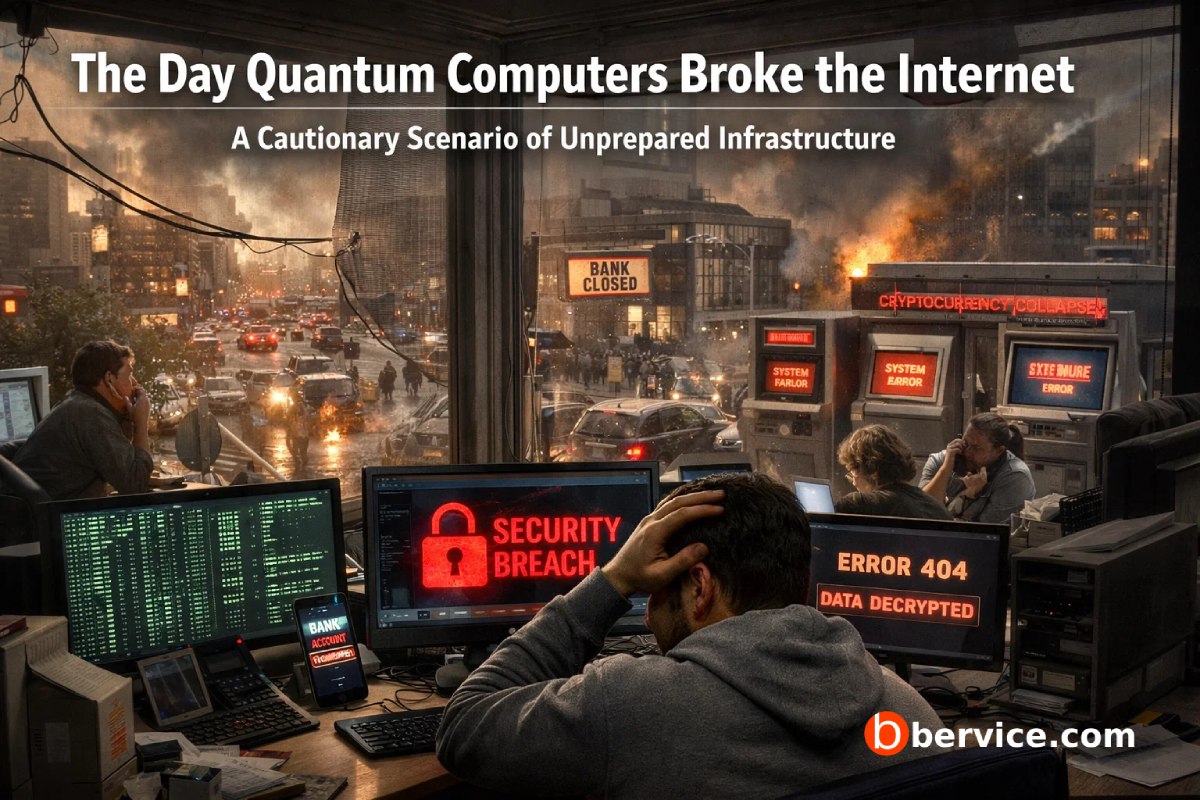
A Cautionary Scenario of Unprepared Infrastructure
Prologue: The Morning Nothing Failed
The day began quietly. No alarms. No warnings. Banks opened. Hospitals ran. Governments logged in.
Every system reported green.
Somewhere else, far from public dashboards and compliance reports, the first large scale fault tolerant quantum computer finished a calculation that classical machines would need millions of years to complete.
The calculation was not theoretical. It was practical.
Private keys. Digital signatures. Trust anchors.
No systems crashed yet. That was the most dangerous part.
Phase One: Silent Decryption
The first victims did not know they were victims.
Encrypted data that had been harvested for years was suddenly readable. VPN tunnels. TLS sessions. Encrypted backups. Secure messaging archives.
Everything that had relied on classical cryptography without quantum resistance was no longer secret.
There was no breach notification. No intrusion detection alert.
The attacker did not need to break in. They simply unlocked the past.
Legal documents. Medical histories. Military communications.
All decrypted offline. All invisible.
Trust was already gone. No one knew yet.
Phase Two: Identity Collapse
The next step was not stealing data. It was becoming someone else.
Digital signatures were forged. Certificates were cloned. Authentication tokens were reproduced perfectly.
Governments still trusted their PKI. Enterprises still trusted their certificate authorities.
Those authorities were now mathematically obsolete.
A signed command was no longer proof of origin.
A verified update was no longer proof of integrity.
When systems cannot tell who is real, they stop being systems. They become illusions.
Phase Three: Financial Paralysis
Banks were the first public casualties.
Transactions conflicted. Ledgers disagreed.
Two valid signatures appeared for the same funds, both cryptographically correct.
Trading systems halted. Payment rails froze. ATMs went offline.
Not because of bugs, but because trust conditions were violated.
Insurance contracts could not be verified.
Ownership could not be proven.
Debt could not be enforced.
Money still existed, but belief in it did not.
Phase Four: Infrastructure Breakdown
Power grids rely on signed commands.
So do water systems, transportation networks, satellites, and industrial control systems.
When those signatures lost meaning, operators chose safety over continuity.
They shut systems down.
Cities went dark not because of attacks, but because operators no longer trusted their own controls.
Hospitals reverted to paper.
Airports stopped departures.
Ports closed indefinitely.
The physical world followed the digital one into uncertainty.
Phase Five: Legal and Social Chaos
Courts require evidence.
Evidence requires integrity.
If a document can be forged retroactively, then contracts lose force.
If logs can be altered undetectably, then accountability disappears.
Years of legal history became questionable overnight.
Who owned what
Who authorized whom
Who committed which act
No one could prove anything with certainty.
The rule of law did not collapse violently.
It dissolved quietly.
Phase Six: The Trust Reset
Only then did emergency committees form.
Post quantum cryptography was already standardized.
Migration plans already existed.
Whitepapers had warned for years.
But migration requires time.
And time had run out.
Systems that had postponed the transition now faced a full rebuild under crisis conditions.
Keys had to be rotated without trusted channels.
Identities had to be re issued without reliable registries.
Data had to be re verified without intact provenance.
The cost was not financial.
It was existential.
Epilogue: The Systems That Survived
Not everything failed.
Some infrastructures had migrated early.
Some had deployed hybrid cryptography.
Some had assumed breach and designed for cryptographic agility.
Their systems degraded gracefully.
Their trust anchors held.
Their identities remained verifiable.
They did not win.
They survived.
Final Warning
Quantum computers did not destroy security.
They revealed which security was imaginary.
The disaster was not the arrival of quantum machines.
It was the delay in preparing for them.
In cryptography, time is not neutral.
What is secure today may already be broken tomorrow.
The question is no longer if quantum attacks arrive.
The question is which systems will still be standing when they do.
Connect with us : https://linktr.ee/bervice
Website : https://bervice.com