Introduction
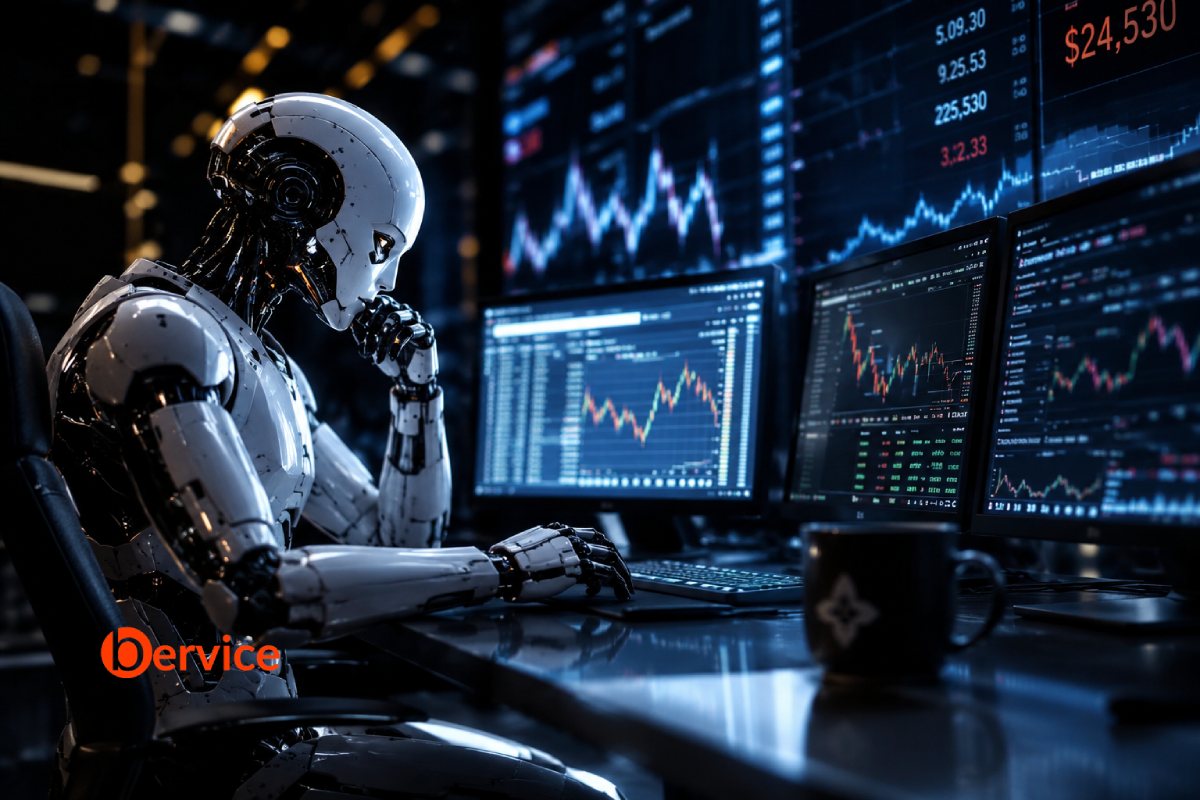
Artificial Intelligence has rapidly transformed from an experimental technology into a powerful force influencing nearly every industry. Financial markets are among the sectors experiencing the most significant changes. Today, AI systems analyze vast amounts of market data, identify patterns invisible to human traders, execute transactions in milliseconds, and continuously adapt their strategies through machine learning.
As AI becomes more sophisticated, an important question emerges: If artificial intelligence eventually dominates trading activity, could financial markets become biased toward a single direction of decision-making? In other words, if many AI systems are trained on similar data and objectives, could they begin making the same decisions simultaneously, threatening market balance and stability?
Understanding this question requires examining both the opportunities and risks associated with AI-driven trading.
The Evolution of Trading Technology
Financial markets have always embraced technology. Trading evolved from physical trading floors to electronic exchanges, and later to algorithmic trading systems capable of executing thousands of transactions per second.
The introduction of AI represents the next stage of this evolution. Unlike traditional algorithms that follow predefined rules, AI systems can learn from historical data, adapt to changing market conditions, and improve their performance over time.
Modern AI-powered trading systems analyze:
- Price movements
- Trading volume
- Economic indicators
- Corporate financial reports
- News articles
- Social media sentiment
- Geopolitical events
- Alternative datasets such as satellite imagery and shipping activity
This ability allows AI to process information at a scale impossible for human traders.
Why AI Has Advantages Over Human Traders
Human decision-making is influenced by emotions such as fear, greed, overconfidence, and panic. These psychological factors often contribute to poor investment decisions.
AI systems offer several advantages:
Speed
AI can analyze millions of data points and execute trades within milliseconds.
Consistency
Unlike humans, AI does not become tired, distracted, or emotionally overwhelmed.
Data Processing Capacity
An AI model can simultaneously monitor thousands of assets, markets, and economic variables.
Continuous Learning
Advanced machine learning systems can refine strategies based on new information and market outcomes.
Because of these advantages, many hedge funds, investment banks, and quantitative trading firms increasingly rely on AI-driven systems.
Can AI Completely Replace Human Traders?
Despite impressive capabilities, AI has not fully replaced humans.
Financial markets involve uncertainty, changing regulations, political events, and human behavior that often cannot be predicted from historical data alone.
Major events such as:
- Pandemics
- Wars
- Regulatory shifts
- Political crises
- Technological disruptions
can create situations where historical patterns become less useful.
Human judgment remains valuable in interpreting unprecedented events and understanding broader economic contexts.
For this reason, most successful institutions currently combine human expertise with AI-driven analysis rather than relying entirely on autonomous systems.
The Risk of AI Herd Behavior
One of the most discussed concerns is the possibility of “AI Herd Behavior.”
Herd behavior occurs when many market participants begin making similar decisions at the same time.
Traditionally, human investors often follow market trends because of social influence or fear of missing opportunities.
A similar phenomenon could emerge among AI systems.
If numerous firms train their models using:
- Similar historical datasets
- Similar optimization objectives
- Similar risk management frameworks
- Similar machine learning architectures
their systems may reach comparable conclusions.
For example, multiple AI models could identify the same signal indicating that a stock should be sold. If thousands of systems react simultaneously, the resulting market movement could become amplified.
Could Markets Become One-Sided?
In theory, a market dominated by identical AI systems could become less diverse in its decision-making.
However, several factors make complete convergence unlikely.
Different Objectives
Not all traders pursue the same goals.
Some seek:
- Short-term profits
- Long-term growth
- Risk reduction
- Arbitrage opportunities
- Portfolio hedging
Different objectives naturally lead to different trading decisions.
Different Data Sources
Organizations increasingly use proprietary datasets unavailable to competitors.
Unique information often produces unique strategies.
Different Risk Tolerances
Two AI systems may analyze the same opportunity but reach different conclusions based on acceptable risk levels.
Competitive Pressure
Financial markets reward uniqueness.
If all firms use identical strategies, profits quickly disappear because competitors exploit the same opportunities.
As a result, firms actively seek differentiated AI models rather than identical ones.
Flash Crashes and AI-Induced Volatility
Although complete decision uniformity is unlikely, AI can contribute to sudden market instability.
A well-known example is the phenomenon known as a “flash crash.”
During a flash crash:
- AI systems detect unusual conditions.
- Multiple algorithms begin selling.
- Falling prices trigger additional automated sales.
- Liquidity disappears.
- Prices collapse rapidly before recovering.
Such events demonstrate how automated systems can amplify market movements.
As AI adoption increases, regulators must carefully monitor these risks.
The Future: AI Versus AI Markets
An interesting possibility is that future financial markets may become environments where AI systems primarily interact with other AI systems.
In such a scenario:
- AI models generate investment ideas.
- AI models execute trades.
- AI models manage risk.
- AI models detect market anomalies.
- AI models compete against other AI models.
Rather than eliminating market diversity, this could create an arms race of increasingly sophisticated algorithms.
Each participant would continuously develop better models to outperform competitors.
Ironically, the widespread adoption of AI may increase strategic diversity because firms will constantly search for unique advantages.
Regulatory Challenges
Governments and financial regulators face new questions:
- How should AI trading systems be audited?
- Who is responsible for AI-generated losses?
- How can regulators prevent systemic AI risks?
- Should certain autonomous trading behaviors be restricted?
- How can market fairness be maintained?
Future regulations may require greater transparency regarding AI decision-making processes, risk controls, and model validation procedures.
Conclusion
Artificial Intelligence is already deeply integrated into modern financial markets and will likely play an even larger role in the future. AI systems offer remarkable advantages in speed, data analysis, and decision consistency, making them valuable tools for traders and institutions.
However, concerns about AI-driven herd behavior and market instability are legitimate. If large numbers of systems rely on similar information and objectives, synchronized actions could amplify volatility and create systemic risks.
Nevertheless, complete one-sided decision-making is unlikely because financial markets are fundamentally competitive. Firms continuously seek unique strategies, proprietary data, and differentiated models to gain an advantage over rivals.
The most probable future is not a market controlled by a single collective intelligence, but rather a highly dynamic ecosystem where countless AI systems compete, adapt, and evolve against one another. In this environment, human oversight, regulatory frameworks, and technological innovation will remain essential for preserving market stability and fairness.
Ultimately, the future of finance may not be defined by humans versus artificial intelligence, but by how effectively humans and AI learn to work together in increasingly complex and interconnected markets.
Connect with us : https://linktr.ee/bervice
Website : https://bervice.com