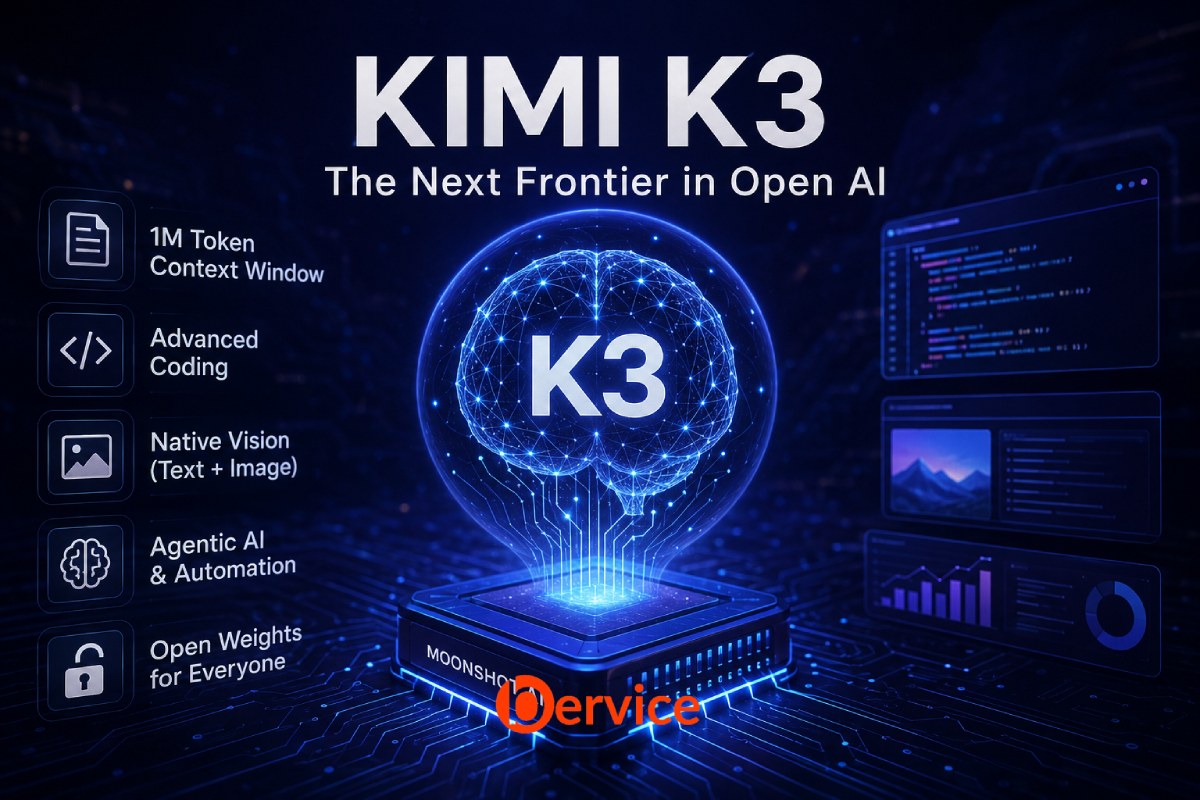
Features, Advantages, Limitations, and Why It Matters
Artificial Intelligence is entering a new era where openness, scalability, and long horizon reasoning are becoming as important as raw benchmark scores. While proprietary models from companies like OpenAI, Anthropic, and Google continue to dominate commercial AI, a new generation of open weight models is rapidly changing the competitive landscape.
One of the most significant releases of 2026 is Kimi K3, developed by Moonshot AI. Rather than competing only on chatbot conversations, Kimi K3 is designed as an agentic AI model capable of handling coding, research, multimodal understanding, and complex long running tasks.
This article explores what Kimi K3 is, its architecture, major capabilities, strengths, weaknesses, and why many researchers believe it represents a turning point for open AI.
What is Kimi K3?
Kimi K3 is Moonshot AI’s newest flagship large language model and the company’s first open weight frontier model.
Unlike traditional chat focused models, K3 is designed for:
- Autonomous coding
- Long context reasoning
- Research automation
- Visual understanding
- Software engineering
- Knowledge work
- Agent workflows
The model combines extremely large scale training with a new attention architecture that allows it to process up to one million tokens in a single context window while supporting text and image inputs natively. (GitHub)
Core Specifications
| Feature | Kimi K3 |
|---|---|
| Developer | Moonshot AI |
| Architecture | Mixture of Experts (MoE) |
| Total Parameters | 2.8 Trillion |
| Active Parameters | 104 Billion |
| Context Window | 1 Million Tokens |
| Modalities | Text + Image |
| Open Weights | Yes |
| Native Vision | Yes |
| Focus | Coding, Research, Agentic AI |
Although the model contains 2.8 trillion parameters, only 104 billion are activated for each token, making inference much more efficient than using every parameter simultaneously. (GitHub)
Major Capabilities
1. Massive Context Window
Perhaps the most impressive feature is its 1 million token context window.
This enables the model to:
- Read entire books
- Analyze very large codebases
- Understand extensive documentation
- Maintain memory during long conversations
- Process months of research material
Instead of splitting information into many prompts, K3 can often work with everything at once.
2. Frontier Coding Performance
Kimi K3 was specifically optimized for software engineering.
It can:
- Write production code
- Debug large projects
- Refactor repositories
- Understand Git workflows
- Work with terminal commands
- Generate tests
- Explain legacy code
Moonshot positions it as a model that can sustain long engineering sessions with minimal human supervision. (GitHub)
3. Native Multimodal Understanding
Unlike older models that attach vision as a separate module, Kimi K3 was designed with native multimodal capabilities.
It understands:
- Images
- Diagrams
- Screenshots
- UI designs
- Technical drawings
- Mixed text and visuals
This makes it useful for frontend development, design review, and technical documentation.
4. Agentic Workflows
K3 is built for autonomous execution rather than single prompt responses.
Examples include:
- Multi step research
- Planning software projects
- Building dashboards
- Creating reports
- Long horizon reasoning
- Tool orchestration
Instead of answering isolated questions, it attempts to complete entire workflows.
5. Open Weights
One of Kimi K3’s biggest differentiators is that Moonshot released the model with open weights, allowing researchers and organizations to inspect, adapt, and deploy it under its license. This distinguishes it from fully closed commercial models and encourages experimentation and ecosystem development. (GitHub)
Technical Innovations
Kimi K3 introduces several architectural improvements.
Kimi Delta Attention (KDA)
Designed to improve efficiency across extremely long contexts while reducing computational cost.
Benefits include:
- Better long context reasoning
- Faster decoding
- Lower memory overhead
Attention Residuals
Improves information flow across very deep transformer layers.
This leads to:
- Better stability
- Higher training efficiency
- Improved reasoning
Stable LatentMoE
Instead of activating every expert, K3 activates only 16 out of 896 experts for each token.
Advantages:
- Lower inference cost
- Better scalability
- Higher efficiency
- Strong performance despite enormous model size
Moonshot reports roughly a 2.5× improvement in scaling efficiency over its previous generation. (GitHub)
Advantages of Kimi K3
Exceptional Coding Ability
K3 is among the strongest open weight models for software development.
Ideal for:
- Full stack engineering
- Repository analysis
- Code reviews
- Debugging
- Agent coding
Huge Context Memory
Very few publicly available models currently offer a practical 1 million token context.
This makes it especially useful for:
- Enterprise documentation
- Legal analysis
- Research
- Large software systems
Competitive with Frontier Models
Independent coverage suggests K3 approaches the performance of leading proprietary systems in many coding and reasoning tasks, even if it does not consistently surpass the very top closed models. (Nature)
Native Vision
Built in image understanding removes the need for separate vision models in many workflows.
Open Ecosystem
Developers can:
- Experiment
- Fine tune
- Study the architecture
- Build specialized products
without relying entirely on proprietary platforms.
Limitations
No AI model is perfect, and Kimi K3 has several practical tradeoffs.
Extremely Large Infrastructure Requirements
Although the weights are open, self hosting the full model is unrealistic for most individuals.
Running K3 efficiently may require:
- Multiple enterprise GPUs
- Large amounts of storage
- High bandwidth infrastructure
For most users, the hosted API is the practical option. (K3-Kimi.com)
Not the Absolute Leader Everywhere
While K3 performs at the frontier, independent evaluations indicate that the strongest proprietary models still maintain an edge on some benchmarks and complex reasoning tasks. (arXiv)
Higher Token Consumption
Early reviewers have noted that K3 can be verbose, increasing effective token usage and potentially raising overall inference costs despite competitive pricing. (Syntax Dispatch)
New Ecosystem
Compared with OpenAI or Anthropic, the surrounding ecosystem of SDKs, tutorials, integrations, and third party tooling is still relatively young.
Who Should Use Kimi K3?
K3 is an excellent fit for:
- AI researchers
- Software engineers
- Enterprise developers
- AI agent builders
- Data scientists
- Research teams
- Organizations requiring long context reasoning
It is less suitable for users seeking a lightweight local model or those without access to hosted inference services.
Kimi K3 vs Traditional LLMs
| Capability | Kimi K3 | Typical Closed Models |
|---|---|---|
| Open Weights | ✅ | Usually No |
| 1M Context | ✅ | Varies |
| Native Vision | ✅ | Many support it |
| Large Scale Coding | Excellent | Excellent |
| Self Hosting | Possible but demanding | Not possible |
| Ecosystem Maturity | Growing | Mature |
The Bigger Picture
Kimi K3 reflects a broader shift in AI toward open weight frontier models that combine cutting edge capabilities with greater transparency. Rather than competing solely on chatbot interactions, it emphasizes long horizon reasoning, software engineering, multimodal understanding, and autonomous task execution.
Although proprietary models continue to lead in some areas, Kimi K3 demonstrates that open weight systems are rapidly narrowing the gap. Its release has intensified competition around openness, developer control, and large scale AI deployment, making it one of the most influential model launches of 2026. (The Verge)
Connect with us : https://linktr.ee/bervice
Website : https://bervice.com