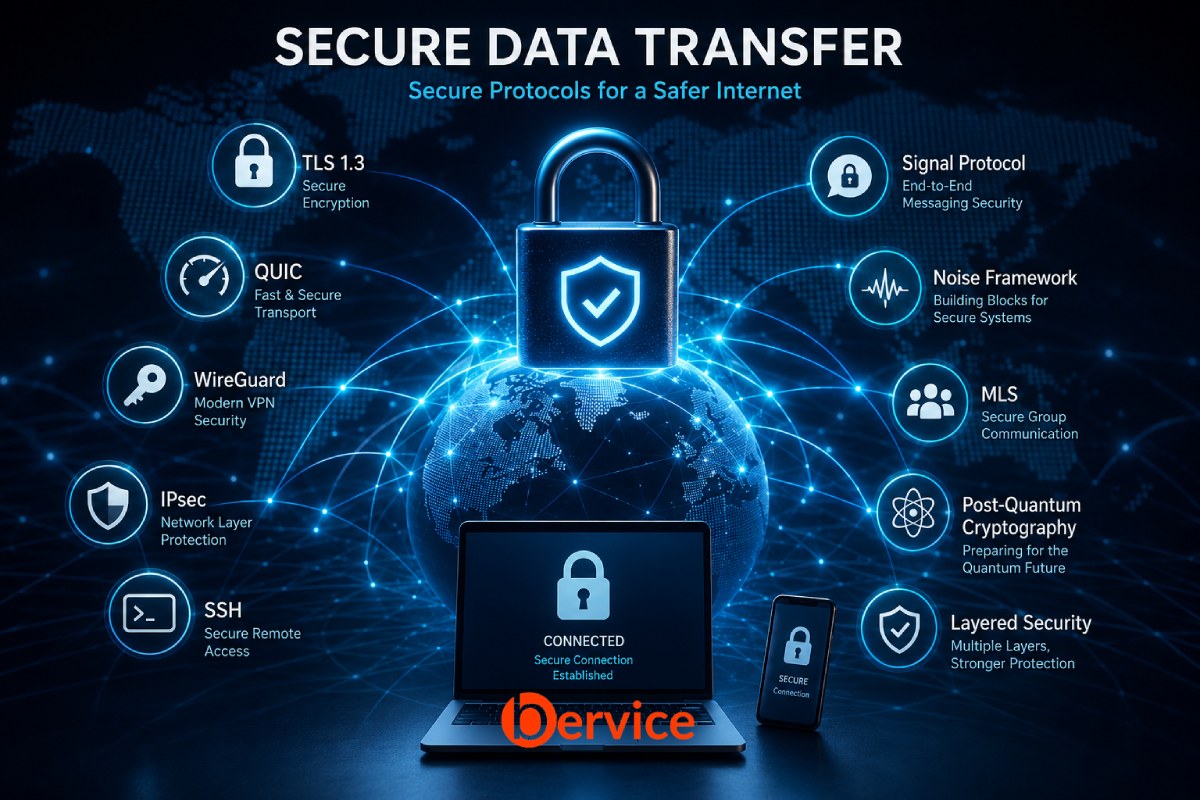
Why Secure Communication Has Become a Strategic Necessity
Every second, trillions of bytes of data travel across the Internet. Financial transactions, healthcare records, military communications, AI model interactions, cloud infrastructure, industrial control systems, and personal conversations all rely on digital networks.
Yet many people mistakenly assume that “using HTTPS” means their information is completely secure.
In reality, HTTPS is only one layer of a much larger security ecosystem.
Modern cyber threats have evolved dramatically. Nation-state attacks, ransomware organizations, AI-assisted hacking, supply chain compromises, quantum computing research, and zero-day vulnerabilities have forced engineers to build communication protocols that go far beyond traditional encryption.
Today, the question is no longer:
“Is my data encrypted?”
The real question is:
“How many independent security layers protect my data while it travels across the Internet?”
This distinction separates ordinary Internet traffic from communications trusted by governments, financial institutions, defense organizations, and critical infrastructure.
What Makes a Data Transfer Protocol Truly Secure?
A protocol should not be judged solely by the encryption algorithm it uses.
A highly secure communication protocol typically provides:
- Strong authentication
- End-to-end encryption
- Forward secrecy
- Replay attack protection
- Integrity verification
- Certificate validation
- Resistance against man-in-the-middle attacks
- Minimal metadata exposure
- Secure key exchange
- Continuous cryptographic updates
The strongest systems combine several protocols together rather than relying on a single one.
TLS 1.3
The Foundation of Modern Internet Security
Transport Layer Security (TLS) is the protocol behind HTTPS.
The latest version, TLS 1.3, dramatically improved security compared to previous generations by removing outdated cryptographic algorithms and simplifying the handshake process.
Key advantages include:
- Perfect Forward Secrecy by default
- Faster handshakes
- Reduced attack surface
- Stronger cipher suites
- Improved resistance against downgrade attacks
Today, virtually every major cloud provider, bank, SaaS platform, and e-commerce website relies on TLS 1.3.
Without it, modern Internet commerce would not exist.
QUIC
Security Built Into the Transport Layer
Traditional Internet communication relies on TCP.
QUIC replaces TCP with a modern encrypted transport protocol developed by Google and standardized by the IETF.
Unlike TCP, encryption is built directly into the protocol.
Benefits include:
- Faster connections
- Built-in TLS 1.3
- Better mobile performance
- Improved packet recovery
- Lower latency
- Connection migration between networks
HTTP/3 is built entirely on QUIC.
Major Internet companies including Google, Meta, Microsoft, and Cloudflare have adopted it.
WireGuard
The Next Generation VPN Protocol
WireGuard has become one of the most respected VPN protocols ever created.
Unlike older VPN technologies containing hundreds of thousands of lines of code, WireGuard was intentionally designed to remain compact and easier to audit.
Advantages include:
- Modern cryptography
- Small attack surface
- Excellent performance
- Fast roaming
- Strong authentication
- Easier security auditing
Many enterprise VPN solutions are now replacing OpenVPN and IPsec with WireGuard.
IPsec
Enterprise and Government Grade Network Encryption
Before WireGuard became popular, IPsec was the gold standard for secure network tunnels.
It remains one of the most trusted protocols for:
- Government agencies
- Military infrastructure
- Corporate WANs
- Cloud connectivity
- Site-to-site VPNs
Although configuration can be complex, properly implemented IPsec remains extremely secure.
SSH
Secure Remote Administration
SSH transformed system administration.
Instead of sending passwords across networks in plain text, SSH encrypts every command, response, and authentication process.
It supports:
- Public key authentication
- Secure tunneling
- Port forwarding
- File transfer (SCP/SFTP)
- Multi-factor authentication
Millions of Linux servers rely on SSH every day.
Signal Protocol
Gold Standard for Private Messaging
Among messaging protocols, the Signal Protocol is widely regarded as one of the strongest ever developed.
Its innovations include:
- Double Ratchet Algorithm
- Forward secrecy
- Post-compromise security
- End-to-end encryption
- Ephemeral session keys
Even if one encryption key is compromised, previous conversations remain protected.
This protocol has influenced secure messaging across the industry.
Noise Protocol Framework
The Building Blocks of Modern Encryption
Rather than being a single protocol, Noise is a cryptographic framework used to design secure communication systems.
It powers numerous applications including:
- WireGuard
- Cryptocurrency networks
- Distributed systems
- Embedded devices
- IoT infrastructure
Its flexibility allows engineers to construct highly secure communication patterns while maintaining strong cryptographic guarantees.
MLS (Messaging Layer Security)
Securing Large Groups
Traditional end-to-end encryption becomes increasingly difficult as group size grows.
Messaging Layer Security (MLS) was developed to solve this challenge.
Its goals include:
- Efficient group key management
- Forward secrecy
- Scalable encryption
- Membership authentication
- Secure group updates
MLS is expected to become a major standard for enterprise collaboration platforms.
Post-Quantum Cryptography
Preparing for the Next Era
Today’s encryption algorithms are designed to resist classical computers.
Quantum computers introduce new risks.
To prepare, organizations are beginning to deploy post-quantum cryptographic algorithms developed through international standardization efforts.
These algorithms are designed to remain secure even if practical quantum computers become available in the future.
The transition has already begun across governments, cloud providers, and cybersecurity vendors.
Layered Security Beats Individual Protocols
The strongest systems rarely rely on only one protocol.
A modern secure architecture may combine:
- TLS 1.3
- QUIC
- DNS over HTTPS (DoH) or DNS over TLS (DoT)
- WireGuard
- Hardware security modules
- Certificate Transparency
- Multi-factor authentication
- Zero Trust networking
- Secure enclaves
- Continuous key rotation
Security today is achieved through defense in depth rather than any single technology.
Security Is No Longer Optional
As artificial intelligence accelerates software development, attackers gain access to increasingly powerful tools for automation, reconnaissance, and vulnerability discovery.
At the same time, organizations are exchanging larger volumes of highly sensitive data than ever before.
This reality makes secure communication protocols one of the most critical foundations of the digital economy.
Businesses that continue relying on outdated protocols expose themselves to unnecessary operational, financial, and reputational risks.
The future belongs to systems that are not only connected, but cryptographically resilient by design.
Conclusion
The Internet has evolved far beyond simple web browsing.
Secure communication now underpins global finance, healthcare, artificial intelligence, autonomous systems, cloud computing, and national infrastructure.
Protocols such as TLS 1.3, QUIC, WireGuard, IPsec, SSH, Signal Protocol, Noise Framework, MLS, and emerging post-quantum cryptography represent decades of continuous innovation in protecting digital communications.
The next generation of cybersecurity will not be defined by stronger passwords or larger firewalls.
It will be defined by smarter protocols, layered cryptography, and architectures built on the assumption that attacks are inevitable.
In the digital age, trust is no longer created by promises.
It is created by mathematics.
Connect with us : https://linktr.ee/bervice
Website : https://bervice.com