Introduction
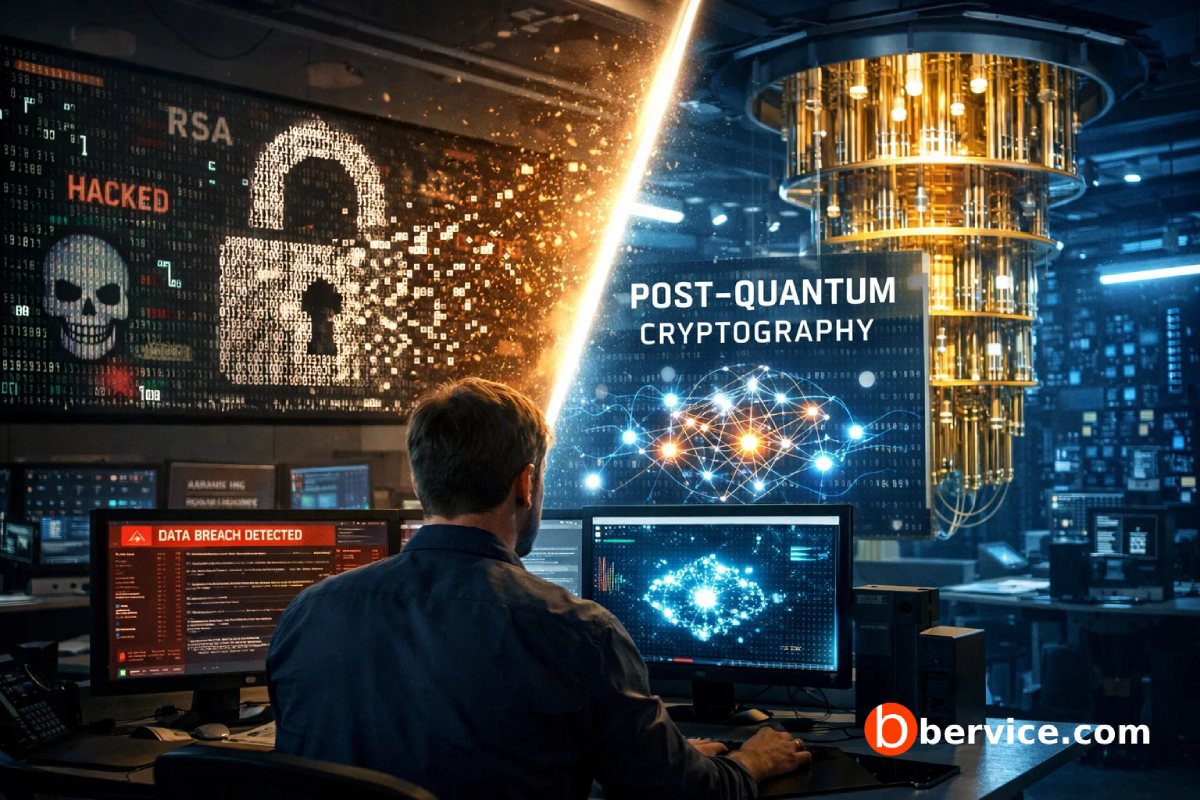
The rapid advancement of quantum computing is reshaping the landscape of cybersecurity. While large-scale, fault-tolerant quantum computers are not yet widely available, their eventual emergence poses a serious threat to many of today’s cryptographic systems. Algorithms such as RSA, ECC, and Diffie–Hellman, which underpin global digital security, are vulnerable to quantum attacks most notably Shor’s algorithm.
In response to this looming challenge, Post-Quantum Cryptography (PQC) has emerged as a critical software-based solution designed to secure data against both classical and quantum adversaries.
Understanding the Quantum Threat
Classical cryptographic systems rely on the computational difficulty of mathematical problems such as integer factorization or discrete logarithms. These problems are infeasible to solve efficiently with classical computers but become tractable when quantum algorithms are applied at scale.
The most concerning risk is the “harvest now, decrypt later” strategy: attackers can collect encrypted data today and decrypt it in the future once quantum capabilities mature. This threat is especially severe for sensitive data with long confidentiality lifetimes, such as government records, financial data, intellectual property, and medical information.
What Is Post-Quantum Cryptography?
Post-Quantum Cryptography refers to cryptographic algorithms that are designed to be secure against attacks from both classical and quantum computers. Unlike quantum cryptography, PQC does not require quantum hardware; it runs entirely on existing digital infrastructure.
PQC algorithms are typically based on mathematical problems believed to be resistant to quantum attacks, including:
- Lattice-based cryptography
- Hash-based cryptography
- Code-based cryptography
- Multivariate polynomial cryptography
- Isogeny-based cryptography
These approaches avoid the mathematical structures exploited by known quantum algorithms, making them strong candidates for long-term security.
Integration into Modern Systems
Post-quantum cryptography is no longer a purely academic concept. It is actively being integrated into real-world systems:
- Web Browsers are experimenting with hybrid key exchange mechanisms that combine classical and post-quantum algorithms.
- Operating Systems are incorporating PQC-ready cryptographic libraries.
- SSL/TLS Protocols are evolving to support quantum-resistant key exchanges.
- Cloud Providers and Enterprises are testing PQC in secure communications and data-at-rest encryption.
This gradual integration allows organizations to adopt PQC without disrupting existing infrastructure, while maintaining backward compatibility during the transition period.
PQC vs. Quantum Networks
It is important to distinguish between Post-Quantum Cryptography and Quantum Communication Networks.
- PQC is a software-based defensive strategy, deployable today, designed to protect against future quantum attacks.
- Quantum Networks, such as those using quantum key distribution (QKD), rely on quantum phenomena like entanglement and require specialized hardware.
While quantum networks promise theoretically unbreakable security, they face significant challenges in scalability, cost, and global deployment. PQC, by contrast, offers a pragmatic and immediately deployable solution for securing today’s digital systems.
Challenges and Considerations
Despite its promise, PQC introduces new challenges:
- Performance overhead: Some PQC algorithms require larger keys and ciphertexts.
- Implementation risks: Poor implementations can introduce side-channel vulnerabilities.
- Standardization uncertainty: Although progress is strong, long-term confidence depends on rigorous cryptanalysis and global adoption.
To address these risks, many organizations adopt hybrid cryptographic models, combining classical and post-quantum algorithms to hedge against unforeseen weaknesses.
The Future of Data Security
The future of cybersecurity will not be defined by a single technology, but by layered and adaptive defenses. Post-Quantum Cryptography represents a foundational shift toward resilience in a quantum-enabled world.
By proactively adopting PQC, organizations can:
- Protect sensitive data against long-term threats
- Ensure regulatory and compliance readiness
- Preserve trust in digital systems and communications
Conclusion
Post-Quantum Cryptography marks a decisive transformation in how we think about digital security. As quantum computing continues to evolve, waiting is no longer a viable strategy. The transition to quantum-resilient cryptography must begin now.
The future of data security appears increasingly robust not because threats are diminishing, but because cryptography itself is evolving to meet them. Organizations that embrace post-quantum solutions today will be far better positioned to withstand the cybersecurity challenges of tomorrow.
Connect with us : https://linktr.ee/bervice
Website : https://bervice.com