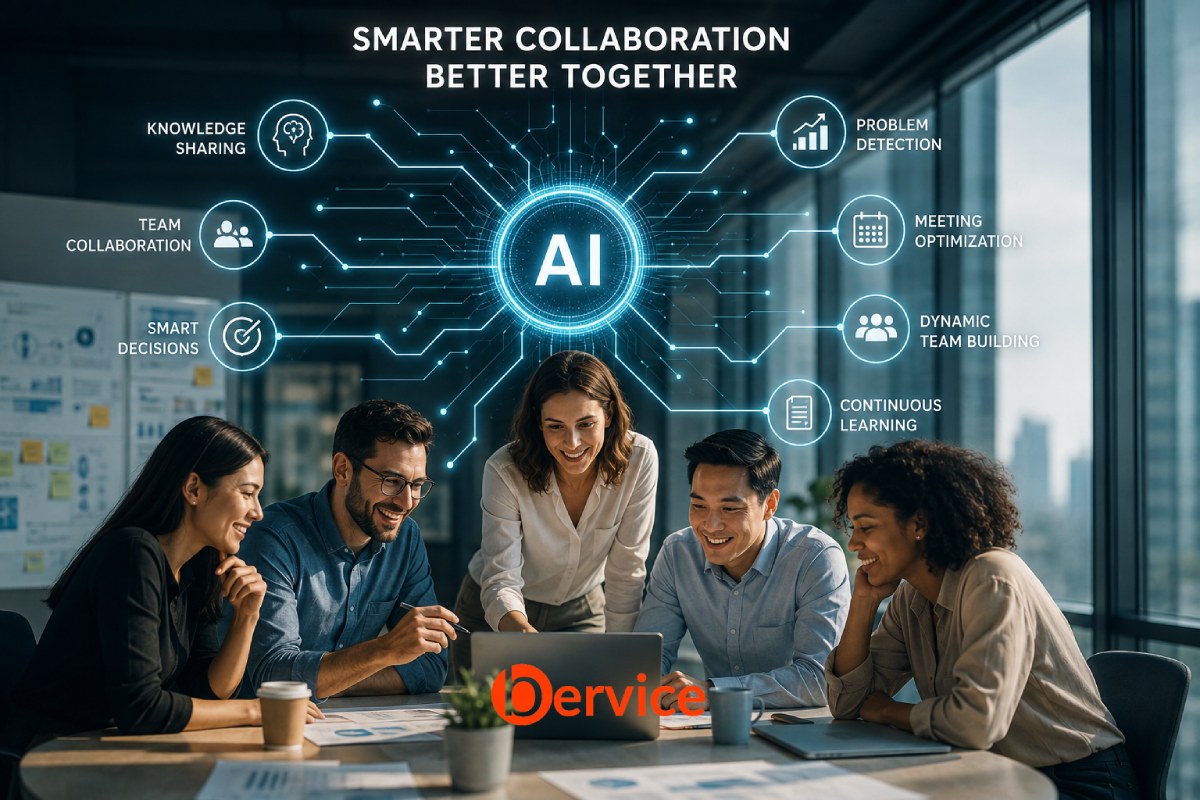
The Next Competitive Advantage Is Not Better Individuals. It Is Better Collaboration.
Artificial intelligence is often discussed as a tool that makes individuals more productive. We celebrate AI because it writes faster, analyzes data instantly, generates software, designs graphics, and automates repetitive work.
Yet the greatest transformation AI will create may not be individual productivity at all.
Its real impact lies in improving how humans work together.
Modern organizations rarely fail because employees lack intelligence or technical skills. They fail because collaboration is inefficient. Information arrives too late. Responsibilities become unclear. Knowledge stays trapped inside departments. Meetings consume time without creating progress. Small misunderstandings multiply into expensive delays.
AI has the potential to become the invisible operating system that continuously improves human collaboration.
The future of work is not Human vs AI.
It is AI improving Human + Human.
Human Collaboration Is Full of Hidden Friction
Every large project suffers from invisible costs.
Developers misunderstand business requirements.
Designers receive outdated specifications.
Managers spend hours following up instead of solving problems.
Teams duplicate work because they cannot see what others are doing.
Experts answer the same questions repeatedly.
Knowledge disappears when employees leave.
Deadlines slip because no one notices small issues until they become major problems.
These are not technical problems.
They are coordination problems.
Ironically, as organizations grow larger, communication becomes exponentially more difficult.
Adding more people does not always increase productivity.
Sometimes it creates more complexity.
AI as a Collaboration Layer
Instead of replacing workers, AI can serve as a collaboration layer between them.
Imagine every interaction inside an organization becoming understandable by intelligent systems.
Emails.
Meetings.
Project management.
Documentation.
Code repositories.
Design revisions.
Customer conversations.
Support tickets.
Operational reports.
Rather than replacing these workflows, AI continuously analyzes them to identify bottlenecks before humans notice them.
The result is smoother teamwork without requiring employees to change how they work.
Intelligent Knowledge Distribution
One of the biggest problems inside companies is knowledge inequality.
Some employees know everything.
Others know almost nothing.
Experts become bottlenecks because everyone depends on them.
AI changes this dynamic.
Instead of asking:
“Who knows the answer?”
Employees ask AI.
The AI retrieves organizational knowledge instantly, summarizes previous decisions, finds similar projects, recommends best practices, and provides context from thousands of documents.
Knowledge becomes available to everyone.
Expertise scales.
AI Detects Collaboration Problems Before They Happen
Human managers often discover problems too late.
Projects are already behind schedule.
Communication has already broken down.
Clients are already unhappy.
AI can detect early warning signals.
Examples include:
- Increasing response times between departments
- Declining participation in project discussions
- Repeated task reassignment
- Growing documentation gaps
- Conflicting project priorities
- Missing approvals
- Overloaded team members
- Silent stakeholders
Instead of reporting failure,
AI predicts failure.
Organizations shift from reactive management to proactive coordination.
Better Meetings With Less Time
Millions of meetings happen every day.
Many create little value.
AI can fundamentally redesign meetings.
Instead of simply recording conversations, AI can:
- Identify unresolved decisions
- Detect conflicting opinions
- Summarize agreements
- Generate action items automatically
- Assign responsibilities
- Monitor follow up completion
- Connect discussions to previous projects
- Recommend experts who should participate
Meetings become execution engines instead of discussion sessions.
AI Creates Dynamic Teams
Traditional organizations build fixed teams.
Future organizations may build dynamic teams.
AI understands:
Skills
Experience
Availability
Communication styles
Past collaboration success
Current workload
Learning goals
Instead of assigning people manually, AI recommends the best team for every project.
Not simply based on job titles.
Based on evidence.
Every project begins with the optimal combination of people.
Eliminating Communication Noise
Employees spend enormous amounts of time processing information that is irrelevant.
Too many emails.
Too many Slack messages.
Too many notifications.
Too many documents.
AI acts as an intelligent communication filter.
Every employee receives only what requires attention.
Everything else is summarized.
Information overload becomes information precision.
Continuous Organizational Learning
Companies repeat mistakes because organizational memory is weak.
Projects finish.
Lessons disappear.
Employees leave.
Knowledge vanishes.
AI continuously captures organizational learning.
Every project improves the next one.
Every success becomes reusable.
Every failure becomes searchable.
Organizations become learning systems instead of collections of individuals.
AI Supports Managers Instead of Replacing Them
Some fear AI will replace leadership.
More likely, it will enhance leadership.
Managers currently spend much of their time on administrative coordination.
Scheduling.
Status tracking.
Reporting.
Reminder emails.
Documentation.
AI automates these activities.
Managers spend more time:
Coaching people.
Building culture.
Making strategic decisions.
Solving difficult problems.
Developing talent.
The role of leadership becomes more human, not less.
Measuring Collaboration Instead of Guessing
Organizations typically measure output.
Revenue.
Sales.
Tickets completed.
Features delivered.
But they rarely measure collaboration quality.
AI introduces entirely new organizational metrics.
Knowledge sharing velocity.
Decision latency.
Cross-functional collaboration.
Communication effectiveness.
Expert accessibility.
Organizational learning speed.
These metrics reveal how efficiently humans work together, not just how much they produce.
The healthiest organizations will optimize collaboration, not only productivity.
Human Judgment Remains Essential
AI can recommend.
- Analyze.
- Predict.
- Coordinate.
- Organize.
- But humans still provide what AI cannot fully replicate.
- Judgment.
- Creativity.
- Empathy.
- Ethics.
- Trust.
- Leadership.
- Culture.
- Purpose.
- The future workplace is built on complementary strengths.
- Humans decide.
- AI accelerates.
The Rise of Collective Intelligence
Historically, organizations competed based on:
Capital.
Technology.
Talent.
Tomorrow they may compete on something entirely different.
Collective intelligence.
AI enables organizations to think as connected systems rather than isolated individuals.
Knowledge moves instantly.
Decisions improve continuously.
Expertise becomes accessible.
Execution becomes synchronized.
The organization itself becomes smarter every day.
Conclusion
Artificial intelligence is often measured by how much work it can perform independently.
That is only part of the story.
Its greatest contribution may be improving how humans collaborate.
When AI reduces communication friction, distributes knowledge, predicts coordination failures, builds stronger teams, and preserves organizational learning, every individual becomes more effective because everyone around them becomes more effective.
The future of work is not defined by smarter machines.
It is defined by smarter collaboration.
Organizations that successfully combine human creativity with AI powered coordination will not simply work faster.
They will think together better.
And in the coming decade, the ability to collaborate intelligently may become the most valuable competitive advantage of all.
Connect with us : https://linktr.ee/bervice
Website : https://bervice.com