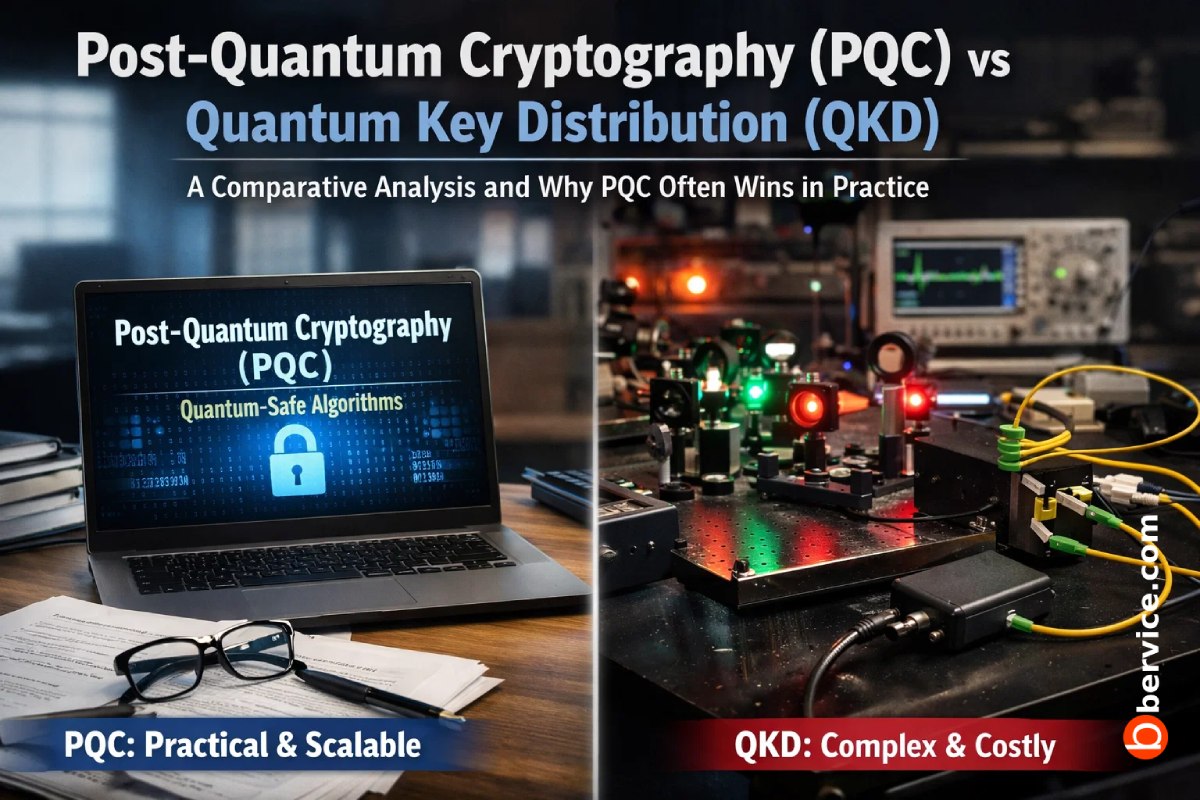
1. Introduction: The Quantum Threat to Modern Cryptography
Modern digital security relies heavily on cryptographic systems such as RSA and ECC. These systems are considered secure today but are fundamentally vulnerable to future quantum computers due to algorithms like Shor’s algorithm, which can efficiently break them.
To address this existential threat, two primary paradigms have emerged:
- Post-Quantum Cryptography (PQC)
- Quantum Key Distribution (QKD)
Both aim to provide quantum-safe security, but they differ radically in philosophy, implementation, and practicality.
2. What is Post-Quantum Cryptography (PQC)?
Post-Quantum Cryptography refers to classical cryptographic algorithms designed to remain secure even against quantum computers.
- PQC relies on mathematical hardness problems (e.g., lattices, hash-based systems).
- It runs on traditional hardware and networks.
- It can replace current cryptographic algorithms with minimal infrastructure changes.
Unlike quantum-based systems, PQC does not rely on quantum mechanics, but instead on computational problems believed to be hard for both classical and quantum attackers.
In essence, PQC is an evolution of classical cryptography, not a replacement of the communication infrastructure.
3. What is Quantum Key Distribution (QKD)?
Quantum Key Distribution is a physics-based method for securely distributing encryption keys.
- It uses quantum particles (photons) to transmit keys.
- Security is based on quantum mechanics principles such as:
- Measurement disturbance
- No-cloning theorem
If an attacker tries to intercept the key, the system detects it automatically.
QKD provides information-theoretic security, meaning its security does not depend on computational assumptions.
4. Fundamental Differences Between PQC and QKD
| Aspect | PQC | QKD |
|---|---|---|
| Nature | Software-based | Hardware + physics-based |
| Security Basis | Mathematical assumptions | Laws of quantum physics |
| Deployment | Existing infrastructure | Requires new optical/satellite links |
| Scalability | High | Limited |
| Cost | Low to moderate | High |
| Use Case | General-purpose encryption | Secure key exchange |
A critical conceptual difference is:
- PQC changes the encryption algorithms
- QKD changes how keys are distributed
5. Advantages of QKD (For Context)
Before analyzing PQC superiority, it is important to fairly recognize QKD’s strengths:
5.1 Information-Theoretic Security
QKD is theoretically unbreakable because it relies on physical laws, not assumptions.
5.2 Eavesdropping Detection
Any interception attempt changes the quantum state and is immediately detectable.
5.3 Future-Proof Against Computational Advances
Even infinitely powerful computers cannot break QKD directly.
6. Core Limitations of QKD
Despite its strong theoretical guarantees, QKD has significant practical limitations:
6.1 Requires Specialized Hardware
QKD needs:
- Optical fiber links or free-space communication
- Quantum transmitters and detectors
It cannot be deployed as software.
6.2 High Cost and Infrastructure Complexity
- Dedicated infrastructure increases CAPEX
- Trusted nodes introduce additional risks
6.3 Limited Scalability
QKD is primarily:
- Point-to-point
- Difficult to scale globally
6.4 Incomplete Security Stack
QKD only solves key distribution, not:
- Authentication
- Encryption itself
It still depends on classical cryptography for full security.
7. Key Advantages of PQC Over QKD
Now we analyze the main advantages of PQC, which explain why it is widely considered the more practical solution today.
7.1 Immediate Deployability
PQC can be implemented:
- In software
- On existing internet infrastructure
- Inside current protocols (TLS, VPNs, blockchain)
No new hardware is required.
➡ This is the single biggest advantage.
7.2 Cost Efficiency
PQC:
- Avoids expensive optical networks
- Requires only software upgrades
Even government agencies consider PQC more cost-effective and maintainable than QKD.
7.3 Scalability to Global Systems
PQC works naturally with:
- Internet-scale systems
- Cloud infrastructure
- Mobile devices
In contrast, QKD struggles beyond controlled environments.
7.4 Flexibility and Crypto-Agility
PQC:
- Can be updated or replaced easily
- Supports hybrid deployments
- Integrates with existing PKI systems
QKD lacks this flexibility due to hardware constraints.
7.5 Mature Standardization (NIST Process)
PQC is undergoing formal standardization (e.g., NIST), making it:
- Industry-ready
- Interoperable
QKD lacks comparable global standard maturity.
7.6 Broad Use Case Coverage
PQC can secure:
- Encryption
- Signatures
- Authentication
- Key exchange
QKD only addresses key distribution.
7.7 Real-World Feasibility
Many experts and organizations consider PQC:
- More practical
- More accessible
- Ready for near-term deployment
8. Security Trade-off: Assumptions vs Physics
A critical nuance:
- QKD:
- Security is provable based on physics
- PQC:
- Security depends on unproven mathematical assumptions
This creates a trade-off:
| Dimension | PQC | QKD |
|---|---|---|
| Practicality | High | Low |
| Theoretical security | Assumption-based | Absolute (ideal model) |
In reality, most systems prioritize practical deployability over theoretical perfection.
9. Why PQC is the Dominant Strategy Today
Several major cybersecurity agencies recommend PQC over QKD due to:
- Easier integration
- Lower cost
- Better scalability
- Proven deployment pathways
Additionally:
- PQC can be deployed today
- QKD is still limited to niche, high-security environments
10. Hybrid Approach: The Future Direction
Rather than choosing one, many experts advocate:
- PQC + QKD hybrid systems
This provides:
- Redundancy
- Defense-in-depth
- Long-term resilience
However, even in hybrid models:
- PQC typically forms the core layer
11. Conclusion
Post-Quantum Cryptography and Quantum Key Distribution represent two fundamentally different paths toward quantum-safe security:
- QKD offers theoretically perfect security, but suffers from severe practical limitations
- PQC offers practical, scalable, and deployable security, making it the dominant real-world solution
Final Insight
If your goal is:
- Global deployment → PQC wins
- Maximum theoretical security in controlled environments → QKD has value
But in the current technological and economic landscape:
PQC is not just an alternative to QKD
it is the only solution that can realistically secure the global digital infrastructure in the quantum era.
Connect with us : https://linktr.ee/bervice
Website : https://bervice.com