Introduction
As artificial intelligence becomes more powerful, one specification appears frequently in discussions about modern Large Language Models (LLMs): the context window.
You may hear statements such as:
“This model supports 32K tokens.”
“That model can process 128K tokens.”
“The latest model offers a 200K context window.”
But what do these numbers actually mean? Why can’t an AI model simply remember everything? And why do context limits exist at all?
Understanding context windows is essential for anyone working with AI because they directly influence what a model can read, remember, analyze, and generate during a conversation.
What Is a Context Window?
A context window is the amount of information an LLM can consider at one time.
Think of it as the model’s temporary working memory.
When you interact with an AI model, everything that matters for generating the next response must fit inside this window:
- Your current message
- Previous messages
- Uploaded documents
- Instructions
- System prompts
- The model’s own generated responses
If the total information exceeds the available context size, older content must be removed or compressed.
The model does not truly “remember” information outside the current context window.
What Are Tokens?
Context windows are measured in tokens, not words.
A token is a small unit of text.
For example:
| Text | Approximate Tokens |
|---|---|
| Hello | 1 |
| Artificial Intelligence | 2-3 |
| One paragraph | 50-150 |
| One page of text | 400-800 |
| One novel | 80,000-150,000 |
As a rough estimate:
- 1 token ≈ 0.75 words in English
- 100,000 tokens ≈ 75,000 words
- 200,000 tokens ≈ 150,000 words
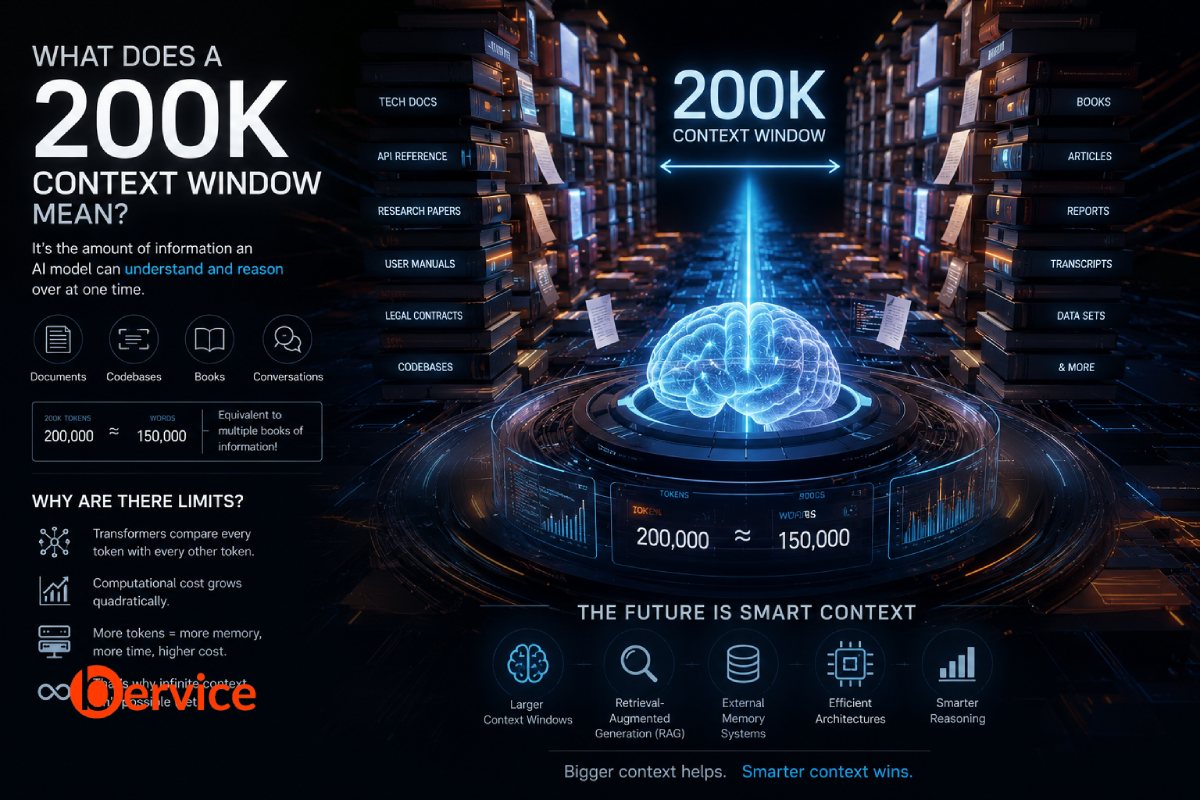
This means a 200K context window can often contain the equivalent of multiple books simultaneously.
What Does a 200K Context Window Mean?
When a model supports a 200,000-token context window, it means the model can analyze and reason over approximately 150,000 words at once.
This could include:
- Entire technical manuals
- Large codebases
- Legal contracts
- Research papers
- Long conversations
- Multiple documents simultaneously
For example:
Imagine uploading:
- A 500-page software specification
- A 200-page API documentation set
- Several project reports
A 200K model may be able to process all of them in a single session without needing aggressive summarization.
This dramatically improves the model’s ability to understand long-term relationships between pieces of information.
Why Not Give Models Unlimited Context?
At first glance, unlimited context sounds ideal.
Why not allow a model to process millions or billions of tokens?
The answer lies in mathematics and computing costs.
The core architecture behind most LLMs is called the Transformer.
Transformers use a mechanism known as attention.
Attention allows every token to compare itself with every other token.
This is extremely powerful, but it comes with a major cost.
The Attention Problem
Suppose a model receives:
- 1,000 tokens
Each token must potentially interact with 1,000 others.
This creates:
1,000 × 1,000 = 1,000,000 relationships
Now increase the context:
- 10,000 tokens
The relationships become:
10,000 × 10,000 = 100,000,000
For 200,000 tokens:
200,000 × 200,000 = 40,000,000,000
That is 40 billion possible attention relationships.
The computational requirements grow dramatically as context increases.
This phenomenon is called quadratic scaling.
Memory Consumption Becomes Massive
Longer context windows require enormous memory.
Every token generates internal mathematical representations.
As context grows:
- RAM usage increases
- GPU memory requirements increase
- Processing latency increases
- Infrastructure costs increase
A model capable of handling 200K tokens may require significantly more resources than one handling 32K tokens.
This is one reason why long-context AI services are more expensive to operate.
Speed Becomes a Challenge
Users expect AI systems to respond quickly.
However:
- Larger context = more calculations
- More calculations = slower inference
- Slower inference = worse user experience
AI providers must balance:
- Accuracy
- Speed
- Cost
- Context size
A model with unlimited context might take minutes rather than seconds to generate responses.
Does a Bigger Context Mean Better Memory?
Not necessarily.
Many people assume:
“Bigger context = perfect memory.”
This is incorrect.
Even if a model can technically read 200K tokens, it may not treat every token equally.
Researchers have observed phenomena such as:
Lost in the Middle
Models often pay more attention to:
- Information at the beginning
- Information at the end
Important information buried deep in the middle may receive less attention.
As context grows larger, retrieving the right detail becomes more difficult.
Therefore, larger context windows improve capacity but do not guarantee perfect recall.
How Companies Extend Context Windows
Modern AI companies use several techniques to increase context sizes:
Efficient Attention Mechanisms
Alternative attention architectures reduce computational costs.
Examples include:
- Sparse Attention
- Linear Attention
- Flash Attention
These methods avoid comparing every token with every other token.
Retrieval-Augmented Generation (RAG)
Instead of loading all information into context:
- Relevant documents are searched.
- Only useful portions are inserted.
- The model reasons over the selected content.
This approach effectively gives AI access to knowledge far beyond its native context window.
Memory Systems
Some systems create external memory layers.
The AI can:
- Store information
- Retrieve it later
- Reinsert it into context when needed
This creates the appearance of long-term memory without requiring infinite context.
Why Context Windows Matter for Real Applications
Large context windows unlock new possibilities.
Software Development
Developers can provide:
- Entire repositories
- Architecture documents
- API references
The model can understand the broader system instead of isolated files.
Legal Analysis
Lawyers can analyze:
- Contracts
- Regulations
- Supporting documents
in a single session.
Research
Researchers can compare:
- Multiple papers
- Datasets
- Reports
without constantly switching context.
Business Intelligence
Companies can analyze:
- Financial reports
- Meeting transcripts
- Customer feedback
together rather than separately.
The Future of Context Windows
The industry is moving toward larger and more efficient context handling.
Future systems may support:
- Millions of tokens
- Persistent memory
- Dynamic retrieval
- Hierarchical reasoning
However, simply increasing context size is unlikely to be the final solution.
The future will probably combine:
- Large context windows
- External memory
- Search systems
- Specialized reasoning architectures
Together, these technologies will enable AI systems that can work with information at human and organizational scales.
Conclusion
A 200K context window means an AI model can process roughly 150,000 words of information simultaneously, allowing it to analyze extremely large documents, conversations, and codebases in a single session.
However, context windows are limited because the underlying Transformer architecture becomes increasingly expensive as more information is added. Computational complexity, memory consumption, response speed, and infrastructure costs all grow rapidly with larger contexts.
The future of AI will not be defined solely by bigger context windows. Instead, it will be shaped by smarter ways of managing information through retrieval systems, memory architectures, and more efficient attention mechanisms.
In other words, the challenge is no longer just teaching AI to read more. The real challenge is teaching AI to remember, retrieve, and reason more intelligently.
Connect with us : https://linktr.ee/bervice
Website : https://bervice.com