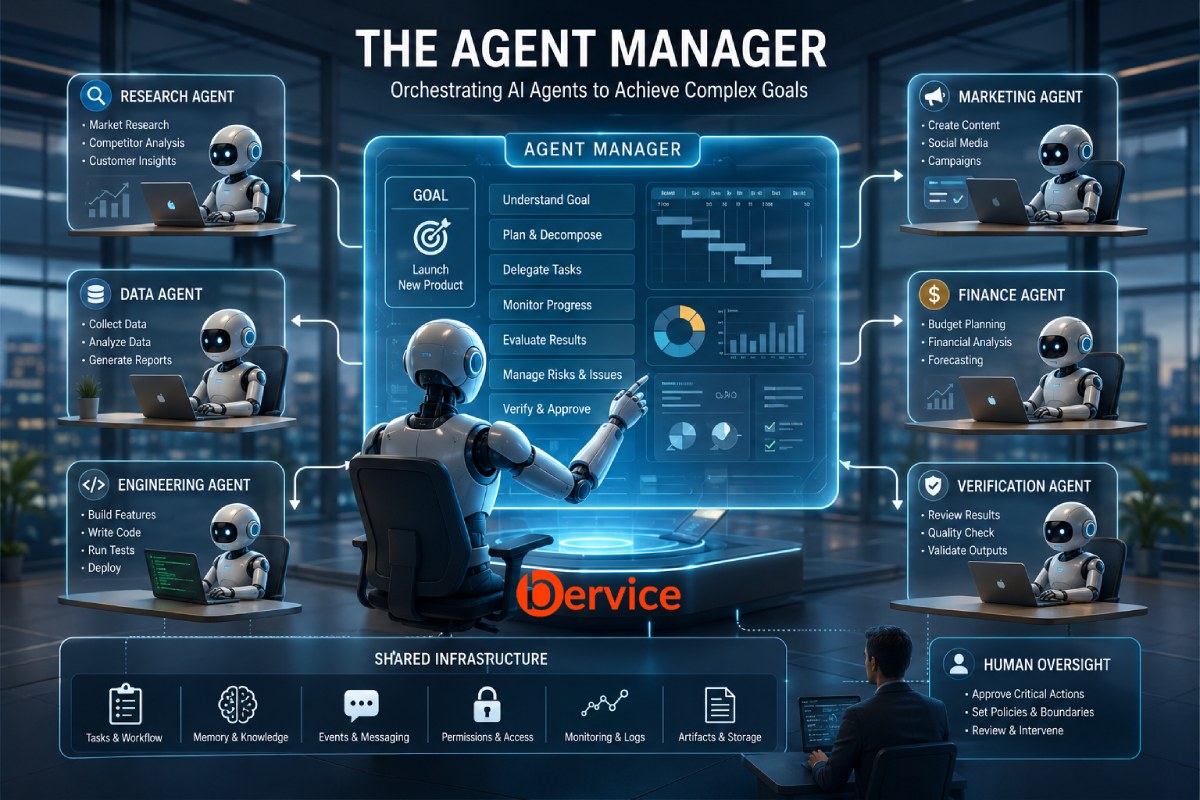
Artificial intelligence is moving beyond the era of the single assistant.
The next generation of AI systems will not consist of one model trying to understand a request, search for information, use tools, make decisions, execute actions, verify results, and communicate with the user all inside the same loop.
Instead, AI systems are beginning to look more like organizations.
One agent researches.
- Another writes code.
- Another analyzes data.
- Another communicates with customers.
- Another monitors systems.
- Another verifies the work.
But once multiple agents are working simultaneously, a new problem appears:
Who manages the agents?
The answer is a new architectural layer: the Agent Manager, also called an orchestrator, supervisor, coordinator, or lead agent.
Its purpose is not necessarily to perform every task itself.
Its purpose is to understand the objective, decide what work needs to happen, assign that work to the right agents, monitor execution, resolve problems, verify results, and determine when the overall objective has actually been completed.
In other words, we are beginning to build something remarkably similar to management itself.
From AI Assistant to AI Organization
Most AI applications today still follow a relatively simple architecture:
User
  |
  v
AI Agent
  |
  +--> Model
  +--> Memory
  +--> Tools
  +--> APIs
  |
  v
Result
This works well when the task is reasonably contained.
But imagine asking an AI system:
“Prepare everything required to launch our new product.”
This could involve:
- Market research
- Competitor analysis
- Pricing
- Financial modeling
- Website development
- Marketing content
- Legal review
- Product documentation
- Customer outreach
- Analytics
- Quality assurance
Giving all of these responsibilities to one enormous agent quickly becomes difficult to manage.
A better architecture is:
                         USER
                           |
                           v
                  +------------------+
                  |   AGENT MANAGER  |
                  |   Orchestrator   |
                  +------------------+
                           |
          +----------------+----------------+
          |                |                |
          v                v                v
    Research Agent    Engineering Agent   Marketing Agent
          |                |                |
          v                v                v
       Tools            Coding Tools     Content Tools

          +----------------+----------------+
                           |
                           v
                     Review Agent
                           |
                           v
                        RESULT
The intelligence of the system no longer comes only from the intelligence of one model.
It also comes from how intelligence is organized.
This orchestrator-worker pattern is already appearing in production multi-agent architectures. Anthropic has described a research system where a lead agent develops a strategy and creates specialized subagents that investigate different parts of a problem in parallel. OpenAI’s Agents SDK similarly supports multi-agent orchestration through concepts including agents, handoffs, guardrails, and tracing.
What Is an Agent Manager?
An Agent Manager is an AI agent responsible for coordinating other agents.
It sits between the user’s objective and the execution layer.
Instead of asking:
“How do I complete this task?”
its primary question is:
“What needs to happen, who should do it, and how do I know it was done correctly?”
That difference is fundamental.
A normal agent is optimized for execution.
A manager agent is optimized for coordination.
A sophisticated Agent Manager may have responsibilities similar to a human manager:
Understand
   ↓
Plan
   ↓
Decompose
   ↓
Delegate
   ↓
Monitor
   ↓
Evaluate
   ↓
Correct
   ↓
Approve
   ↓
Report
The manager becomes the control plane of an AI workforce.
The Core Architecture
A practical multi-agent system can be divided into several layers.
                  USER / BUSINESS
                        |
                        v
              +-------------------+
              |   AGENT MANAGER   |
              +-------------------+
                        |
                Task Orchestration
                        |
       +----------------+----------------+
       |                |                |
       v                v                v
   Agent A          Agent B          Agent C
       |                |                |
       +----------------+----------------+
                        |
                        v
                  SHARED STATE
                        |
          +-------------+-------------+
          |             |             |
        Memory       Artifacts       Events
          |             |             |
          +-------------+-------------+
                        |
                        v
                Verification Layer
The important insight is that the manager should not merely send prompts to several models.
It needs infrastructure for tasks, state, permissions, communication, verification, observability, and recovery.
1. The Agent Registry
Before a manager can delegate work, it needs to know what workers exist.
This requires an Agent Registry.
Each agent should have a machine-readable description.
For example:
Agent:
    id: frontend-engineer

Capabilities:
    - React
    - TypeScript
    - UI development

Tools:
    - GitHub
    - Browser
    - Sandbox

Permissions:
    - Read repository
    - Create branch
    - Modify frontend files

Restrictions:
    - Cannot deploy production
    - Cannot access billing

Status:
    AVAILABLE
Another might be:
Agent:
    id: financial-analyst

Capabilities:
    - Financial analysis
    - Forecasting
    - Accounting

Tools:
    - Database
    - Spreadsheet
    - Accounting API

Permissions:
    - Read financial data

Restrictions:
    - Cannot initiate payments
The manager should not need to understand the internal implementation of every agent.
It needs to understand their capabilities and boundaries.
This creates a fundamental abstraction:
Agent = Capability + Tools + Permissions + State
2. The Task Planner
Suppose the user says:
“Launch a landing page for our new product and prepare a campaign.”
The Agent Manager should not immediately start generating HTML.
It should first transform the objective into a task graph.
GOAL
Launch product campaign
        |
        +--> T1 Research competitors
        |
        +--> T2 Define positioning
        |
        +--> T3 Write landing page
        |
        +--> T4 Build landing page
        |
        +--> T5 Create campaign assets
        |
        +--> T6 QA website
        |
        +--> T7 Prepare launch
But tasks also have dependencies.
For example:
T1 Research
     |
     v
T2 Positioning
     |
 +---+---+
 |       |
 v       v
T3      T5
Copy    Campaign
 |
 v
T4 Development
 |
 v
T6 QA
 |
 v
T7 Launch
This is effectively a dynamic dependency graph.
The manager continuously updates it as work progresses.
3. Intelligent Delegation
Delegation should not simply mean randomly choosing an available agent.
The manager should evaluate several variables.
A simplified assignment function could be imagined as:
AgentScore =
    CapabilityMatch
  + ContextMatch
  + Reliability
  + Availability
  + HistoricalPerformance
  - EstimatedCost
  - EstimatedLatency
  - Risk
Suppose three coding agents exist.
Agent A
React specialist
Reliability: 97%

Agent B
General software engineer
Reliability: 91%

Agent C
Backend specialist
Reliability: 98%
For a React interface, Agent A may be selected even though Agent C has a slightly higher overall reliability score.
The important principle is:
The best agent is contextual, not absolute.
4. Agents Should Receive Contracts, Not Vague Prompts
One of the biggest mistakes in multi-agent architecture is sending instructions such as:
Research the market.
That is too ambiguous.
A manager should create something closer to a task contract:
TASK_ID: 4821

OBJECTIVE:
Identify the five strongest competitors.

SCOPE:
New Zealand market.

OUTPUT:
Structured JSON.

REQUIRED_FIELDS:
company
product
pricing
strengths
weaknesses
sources

DEADLINE:
10 minutes

TOOLS_ALLOWED:
web_search

WRITE_ACCESS:
none

SUCCESS_CRITERIA:
At least five verified competitors with primary sources.
Now the worker knows exactly what success means.
Anthropic has reported a similar lesson from its multi-agent research architecture: subagents perform better when the orchestrator gives them clear objectives, output formats, tool guidance, and boundaries. Vague delegation caused duplicated work and gaps in coverage.
This suggests an important rule:
Do not delegate prompts. Delegate contracts.
5. Shared State Is More Important Than Shared Conversation
A common architectural mistake is forcing every agent to communicate through one gigantic conversation history.
That becomes expensive and confusing.
Instead, agents should operate around a structured shared state.
For example:
PROJECT
  |
  +-- Objective
  |
  +-- Task Graph
  |
  +-- Agent Registry
  |
  +-- Artifacts
  |
  +-- Decisions
  |
  +-- Events
  |
  +-- Permissions
  |
  +-- Audit Log
The manager sees the high-level project state.
Individual agents receive only the context required for their task.
This keeps context focused and reduces unnecessary information propagation.
Anthropic has described this separation as one benefit of subagent architectures: specialized agents can work with independent context windows and return condensed results to the lead agent. It has also explored persistent artifacts so agents can store outputs externally instead of repeatedly transmitting large results through the coordinator.
6. Build an Event System
A manager should not constantly ask every agent:
“Are you finished?”
Agents should emit events.
For example:
TASK_CREATED
TASK_ASSIGNED
TASK_STARTED
TASK_PROGRESS
TASK_BLOCKED
TASK_COMPLETED
TASK_FAILED
TASK_REVIEW_REQUIRED
TASK_APPROVED
A worker might produce:
event: TASK_BLOCKED

task_id: 4821

reason:
Missing API credentials.

required_action:
Request authorization.
The manager can then determine what happens next.
This architecture makes asynchronous operation possible.
Instead of:
Manager waits
    ↓
Agent works
    ↓
Manager waits
you can eventually support:
Agent A ───────────────►
Agent B ───────►
Agent C ─────────────────────►
Agent D ───►

Manager continuously coordinates events
Asynchronous orchestration increases potential parallelism, although it also creates harder engineering problems around state consistency, result coordination, and failure propagation.
7. Monitoring Agents Is Different From Managing Servers
Traditional monitoring asks:
Is the process alive?
Agent monitoring must ask much more.
Is the agent alive?

Is it progressing?

Is it solving the correct problem?

Is it repeating itself?

Is it spending too much?

Is it using the correct tools?

Is the evidence sufficient?

Has it exceeded its authority?

Should it stop?

Should another agent replace it?
This requires an Agent Observability Layer.
A manager dashboard might show:
AGENT                 STATUS       TASK          COST      CONFIDENCE

Research Agent        WORKING      #4821         $0.18     91%
Frontend Agent        WORKING      #4822         $0.44     87%
Finance Agent         WAITING      #4823         $0.09     96%
QA Agent              BLOCKED      #4824         $0.05     72%
Tracing becomes critical because developers need to understand not only the final output but how the system reached it. OpenAI’s agent tooling explicitly includes tracing and observability for inspecting agent workflow execution.
8. The Manager Must Know When to Intervene
A manager should not micromanage every action.
But it should recognize abnormal behavior.
Imagine an agent assigned a task expected to require:
5 tool calls
2 minutes
$0.10
Instead it reaches:
42 tool calls
11 minutes
$1.80
The manager should investigate.
Possible actions include:
CONTINUE
REPLAN
PAUSE
RETRY
REASSIGN
ESCALATE
TERMINATE
This creates an important distinction between execution intelligence and supervisory intelligence.
9. Verification Should Be Independent
One dangerous architecture is:
Agent performs work
        |
        v
Same Agent evaluates itself
A stronger pattern is:
Worker Agent
     |
     v
Result
     |
     v
Verifier Agent
     |
     +--> APPROVED
     |
     +--> REJECTED
             |
             v
         Rework
For important work, the manager may require independent validation.
For example:
Developer Agent
       |
       v
      Code
       |
       +--> Test Agent
       |
       +--> Security Agent
       |
       +--> Review Agent
                |
                v
             Manager
This resembles how reliable human organizations separate execution from approval.
10. Permissions Must Belong to Agents, Not the Entire System
Suppose your system contains:
Marketing Agent
Finance Agent
Developer Agent
Infrastructure Agent
Giving every agent access to every tool would be dangerous.
Instead:
Marketing Agent
    → Social media
    → Analytics

Finance Agent
    → Accounting
    → Financial database

Developer Agent
    → Git repository
    → Development sandbox

Infrastructure Agent
    → Cloud infrastructure
And sensitive actions should require stronger authorization.
For example:
READ DATABASE
       ↓
Automatically allowed

MODIFY DATABASE
       ↓
Manager approval

DELETE DATABASE
       ↓
Human approval
Modern agent architectures increasingly treat guardrails, tool restrictions, and approval checkpoints as core infrastructure rather than optional additions. OpenAI, for example, exposes guardrails as a first-class concept in its Agents SDK and recommends human checkpoints around sensitive actions.
11. The Agent Manager Should Control Budgets
AI agents consume resources.
These may include:
Tokens
API calls
Compute
Database queries
Search requests
Cloud resources
Time
Money
Every task should therefore have a budget.
For example:
TASK BUDGET

Maximum runtime:
15 minutes

Maximum model cost:
$2

Maximum API calls:
50

Maximum retries:
3

Maximum subagents:
5
Without resource boundaries, autonomous systems can accidentally create enormous workloads.
This matters particularly for multi-agent architectures. Anthropic reported that its multi-agent research systems used substantially more tokens than ordinary chat interactions, demonstrating that increased capability can come with significant computational cost.
12. The Manager Needs Memory
A capable manager should learn from previous execution history.
Imagine that after hundreds of tasks the system learns:
Frontend Agent A

React tasks:
96% success

CSS tasks:
92% success

Accessibility:
71% success
Meanwhile:
Frontend Agent B

React tasks:
88%

CSS tasks:
95%

Accessibility:
98%
Future delegation can improve automatically.
The manager is no longer simply routing work.
It is building an operational model of its workforce.
Memory can contain:
Agent performance
Past decisions
Task outcomes
Failure patterns
Cost history
User preferences
Successful workflows
Tool reliability
Over time:
Orchestration itself becomes intelligent.
13. Agents Can Become Tools for Other Agents
There is another powerful architectural idea.
From the manager’s perspective, a specialized agent can be treated almost like a tool.
Instead of:
search_web()
query_database()
send_email()
the manager might have:
research_agent()
finance_agent()
engineering_agent()
legal_agent()
The manager does not necessarily care whether the capability is implemented through one model, several models, deterministic software, or external services.
It simply knows:
Input → Capability → Output
This allows organizations to gradually build reusable AI capabilities.
OpenAI’s agent guidance describes patterns including agent-as-tool delegation and handoffs between specialized agents.
14. Handoffs Become a Fundamental Primitive
Consider a customer request:
Customer
   |
   v
Support Agent
The Support Agent discovers a billing problem.
It hands the task to:
Billing Agent
The Billing Agent discovers a technical problem.
It hands part of the task to:
Engineering Agent
Engineering resolves it.
The result returns through the workflow.
Customer
    |
Support
    |
Billing
    |
Engineering
    |
Billing
    |
Support
    |
Customer
The manager maintains the global state while specialists temporarily own individual tasks.
This is much closer to organizational workflow than traditional chatbot architecture.
15. The Manager Should Not Necessarily Have Every Tool
An interesting design choice is to prevent the manager itself from performing operational work.
Instead:
Agent Manager

CAN:
Plan
Delegate
Inspect
Approve
Terminate
Reassign

CANNOT:
Deploy
Send payments
Modify production
Delete records
Operational tools belong to worker agents.
This separation can reduce the blast radius of mistakes.
It also forces the manager to remain focused on coordination instead of gradually becoming another giant general-purpose agent.
Some multi-agent evaluation architectures explicitly use this pattern, where the orchestrator has no direct research tools and can only delegate to subagents.
16. Human Approval Must Remain Part of the Architecture
Autonomy should not mean unlimited authority.
Actions can be classified by risk.
LOW RISK
Research
Summarization
Draft generation

MEDIUM RISK
Create files
Modify internal documents
Open pull requests

HIGH RISK
Production deployment
Financial transactions
External communications
Permission changes

CRITICAL
Delete infrastructure
Transfer large funds
Change security controls
The manager can automatically execute low-risk tasks.
Higher-risk actions can require human approval.
Agent
  |
  v
Manager
  |
  v
Risk Engine
  |
  +--> Low Risk → Execute
  |
  +--> Medium → Verify
  |
  +--> High → Human Approval
The objective should not be maximum autonomy.
It should be controlled autonomy.
17. Failure Recovery Is a Core Feature
Agents will fail.
APIs will fail.
Models will misunderstand tasks.
Tools will return incorrect information.
Networks will disconnect.
A production Agent Manager must therefore expect failure.
For every task:
Attempt
   |
   +--> Success
   |
   +--> Failure
          |
          v
        Retry
          |
          +--> Success
          |
          +--> Failure
                 |
                 v
              Reassign
                 |
                 +--> Success
                 |
                 +--> Failure
                        |
                        v
                     Escalate
Failure should be treated as a normal state transition rather than an exceptional catastrophe.
18. Prevent Infinite Agent Loops
Multi-agent systems create a unique danger.
Agent A asks Agent B.
Agent B asks Agent C.
Agent C asks Agent A.
Suddenly:
A → B → C → A → B → C...
Another failure pattern is uncontrolled delegation:
Manager
   |
   +-- Agent
   |     |
   |     +-- Agent
   |           |
   |           +-- Agent
   |
   +-- Agent
         |
         +-- Agent
The system can explode in cost and complexity.
Therefore the orchestration layer needs hard limits such as:
MAX_AGENT_DEPTH = 3

MAX_ACTIVE_AGENTS = 10

MAX_TASK_RETRIES = 3

MAX_TASK_RUNTIME = 15 minutes

MAX_PROJECT_COST = $20
The exact values depend on the application, but the principle is universal:
Autonomy requires boundaries.
19. Build an Agent Control Plane
Once the number of agents grows, a dedicated infrastructure layer becomes useful.
Think of it as an operating system for agents.
                AGENT CONTROL PLANE

     +--------------------------------------+
     |                                      |
     | Agent Registry                       |
     | Task Scheduler                       |
     | Permission Engine                    |
     | Memory                               |
     | Event Bus                            |
     | Budget Manager                       |
     | Observability                        |
     | Evaluation                           |
     | Audit Logs                           |
     | Human Approval                       |
     |                                      |
     +--------------------------------------+
                       |
                       v
                Agent Runtime
                       |
       +---------------+---------------+
       |               |               |
     Agent           Agent           Agent
At this point, the LLM is only one component.
The surrounding infrastructure determines whether the overall system is reliable.
20. A Practical Technology Architecture
A real implementation might look something like this:
                  User / Application
                         |
                         v
                     API Layer
                         |
                         v
                 Agent Manager
                         |
             +-----------+-----------+
             |                       |
             v                       v
        Task Planner            Policy Engine
             |
             v
         Task Queue
             |
     +-------+-------+-------+
     |       |       |       |
     v       v       v       v
   Agent   Agent   Agent   Agent
     |       |       |       |
     +-------+-------+-------+
             |
             v
          Event Bus
             |
      +------+------+------+
      |             |      |
      v             v      v
    State         Memory  Logs
      |
      v
   Evaluator
      |
      v
Agent Manager
Possible infrastructure could include:
LLM Layer
OpenAI / Anthropic / other models

Orchestration
Custom application logic
Agent SDKs
Workflow engines

State
PostgreSQL

Fast State / Locks
Redis

Messaging
Kafka / RabbitMQ / Redis Streams

Artifacts
Object storage

Observability
OpenTelemetry + tracing

Execution
Containers / sandbox environments
The specific technologies are replaceable.
The architecture is more important than the vendor.
21. The Manager Itself Can Be Hybrid
Not every management decision should be made by an LLM.
This is extremely important.
A reliable Agent Manager can combine:
LLM Reasoning
+
Deterministic Software
+
Policies
+
State Machines
+
Schedulers
+
Human Approval
For example:
An LLM may decide:
"This task should be assigned to the Finance Agent."
But deterministic software should enforce:
Finance Agent cannot access production servers.
The model proposes.
The system validates.
The infrastructure executes.
That separation significantly improves reliability.
22. A Better Mental Model: AI Company Operating System
The easiest way to understand this architecture may be to stop thinking about chatbots entirely.
Imagine an AI organization.
                    HUMAN
                      |
                      v
                  AI MANAGER
                      |
        +-------------+-------------+
        |             |             |
        v             v             v
   Engineering     Finance       Marketing
      Agent          Agent          Agent
        |             |             |
        v             v             v
   Specialist     Specialist     Specialist
     Agents          Agents         Agents
Underneath them sits the organizational infrastructure:
Identity
Permissions
Memory
Tasks
Communication
Budgets
Auditing
Verification
Policies
This begins to resemble a digital company operating system.
The Deeper Shift
The first generation of generative AI was about:
AI generating content.
The second generation became:
AI using tools.
The next generation is becoming:
AI coordinating work.
And eventually:
AI coordinating other AI.
At that point, the central engineering problem changes.
The question is no longer:
“How intelligent is my agent?”
It becomes:
“How effectively can my system organize intelligence?”
That distinction may become one of the most important architectural ideas of the agent era.
Intelligence Is Becoming Organizational
Human civilization did not become powerful simply because individual humans became dramatically more intelligent.
We learned how to organize intelligence.
We created:
- Companies
- Governments
- Universities
- Markets
- Teams
- Management structures
- Communication systems
- Specialized professions
AI may follow a similar trajectory.
One extremely capable agent can accomplish a great deal.
But thousands of specialized agents operating independently would create chaos.
The real breakthrough comes when those agents can be organized.
Individual Intelligence
          +
Specialization
          +
Coordination
          +
Memory
          +
Verification
          +
Governance
          =
Organizational Intelligence
That may be where some of the largest gains from agentic AI ultimately emerge.
Conclusion
Building an Agent Manager is not simply about putting one powerful AI model above several smaller models.
A production-quality system needs an entire coordination architecture.
The manager must understand objectives, decompose work, discover capabilities, delegate tasks, track dependencies, manage shared state, monitor execution, control budgets, enforce permissions, recover from failures, verify results, and know when human approval is required.
The architecture evolves from:
Human → AI
to:
Human
  ↓
Agent Manager
  ↓
Agent Workforce
  ↓
Tools + Systems
And eventually perhaps:
Human Intent
     ↓
AI Management Layer
     ↓
Dynamic Agent Organization
     ↓
Autonomous Execution
     ↓
Verified Outcomes
The future of AI may therefore depend on more than building increasingly intelligent models.
It may depend on building better ways for intelligence to coordinate, specialize, supervise, verify, and work together.
The next major AI platform may not look like a chatbot.
It may look much more like an organization.
And at the center of that organization will be an agent whose most important job is not doing the work itself.
Its job will be managing intelligence.
Connect with us : https://linktr.ee/bervice
Website : https://bervice.com