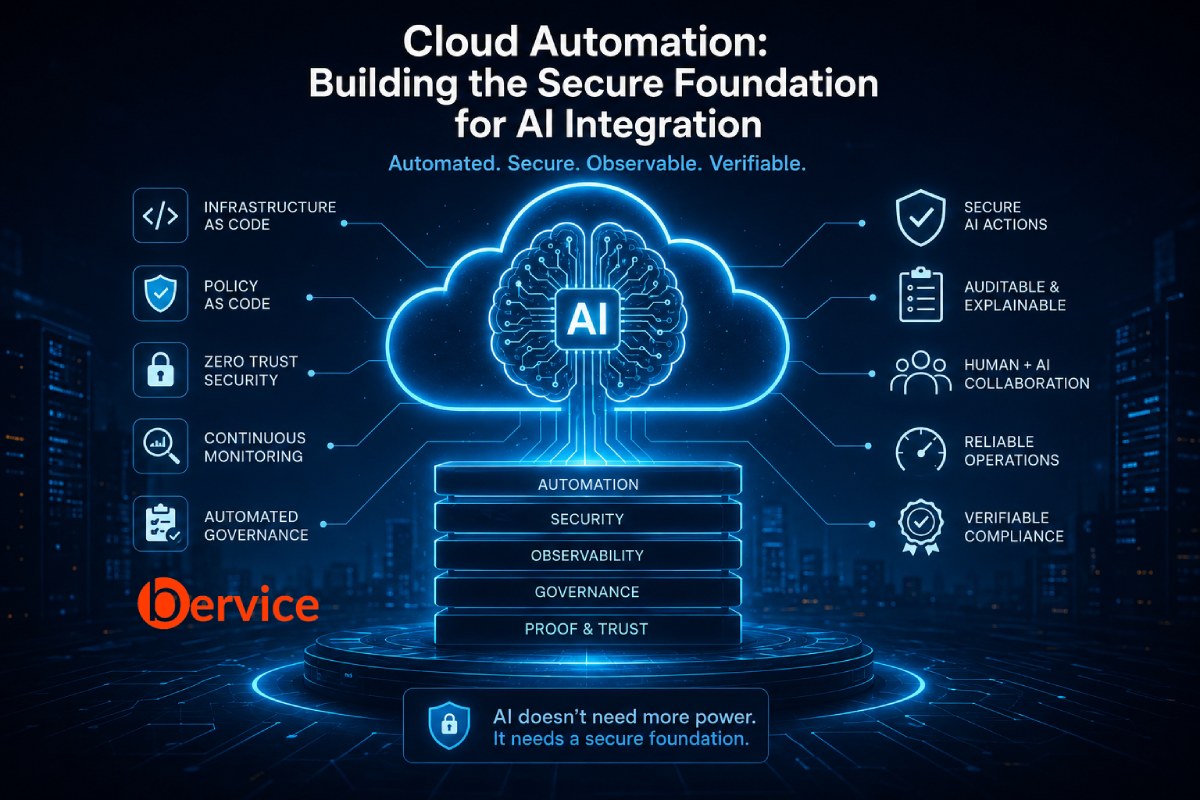
Artificial Intelligence Doesn’t Fail Because of Intelligence. It Fails Because of Infrastructure.
Artificial Intelligence is entering every layer of modern business.
Organizations are embedding AI into customer support, software development, cybersecurity, finance, healthcare, manufacturing, and cloud operations. Yet despite massive investments, many AI initiatives never reach production or fail to deliver long term value.
The reason is surprisingly simple.
The problem is rarely the AI model itself.
The real problem is that organizations attempt to inject AI into infrastructures that were never designed to support autonomous decision making.
AI is becoming the brain of digital systems.
Cloud automation must become the nervous system.
Only then can intelligence operate safely.
The Evolution of Cloud Infrastructure
Cloud computing has evolved dramatically over the past decade.
The first generation focused on virtualization.
The second generation emphasized scalability.
The third generation introduced Infrastructure as Code (IaC), containers, Kubernetes, CI/CD pipelines, and automated deployments.
Now the industry is entering its fourth generation:
AI Native Cloud Infrastructure.
In this generation, systems do not simply execute instructions.
- They observe.
- They analyze.
- They optimize.
- They recommend.
Eventually, they make autonomous decisions.
That level of autonomy requires infrastructure that is predictable, repeatable, and continuously verifiable.
Without automation, AI becomes unpredictable.
Automation Creates Predictable Environments
One of the greatest weaknesses in enterprise infrastructure is inconsistency.
Different servers are configured differently.
Permissions vary between environments.
Security policies drift over time.
Developers manually change production.
Operations teams apply emergency fixes that never return to source control.
AI cannot safely operate inside chaos.
Cloud automation eliminates these inconsistencies.
Infrastructure as Code transforms infrastructure into version controlled software.
Every server becomes reproducible.
Every network policy becomes traceable.
Every deployment becomes auditable.
Instead of asking:
“How is this server configured?”
Organizations know exactly how every resource should exist.
That certainty becomes the foundation AI requires.
Security Begins Before AI Arrives
Many organizations ask:
“How do we secure AI?”
A better question is:
“Is our infrastructure secure enough to host AI?”
Automation allows security to become proactive rather than reactive.
Examples include:
- Automatic identity provisioning
- Continuous access reviews
- Least privilege enforcement
- Automated certificate rotation
- Secret management
- Policy as Code
- Automated vulnerability remediation
- Immutable infrastructure
When AI enters an environment where these controls already exist, its operational risk decreases dramatically.
Instead of creating new attack surfaces, AI operates within predefined security boundaries.
Policy as Code Makes AI Accountable
Human administrators often interpret policies differently.
Automation removes ambiguity.
With Policy as Code, compliance becomes executable.
Every deployment automatically checks:
- Encryption standards
- Network segmentation
- Data residency
- Backup requirements
- Regulatory compliance
- Resource permissions
If a deployment violates policy, it never reaches production.
Now imagine AI proposing an infrastructure change.
Instead of blindly trusting AI, every recommendation passes through automated policy engines before execution.
AI no longer becomes an unrestricted administrator.
It becomes an intelligent contributor operating inside verified boundaries.
Continuous Monitoring Creates Context
AI performs best when it receives reliable, high quality data.
Cloud automation continuously generates operational context:
Infrastructure metrics
Security events
Performance logs
Configuration history
Deployment records
Identity activity
Application telemetry
Dependency maps
This living operational history gives AI something far more valuable than raw data.
It provides context.
Context allows AI to distinguish between normal behavior and genuine anomalies.
Without context, AI generates noise.
With context, AI generates insight.
Automation Enables Responsible AI Decision Making
One of the biggest fears surrounding AI is autonomous action.
What happens if AI makes the wrong decision?
Automation provides layered safeguards.
Every AI generated action can require:
Policy validation
Risk scoring
Human approval
Simulation
Rollback planning
Canary deployment
Post deployment verification
Continuous monitoring
AI no longer acts alone.
Automation surrounds intelligence with governance.
This transforms AI from an unpredictable actor into a trusted operational assistant.
Zero Trust and AI Work Together
Modern cloud security increasingly follows the Zero Trust model.
Never trust.
Always verify.
Automation continuously validates:
User identities
Device posture
Application integrity
Network location
Behavior patterns
Session risk
When AI interacts with infrastructure built on Zero Trust principles, it inherits those verification mechanisms.
Every request is authenticated.
Every action is authorized.
Every operation is logged.
AI becomes another verified participant inside the ecosystem instead of an unrestricted superuser.
Why Observability Matters
AI cannot improve what it cannot observe.
Modern cloud automation emphasizes full observability.
Metrics explain performance.
Logs explain events.
Traces explain relationships.
AI consumes these signals to understand the health of distributed systems.
Instead of reacting after failures occur, AI begins predicting failures before customers notice them.
Predictive operations become possible only because automation continuously collects standardized operational data.
Infrastructure Must Become Explainable
One of the emerging challenges of enterprise AI is explainability.
Organizations increasingly ask:
Why did AI make this recommendation?
Automation provides the answer.
Every infrastructure change has:
Version history
Deployment records
Policy validation
Approval chain
Execution logs
Configuration differences
Rollback history
This evidence allows every AI decision to be reconstructed and audited.
Trust grows when decisions become explainable.
The Missing Layer: Proof
Automation creates repeatability.
Security creates protection.
Observability creates visibility.
Governance creates accountability.
But one element is still missing.
Proof.
Organizations increasingly need verifiable evidence that:
AI followed approved policies.
Infrastructure complied with regulations.
Data remained protected.
Human approvals occurred.
Security controls remained active.
Without proof, trust depends on assumptions.
With proof, trust becomes measurable.
This is where the next generation of digital infrastructure is evolving.
Not simply toward intelligent automation.
But toward Verifiable Automation.
For platforms like Pexelle, this represents a significant opportunity.
The future is not just about making AI smarter.
It is about making every AI action provable, auditable, and trustworthy.
Conclusion
Artificial Intelligence is transforming software faster than any previous technological revolution.
Yet AI alone cannot build trustworthy systems.
Cloud automation prepares the environment.
Security establishes boundaries.
Governance enforces accountability.
Observability provides awareness.
Proof establishes trust.
Organizations that automate first will adopt AI faster, more securely, and with greater confidence than those that attempt to layer intelligence on top of manual, inconsistent infrastructure.
The future of cloud computing is not merely autonomous.
It is automated, secure, explainable, and verifiable.
And in that future, cloud automation is not simply an operational advantage.
It is the foundation upon which trustworthy AI is built.
Connect with us : https://linktr.ee/bervice
Website : https://bervice.com