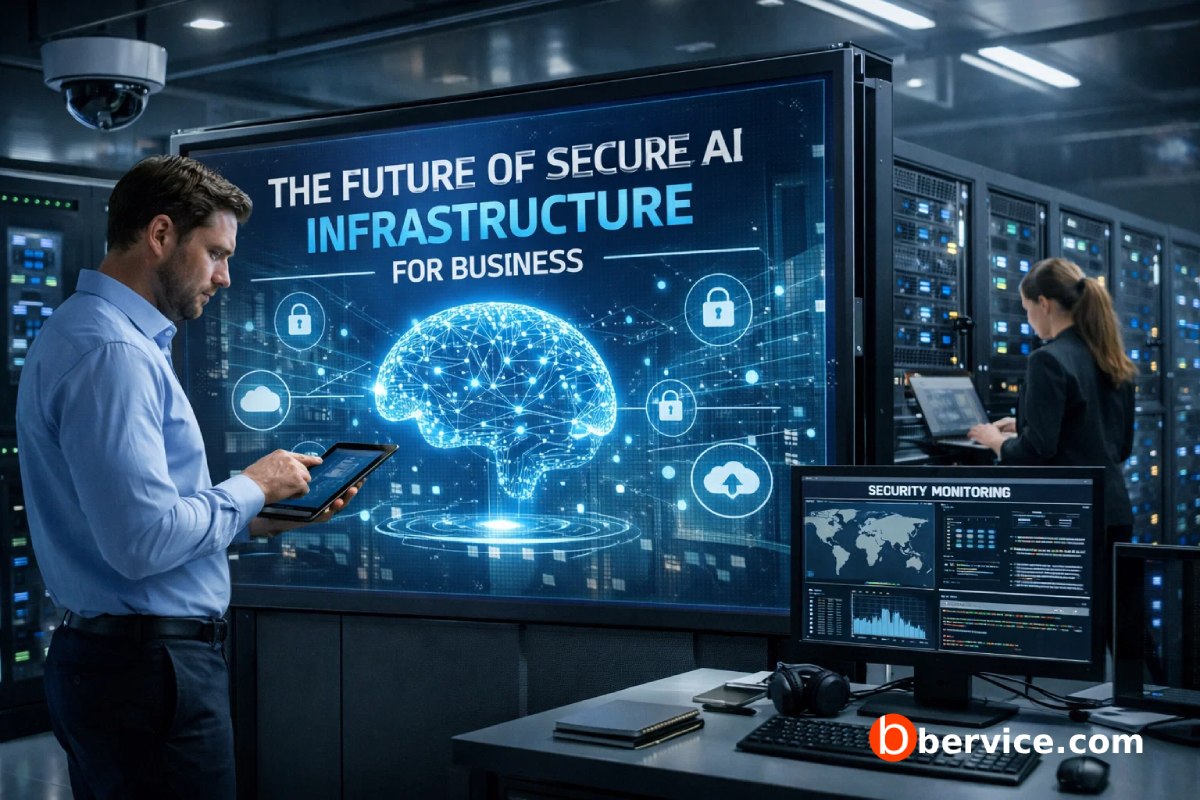
Introduction: A New Era of AI Adoption
In the near future, we will see the rise of new digital infrastructures that allow companies, organizations, and users to benefit from artificial intelligence without sacrificing security, privacy, or control over sensitive information. As AI becomes more central to decision making, operations, customer service, internal analysis, and strategic planning, the demand for trustworthy infrastructure will grow rapidly. Businesses no longer want only intelligence. They want intelligence that is private, controlled, auditable, and aligned with their own operational boundaries.
The Problem: AI Power Without Data Protection Is Not Enough
One of the biggest concerns in modern AI adoption is the fear of exposing internal data to external systems. Companies deal with confidential reports, customer records, product roadmaps, legal documents, financial details, technical architectures, and internal conversations every day. If AI systems require sending all of this information to third party cloud services without strong guarantees, many businesses will remain hesitant. The true challenge is not whether AI is useful. The real challenge is how to make AI useful while keeping company knowledge secure.
Why Traditional Cloud Only AI Creates Friction
Cloud based AI systems have enabled rapid growth in recent years, but they also introduced new layers of concern. Businesses often worry about where their data is stored, who can access it, how it is processed, whether it may be used for model improvement, and what happens if regulations become stricter. For startups and enterprises alike, these concerns are not theoretical. They directly affect procurement decisions, legal reviews, internal approvals, and trust in AI deployments. This is why the next phase of AI infrastructure will move beyond convenience alone.
The Next Step: Security First AI Infrastructure
The future belongs to infrastructures designed from the beginning with security and privacy as core principles rather than optional add ons. In these systems, the architecture itself will be built to protect internal knowledge, isolate sensitive data, control access, and minimize exposure. Instead of forcing companies to adapt their privacy standards to AI, AI infrastructure will adapt to the privacy and security standards of the company. This shift will mark a major turning point in enterprise technology.
Local Language Models as a Strategic Foundation
A major part of this future will be the increasing use of local language models. These are AI models that can run on company controlled hardware, private servers, edge devices, or isolated infrastructure instead of depending entirely on external cloud platforms. Local models offer a powerful advantage because they allow organizations to analyze documents, conversations, codebases, reports, and operational data without moving critical information outside their trusted environment. This creates a new balance between intelligence and confidentiality.
Why Local Models Matter More Than Ever
Local AI models are not simply a technical alternative. They represent a strategic shift in control. When a company runs its own language models, it gains more authority over how data flows, how long it is retained, how inference is handled, and how outputs are monitored. This reduces dependency on external providers and makes it easier to align AI usage with internal policies, legal obligations, and industry regulations. For many businesses, this control will become just as valuable as model performance itself.
The Role of Specialized Agents in Company Analysis
Alongside local models, specialized AI agents will play an increasingly important role. These agents will not be generic assistants designed for broad conversation only. Instead, they will be purpose built systems trained or configured to examine specific dimensions of a company. One agent may focus on operational bottlenecks, another on communication patterns, another on engineering productivity, another on risk detection, and another on executive reporting. Together, they will form an intelligent layer that understands how businesses actually function.
From General Assistance to Operational Intelligence
Today, many people think of AI as a chatbot that answers questions. In the future, that view will feel incomplete. AI infrastructure will evolve into an operational intelligence environment where agents continuously analyze events, connect signals, detect risks, summarize patterns, and support decisions. Rather than waiting for a user to ask a question, these systems will help reveal what matters, what is changing, where friction is increasing, and which actions deserve attention. This is a much deeper role than simple automation.
Secure Data Boundaries as a Core Design Principle
For this future to work, clear data boundaries must be built into the infrastructure. Not every model, agent, or service should have access to everything. Secure AI systems will need strict permission layers, role based access, data segmentation, event logging, encryption, and isolated processing zones. A finance related agent should not automatically have access to engineering secrets. A customer support analysis system should not be able to browse sensitive executive communications. Trust in AI will depend on such boundaries being real, visible, and enforceable.
Hybrid Intelligence: Combining Local and External Capabilities
The future will likely not be purely local or purely cloud based. Instead, many organizations will adopt hybrid AI infrastructures that combine the strengths of both. Highly sensitive tasks may run through local models inside private environments, while less sensitive or more compute intensive tasks may use carefully selected external services. This kind of intelligent routing will allow companies to optimize for privacy, performance, and cost at the same time. The key is that the company will decide what goes where, not the infrastructure provider by default.
Why Smart Orchestration Will Define Success
As companies adopt multiple models and multiple agents, orchestration will become essential. The real value will not come only from having a powerful model, but from knowing which model should handle which task under which conditions. A secure infrastructure may use one local model for internal document understanding, another for coding assistance, another for summarization, and external systems for low risk enrichment when appropriate. This orchestration layer will become the brain of enterprise AI operations, ensuring that every task is processed in the safest and most effective way.
Company Specific Agents Will Become Industry Assets
Over time, businesses will develop specialized agents that reflect their own workflows, priorities, and internal logic. A logistics company will build agents that understand supply chain disruptions, route efficiency, and vendor dependency. A software company will build agents that analyze sprint health, code review delays, release risks, and hidden technical debt. A financial services firm will build agents that monitor compliance patterns, fraud indicators, and internal approval bottlenecks. These agents will become strategic assets because they transform raw company data into actionable organizational intelligence.
Privacy Preserving AI Will Unlock Wider Adoption
Many companies are still cautious about full AI adoption because they are not convinced their data can remain protected. Once privacy preserving infrastructures mature, that hesitation will begin to fade. Businesses that avoided AI due to risk concerns will finally be able to adopt advanced capabilities in secure ways. This will expand AI usage beyond experimentation and into mission critical systems. In other words, security will not slow AI growth. It will enable the next and more serious phase of AI growth.
Trust Will Become a Competitive Advantage
In the coming years, users and organizations will judge AI systems not only by speed or output quality, but also by how trustworthy they are. Can the infrastructure prove where data stays. Can it explain which model processed which information. Can it demonstrate access control, auditability, and isolation. Can it give companies confidence that their internal knowledge is not being exposed. The providers and platforms that answer these questions well will gain a major competitive advantage in the enterprise market.
The Executive Value of Secure AI Analysis
For company leaders, secure AI infrastructure will create a new level of visibility. Executives often struggle because important information is scattered across emails, chats, meetings, documents, project systems, and engineering tools. Specialized agents running in secure environments will be able to connect these fragmented signals and turn them into coherent insights. Leaders will receive reports that are not based on guesswork or incomplete dashboards, but on deeper cross functional analysis. This will improve strategic clarity and reduce blind spots.
Security and Productivity Will No Longer Be Opposites
For many years, businesses often treated security and productivity as opposing forces. The assumption was that stronger security slows teams down, while faster systems introduce more risk. Secure AI infrastructure changes that equation. When designed well, it allows organizations to move faster precisely because they do not need to compromise control. Teams can use AI to summarize knowledge, detect issues, support decisions, and accelerate operations while staying inside trusted environments. This is a more mature model of digital productivity.
The Importance of Domain Aware Intelligence
A powerful future AI infrastructure will not rely only on large general models. It will also depend on domain aware intelligence. Specialized agents must understand the context of the business they serve. They need to know the difference between noise and priority, between routine discussion and real escalation, between temporary delay and structural execution risk. This level of understanding comes from combining strong language models with company specific rules, data structures, workflows, and operational semantics.
From Data Storage to Knowledge Infrastructure
What companies need is not only a place to store information, but a system that can interpret and protect that information intelligently. This is why future AI environments will look more like knowledge infrastructures than simple software stacks. They will ingest communication, documents, workflows, metrics, and events, then organize them into meaningful structures that agents can safely analyze. Instead of disconnected tools, businesses will have secure intelligence layers that understand the company as a living system.
Challenges That Must Still Be Solved
Although this future is promising, several challenges remain. Local models still face tradeoffs in hardware requirements, maintenance complexity, performance tuning, and model quality compared to some large cloud systems. Specialized agents must be designed carefully to avoid false conclusions, biased outputs, or overreach in decision support. Companies will also need strong governance frameworks to define who can deploy agents, what they can access, and how their outputs are validated. The future is achievable, but it requires careful engineering and responsible design.
The Long Term Vision: AI That Respects Boundaries
The most important idea behind this transformation is simple. AI does not need to violate boundaries in order to be useful. In fact, the most valuable AI systems of the future may be the ones that respect boundaries best. They will understand how to operate within company controlled environments, honor internal security rules, and provide powerful analysis without unnecessary exposure. This will create a healthier relationship between intelligence, privacy, and digital trust.
Conclusion: The Infrastructure Shift That Will Define Enterprise AI
Soon, we will witness the emergence of infrastructures that make secure AI adoption not only possible, but practical and scalable. These systems will combine local language models, hybrid orchestration, privacy preserving architecture, and specialized analytical agents built to understand how companies really work. This will allow businesses to use AI with greater confidence, deeper intelligence, and far stronger protection of their information. The future of enterprise AI will not belong only to the biggest models. It will belong to the smartest infrastructures.
Connect with us : https://linktr.ee/bervice
Website : https://bervice.com