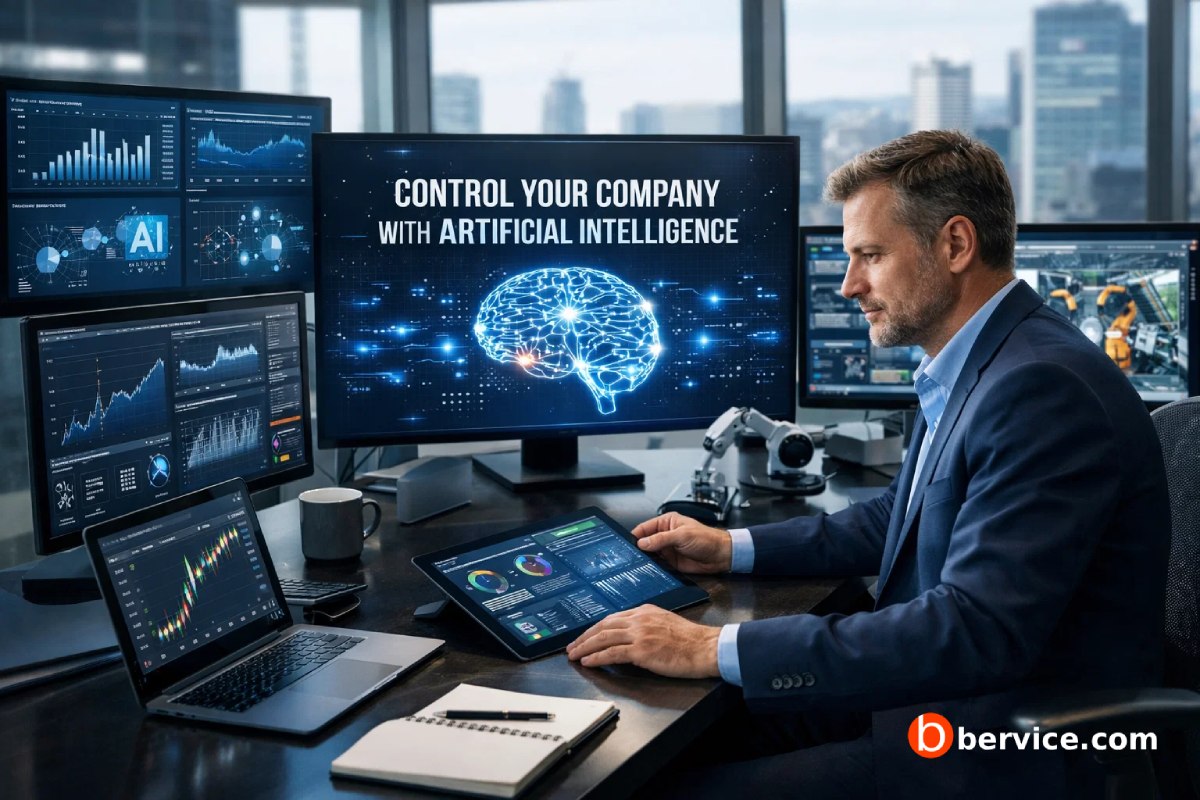
Introduction
Modern companies generate an enormous amount of data every day, yet many important decisions are still made through incomplete reports, flawed human interpretation, and emotional judgment. In fast moving technology businesses, this creates a dangerous gap between reality and leadership perception. Teams may believe they are acting on facts, while in practice they are responding to selective information, personal bias, internal politics, or poorly structured analysis.
Artificial intelligence offers a fundamentally different model of management support. It does not get tired, emotionally attached, or influenced by office dynamics in the same way humans do. When designed properly, AI can process large volumes of operational data, identify patterns that people miss, detect hidden risks early, and produce structured recommendations based on evidence rather than instinct. This makes it one of the most powerful tools a company can use to improve decision quality.
The purpose of AI in company control is not simply automation for the sake of speed. Its real value lies in creating a more objective operating system for the business. Instead of depending on delayed human summaries, leadership can access live intelligence drawn from real workflows, communication patterns, customer issues, delivery signals, and operational performance. In this sense, AI becomes more than a software layer. It becomes a decision support infrastructure.
The Problem with Human Reporting
Human reporting has always been vulnerable to distortion. Employees may unintentionally omit details, simplify complexity, or frame results in a way that protects themselves or their teams. Managers often summarize information based on what they noticed most recently, what they personally consider important, or what they want leadership to believe. Even honest reporting can still be incomplete, inconsistent, and shaped by limited perspective.
In many companies, reports are also delayed by design. Weekly updates, monthly reviews, and manually prepared dashboards represent the past, not the present. By the time leadership reads them, the real situation may already have changed. A product risk may have grown, a customer issue may have escalated, or a delivery problem may already be affecting revenue. Companies often think they are monitoring the business, but in reality they are only reviewing its history.
Another weakness is interpretive error. Two intelligent people can look at the same set of data and draw completely different conclusions. One may see temporary noise, while another sees a structural problem. One may blame execution, while another blames strategy. Emotional pressure, team loyalty, fear of failure, and executive ego all influence how humans interpret the facts. This makes purely human analysis unreliable, especially in high pressure environments such as startups and technology firms.
Why Emotional Decision Making Damages Companies
Emotional decisions are not always obvious. They do not only appear as anger or panic. Often they appear as optimism without evidence, loyalty to failing projects, resistance to uncomfortable facts, overconfidence in familiar people, or delay caused by avoidance. These patterns are common in companies because business decisions are made by humans under pressure, uncertainty, and personal exposure.
A founder may continue investing in a weak product because of personal attachment. A manager may defend a poor performer because of past trust. A leadership team may ignore warning signs because acknowledging them would require admitting a strategic mistake. These are not rare failures. They are normal human behaviors. The problem is that business systems often have no mechanism strong enough to counter them.
Artificial intelligence introduces a counterweight to this problem. When AI is connected to real operational signals, it can evaluate what is actually happening rather than what people hope is happening. It can flag missed deadlines, detect communication breakdowns, identify recurring customer complaints, notice workload imbalance, and reveal contradiction between claimed progress and measurable activity. This does not remove human judgment, but it forces it to confront reality.
AI as an Objective Layer of Company Intelligence
The greatest strength of AI in company control is its ability to operate as an objective analytical layer across the entire organization. Unlike a human manager who sees only part of the system, AI can review information from multiple sources at once. It can connect messages, tickets, code changes, calendar events, customer feedback, sales updates, and operational metrics into one integrated picture.
This matters because business failure rarely starts in one visible place. A delayed release may actually begin with unclear leadership decisions, weak documentation, poor cross team communication, overloaded engineers, and unresolved customer issues. Human observers often see these events separately. AI can connect them into a causal chain. It can show not just what happened, but how one weakness created another and why the company is drifting toward risk.
When used properly, AI becomes a company wide reasoning engine. It can identify execution friction, trace hidden dependencies, measure team behavior, compare statements against evidence, and continuously produce recommendations. Instead of waiting for departments to explain themselves, leadership gains direct visibility into the operating reality of the company.
Better Than Traditional Thought in Pattern Recognition
Humans are excellent at intuition in narrow contexts, but they are weak at tracking complex systems over time. A company is exactly such a system. It contains overlapping workflows, dependencies, incentives, delays, and feedback loops. No executive, no matter how experienced, can manually process every important signal inside a growing organization.
AI is better than traditional human thinking in one key area: large scale pattern recognition. It can analyze trends across hundreds of variables without fatigue. It can compare current activity to past performance, identify anomalies, and recognize weak signals before they become visible crises. For example, it may detect that delivery speed has dropped, internal discussions about one subsystem have sharply increased, documentation activity has decreased, and customer complaints are rising in the same product area. A human may miss the connection until the failure becomes obvious.
This advantage becomes even more valuable in startups, where speed creates blindness. Teams move quickly, responsibilities overlap, and informal decisions happen constantly. Leaders often rely on intuition because there is no time for deep structured analysis. Yet this is exactly where AI can provide the greatest value. It can bring discipline, continuity, and objectivity to environments that are otherwise driven by rapid human reaction.
AI Can Evaluate What People Say Against What They Do
One of the biggest weaknesses in company management is the gap between narrative and evidence. Teams often say progress is strong, priorities are clear, and collaboration is healthy. However, the actual workflow may reveal the opposite. Tasks may remain open without movement, communication may be fragmented, reviews may be delayed, and the same issues may appear repeatedly without resolution.
AI can help close this gap by comparing claims to observable behavior. If a team reports that a feature is nearly complete, AI can examine commits, ticket movement, review activity, test coverage, customer feedback, and internal discussions to assess whether the claim is supported. If leadership says a problem has been handled, AI can monitor whether related risks truly declined or simply disappeared from discussion.
This creates a more accountable environment. It does not depend on distrust. It depends on verification. Companies do not become stronger because everyone speaks confidently. They become stronger because reality is measured accurately. AI helps convert management from a narrative driven activity into an evidence driven one.
Removing Bias from Strategic Analysis
Bias is one of the most expensive invisible forces inside any company. People favor their own departments, preferred methods, trusted colleagues, and existing assumptions. Technical teams may blame product teams. Product teams may blame engineering. Founders may overvalue vision and undervalue operational warning signs. Sales teams may overpromise, while delivery teams normalize delay. All of these biases distort strategy.
Artificial intelligence has the potential to reduce this distortion if it is trained and configured carefully. It can evaluate issues according to patterns, impact, and evidence rather than office politics or status. It can identify which projects drain resources without producing results, which teams create dependency bottlenecks, which managers generate confusion, and which customer issues signal deeper product weaknesses.
This does not mean AI is automatically neutral. Poorly designed models can inherit bias from their inputs. But compared with unstructured human judgment, a transparent AI system with clear data sources, traceable logic, and reviewable outputs can be far more consistent and fair. In practice, this can improve not only analysis quality but also trust in decision making.
How AI Improves Leadership Quality
Strong leadership is not only about vision. It is also about the quality of interpretation. Leaders must decide where to focus, what to ignore, when to intervene, and which risks matter most. These decisions become dangerous when they are based on filtered information or instinct unsupported by evidence.
AI can improve leadership by giving executives structured situational awareness. Instead of receiving fragmented updates from different departments, they can review synthesized intelligence across the whole business. They can see where execution is weakening, where collaboration is breaking down, which initiatives are drifting, which people are overloaded, and which signals require immediate action.
This allows leaders to spend less time collecting information and more time making better decisions. It also reduces dependence on the loudest voices in the room. Leadership becomes less reactive and more deliberate. In this model, AI does not replace executives. It raises the quality of executive judgment by giving it a stronger factual foundation.
The Special Importance for Tech Companies
Technology companies are especially vulnerable to human reporting errors because they are structurally complex. Product, engineering, infrastructure, design, support, growth, and customer success all create different streams of information. Problems often begin deep inside technical systems long before they become visible in business metrics. By the time a human written report captures the issue, the damage may already be significant.
AI is particularly powerful in these environments because it can read across technical and non technical signals simultaneously. It can connect bug discussions, deployment failures, incident frequency, code ownership concentration, sprint slippage, support complaints, and release quality into a unified operational picture. This gives tech companies a far more realistic view of their actual health.
In startups, this matters even more. Founders are often too close to the business. They move fast, rely on a small team, and make judgment calls under constant stress. AI can act as an independent layer of operational truth. It can reveal where growth is masking dysfunction, where hidden work is accumulating, and where the company is becoming fragile even if outward progress looks strong.
AI and the Future of Internal Company Control
The future of company control will not be based on more meetings, more manual reports, or more presentation slides. It will be based on intelligent systems that continuously observe the business, interpret operational activity, and provide live recommendations. In the strongest companies, AI will move from being a support tool to becoming a core layer of management infrastructure.
This shift will change how organizations are run. Teams will no longer depend entirely on retrospective reporting. Leaders will ask not just for updates, but for evidence based intelligence. Decisions will be evaluated against real outcomes. Problems will be detected earlier. Waste will become more visible. Structural weaknesses will be harder to hide.
As this model matures, the competitive advantage will belong to companies that can combine human leadership with machine level analytical depth. The companies that continue relying only on human summaries and emotional interpretation will increasingly fall behind, not because their people are weak, but because their systems are too limited for the complexity of modern business.
Limitations and Necessary Caution
Despite its power, AI should not be treated as magical or infallible. It depends on data quality, system design, governance, and the clarity of the objectives it is given. If inputs are incomplete, manipulated, or poorly structured, outputs can still mislead. If leaders use AI only to confirm what they already believe, then the tool becomes another form of bias rather than a corrective to it.
There is also a serious difference between observation and judgment. AI can identify patterns, inconsistencies, and risks, but decisions involving ethics, culture, and human dignity still require responsible leadership. A company must never use AI as an excuse to avoid accountability. It should use AI to strengthen accountability by making reality more visible.
The best approach is not blind trust in machines or blind trust in people. It is disciplined cooperation between the two. AI should provide evidence, pattern recognition, and structured recommendations. Humans should provide values, context, responsibility, and final judgment. When these roles are clear, AI becomes a powerful force for healthier management.
Conclusion
Controlling a company through artificial intelligence does not mean removing people from leadership. It means reducing the damage caused by flawed human reporting, emotional analysis, biased interpretation, and incomplete visibility. In a world where businesses move too fast for manual oversight, AI offers something critically important: a more neutral view of reality.
For technology companies and startups especially, this can be transformative. AI can reveal what is actually happening inside the organization, connect hidden signals across teams and systems, and help leaders respond with greater precision. It can convert management from a process built on assumption into a process built on evidence.
The companies that succeed in the coming era will not be those that simply use AI for automation or marketing. They will be the ones that use AI to understand themselves more truthfully. When a company can see itself clearly, it can act more intelligently. That is where better strategy begins, better execution follows, and stronger businesses are built.
Connect with us : https://linktr.ee/bervice
Website : https://bervice.com