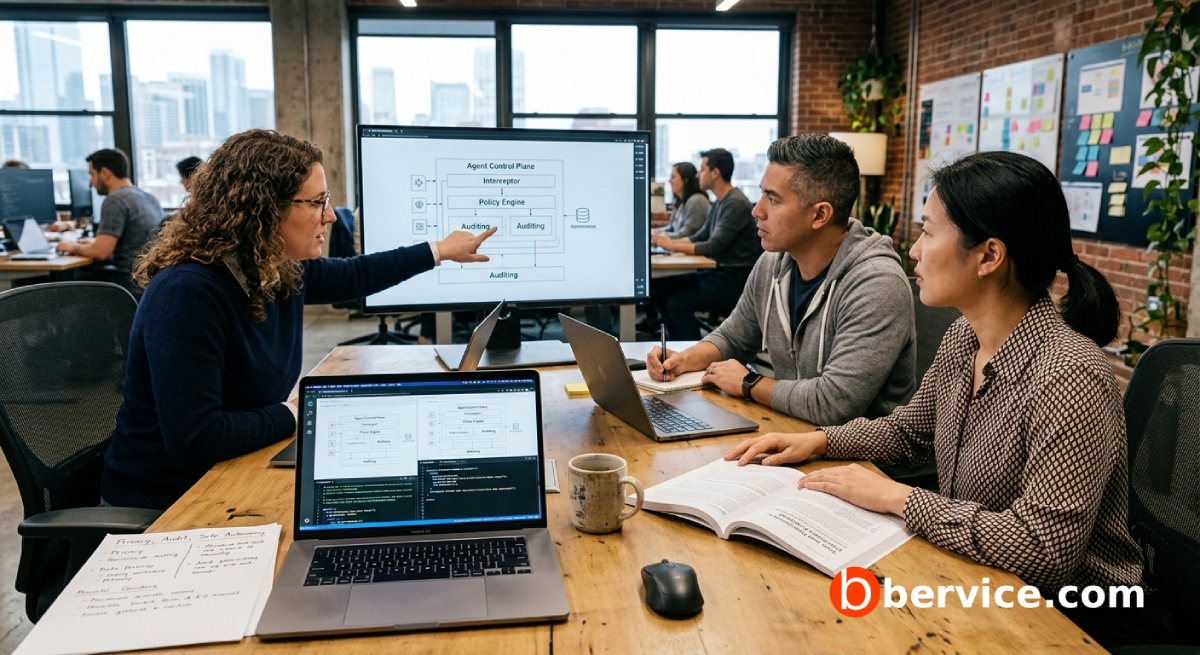
A Practical Guide to Privacy, Governance, and Safe Autonomy
1. Introduction
As AI agents evolve from simple assistants into autonomous decision-makers, the challenge is no longer just capability, but control. Organizations need to ensure that agents act within defined boundaries, respect privacy, and remain auditable.
This is especially critical in systems like decentralized platforms, enterprise intelligence layers, or local AI deployments where data sensitivity is high and trust is non-negotiable.
Controlling AI agents is not a single tool problem. It is a multi-layer architecture combining orchestration frameworks, security systems, data isolation, and observability.
2. The Core Problem: Why Agent Control Matters
Modern AI agents can:
- Access APIs (Slack, GitHub, databases)
- Execute actions (send messages, trigger workflows)
- Store and retrieve memory
- Make autonomous decisions
Without proper control, this introduces risks:
- Unauthorized data access
- Leakage of sensitive information
- Unpredictable or harmful actions
- Lack of auditability
The goal is not to limit agents completely, but to create bounded autonomy.
3. Agent Orchestration Frameworks
These tools define how agents think, decide, and act.
LangChain / LangGraph
- Define structured workflows instead of free-form reasoning
- Enable deterministic pipelines
- Allow step-by-step execution control
Why it matters:
You can replace “open-ended AI behavior” with explicit execution graphs, reducing unpredictability.
AutoGen (by Microsoft)
- Multi-agent collaboration framework
- Agents communicate under defined roles
Risk note:
If not constrained, agent-to-agent communication can become uncontrolled. Requires strict boundaries.
4. Policy Enforcement and Guardrails
These systems define what an agent is allowed to do.
Open Policy Agent (OPA)
- Policy engine using declarative rules
- Controls:
- API access
- Data visibility
- Action permissions
Example:
- Agent can read Slack messages
- But cannot export them externally
AI Guardrail Systems
- Tools like Guardrails AI or custom validators
- Validate:
- Inputs
- Outputs
- Actions
Important:
Guardrails should not rely solely on LLM judgment. Combine with deterministic checks.
5. Privacy-Preserving Architectures
Local AI (On-Device / On-Prem)
- Tools: Ollama, LM Studio, llama.cpp
- Models run locally (8B–70B parameters depending on hardware)
Advantages:
- No data leaves the environment
- Full control over inference
- Reduced compliance risk
Uncertainty to consider:
- Smaller models may reduce reasoning quality
- Requires hardware optimization
Data Sandboxing
- Isolate agent environments
- Use containers (Docker, Firecracker)
- Restrict:
- File system access
- Network calls
- External APIs
Intent: Prevent lateral movement and data leakage
Risk: Misconfiguration can still expose data
6. Identity and Access Control
Fine-Grained Permissions
Every agent should have:
- Scoped API keys
- Role-based access (RBAC)
- Attribute-based access (ABAC)
Example:
- Agent A → Read-only GitHub
- Agent B → Write access to internal tasks only
Secret Management
Tools:
- HashiCorp Vault
- AWS Secrets Manager
- Doppler
Critical principle:
Secrets must never be:
- Stored in memory long-term
- Exposed to the model context
7. Memory Control and Data Minimization
Agents often use memory systems (vector DBs, logs, context buffers).
Techniques:
- Short-lived memory (TTL-based)
- Encrypted vector storage
- Context filtering before inference
Tools:
- Weaviate (self-hosted)
- Qdrant
- Chroma (with encryption layer)
Risk note:
If memory is not controlled, agents can unintentionally leak historical data.
8. Observability and Auditability
You cannot control what you cannot see.
Logging Systems
- Capture:
- Prompts
- Decisions
- Actions
- External calls
Tools:
- LangSmith
- OpenTelemetry
- Custom event pipelines
Replayability
- Ability to reconstruct agent decisions step-by-step
Why this matters:
- Debugging
- Compliance
- Trust verification
9. Network and Execution Control
API Gateway Layer
- All agent actions pass through a gateway
- Enforces:
- Rate limits
- Allowed endpoints
- Data filtering
Egress Control
- Block unauthorized outbound traffic
- Allow only whitelisted domains
Risk:
Without egress control, agents can exfiltrate data silently.
10. Human-in-the-Loop Systems
For high-risk actions:
- Require human approval
- Use staged execution:
- Plan → Review → Execute
Examples:
- Financial transactions
- Data export
- System changes
Balance needed:
Too much human control reduces automation benefits.
11. Combining Everything: A Reference Architecture
A secure agent system typically includes:
- Agent Brain
- Local or hybrid LLM
- Orchestration Layer
- LangGraph or structured pipelines
- Policy Engine
- OPA for rule enforcement
- Sandbox Execution
- Containerized runtime
- Memory Layer
- Encrypted + scoped vector DB
- API Gateway
- Controlled external access
- Observability
- Full logging and replay
- Human Oversight
- Approval for critical actions
This layered approach ensures:
- No single point of failure
- Defense-in-depth
- Controlled autonomy
12. Limitations and Open Questions
There are still unresolved challenges:
- No universal standard for agent safety
- Difficult to formally verify agent decisions
- Trade-off between privacy and performance
- Local models still lag behind frontier models
It cannot be assumed that any single tool guarantees safety.
13. Conclusion
Controlling AI agents is fundamentally about architecture, not tools.
The most secure systems:
- Minimize data exposure
- Restrict capabilities explicitly
- Monitor everything
- Keep humans in the loop where necessary
In privacy-sensitive environments, especially decentralized or local-first systems, the priority should be:
Designing agents that are constrained by default, observable by design, and private by architecture.
Connect with us : https://linktr.ee/bervice
Website : https://bervice.com