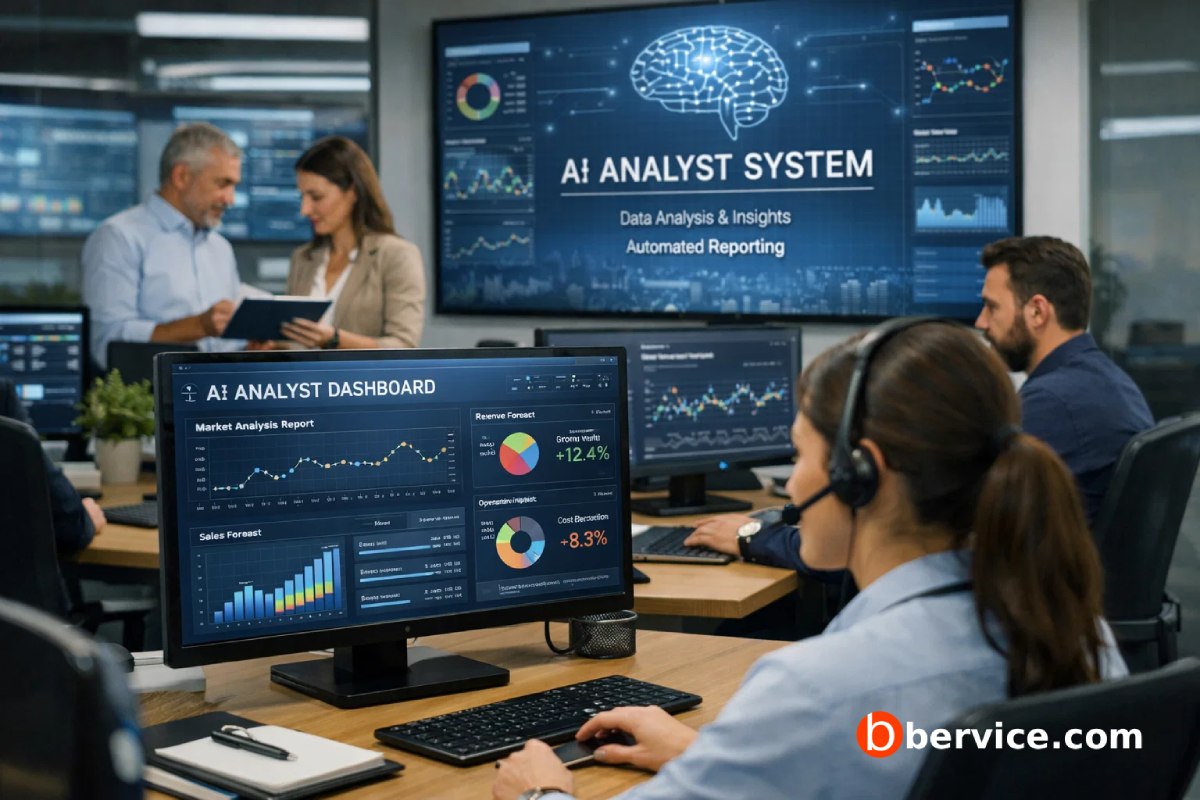
1. A New Kind of Product is Emerging
Companies are on the edge of encountering a fundamentally different type of product, not another SaaS dashboard or analytics tool, but an internal analytical brain. This system is powered by locally trained artificial intelligence and operates directly inside the organization’s infrastructure. Instead of relying on external services, it continuously observes, interprets, and analyzes internal operations in real time.
This shift is not incremental. It represents a transition from tools that assist decision-making to systems that actively generate structured understanding of how a company functions.
2. From Data Tools to Analytical Intelligence
Traditional business intelligence systems focus on presenting data through charts, reports, and dashboards. However, they leave the burden of interpretation on humans. Internal AI analyst systems move beyond this limitation. They do not just display metrics; they analyze relationships, detect patterns, and provide contextual explanations.
For example, instead of showing a drop in performance, such a system can explain why it happened, which teams are involved, and what chain of events led to the outcome. This transforms raw data into actionable intelligence.
3. The Power of Local AI Training
One of the defining characteristics of these systems is that they are trained locally using the company’s own data. This includes communication logs, operational workflows, project histories, and system events. Because the model is trained in-house, it develops a deep and specific understanding of the organization’s structure and behavior.
This approach has several implications:
- Privacy Preservation: Sensitive data never leaves the organization
- Contextual Accuracy: Insights are tailored to the company’s unique environment
- Adaptability: The system evolves as internal processes change
However, it is important to note that the effectiveness of such training depends heavily on data quality and structure. Poor or fragmented data can limit the system’s analytical capabilities.
4. Continuous Analysis Instead of Periodic Reporting
Most companies rely on periodic reporting cycles such as weekly or monthly reviews. Internal AI analyst systems operate differently. They continuously analyze events as they occur, building a dynamic understanding of the organization’s state.
This enables:
- Early detection of risks
- Identification of hidden inefficiencies
- Real-time feedback on decisions
Instead of reacting to problems after they appear, companies can anticipate and address them proactively.
5. From Observation to Recommendation
The real value of these systems lies not only in analysis but in their ability to generate structured recommendations. By understanding workflows, dependencies, and outcomes, the system can suggest specific actions.
Examples include:
- Reassigning overloaded teams
- Identifying untracked work that affects delivery
- Highlighting communication gaps between departments
- Recommending process adjustments to improve efficiency
These recommendations are grounded in observed patterns rather than assumptions, which can significantly improve decision quality.
6. Redefining Decision-Making Inside Organizations
As these systems mature, they will reshape how decisions are made within companies. Leadership will increasingly rely on AI-generated insights that synthesize vast amounts of internal data.
This does not eliminate human decision-making but changes its nature. Executives move from manually analyzing data to evaluating and acting on structured intelligence. The role of leadership becomes more about judgment and prioritization rather than data interpretation.
7. Challenges and Uncertainties
Despite their potential, several uncertainties remain:
- Data Integration Complexity: Many organizations have fragmented systems that are difficult to unify
- Model Reliability: Incorrect or biased data can lead to misleading insights
- Security Risks: Even local systems require strong protection against internal threats
- Adoption Resistance: Teams may be hesitant to trust automated analysis
It cannot be assumed that all companies will successfully implement such systems without addressing these challenges.
8. The Competitive Advantage Factor
Companies that successfully deploy internal AI analyst systems may gain a significant competitive advantage. They will operate with a level of clarity and responsiveness that traditional organizations cannot match.
This advantage is not just about speed but about depth of understanding. Organizations will be able to see connections and risks that were previously invisible, allowing them to act with greater precision.
9. The Future: Organizations with Embedded Intelligence
Looking forward, the boundary between a company and its analytical system may become increasingly blurred. The internal AI analyst will act as a continuous intelligence layer embedded within the organization.
In such a future:
- Every action generates insight
- Every decision is informed by contextual analysis
- Every process is continuously optimized
Companies will not just use data; they will understand themselves in real time.
10. Conclusion
The emergence of locally trained internal AI analyst systems marks a turning point in how organizations operate. These systems shift the focus from data visibility to deep operational understanding.
While there are still uncertainties and technical challenges, the direction is clear. Companies are moving toward a model where intelligence is not external or optional, but internal, continuous, and foundational to how they function.
Connect with us : https://linktr.ee/bervice
Website : https://bervice.com