Introduction
Artificial Intelligence is evolving at an unprecedented pace. Every few months, a new model promises faster reasoning, deeper understanding, lower costs, and more human like interactions. The competition between AI companies has become one of the defining technology races of the decade.
Among the newest entrants generating significant attention is Fable 5, a model that many believe represents another major milestone in AI development. While benchmarks alone never tell the whole story, Fable 5 introduces several innovations that challenge existing assumptions about how AI systems should reason, remember, collaborate, and execute complex tasks.
But is Fable 5 truly revolutionary?
Or is it simply another incremental improvement?
Let’s examine its architecture, strengths, limitations, and how it compares with today’s leading AI models.
Why Fable 5 Matters
Earlier generations of AI focused primarily on one objective:
Generate the next most likely word.
Modern AI has evolved beyond prediction.
Today’s leading models must simultaneously:
- Reason logically
- Plan multiple steps ahead
- Write production quality code
- Understand images
- Analyze documents
- Execute long workflows
- Maintain context
- Interact naturally with humans
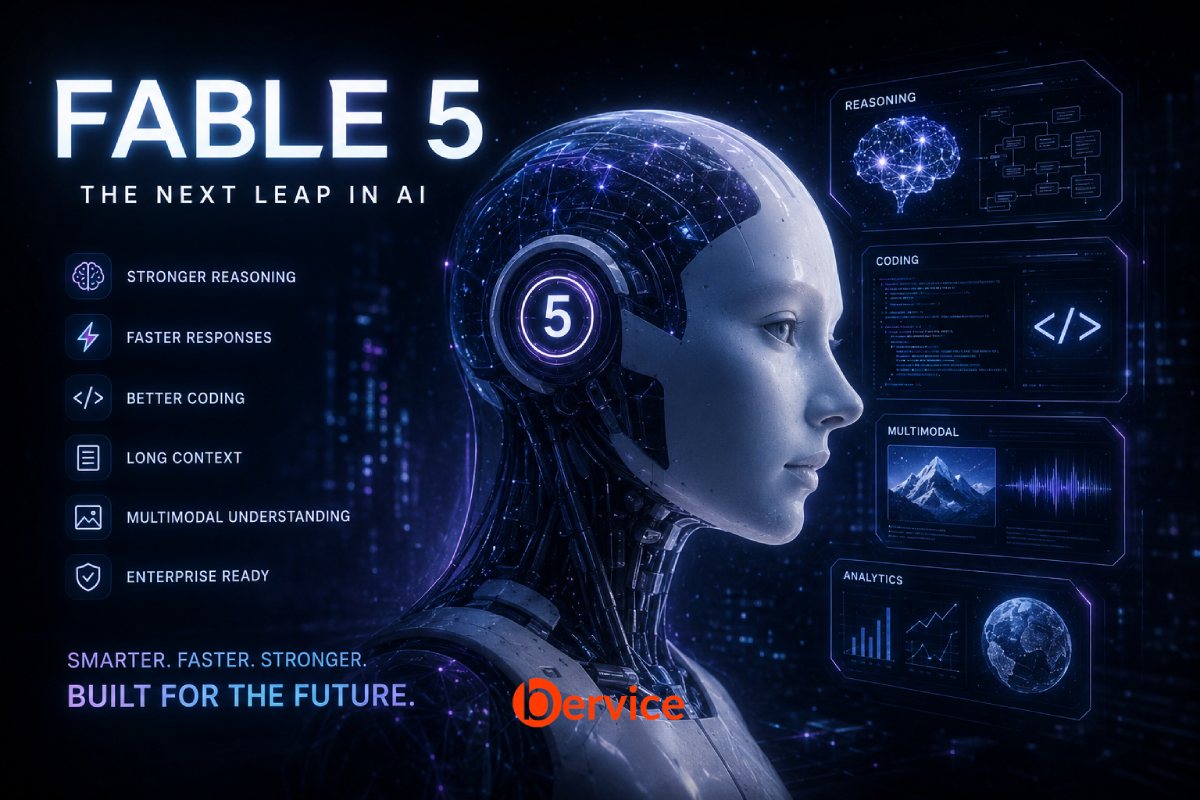
Fable 5 appears to push all of these capabilities further while emphasizing efficiency and practical deployment.
Rather than maximizing benchmark scores alone, the model focuses on improving real world usefulness.
Major Strengths of Fable 5
1. Improved Reasoning
One of Fable 5’s most noticeable improvements is structured reasoning.
Instead of immediately producing an answer, the model appears better at:
- Breaking problems into smaller parts
- Identifying assumptions
- Evaluating alternatives
- Producing more consistent conclusions
This makes it especially valuable for engineering, legal analysis, scientific research, and business strategy.
2. Better Long Context Understanding
Modern workflows often involve:
- Hundreds of pages of documentation
- Large software repositories
- Financial reports
- Research papers
- Enterprise knowledge bases
Fable 5 demonstrates stronger consistency when handling long conversations and extensive documents.
Instead of losing earlier information, it maintains more coherent understanding across lengthy interactions.
3. Faster Responses
Performance is no longer measured only by intelligence.
Latency matters.
Developers increasingly expect AI to feel instantaneous.
Fable 5 focuses heavily on:
- Lower response time
- Reduced waiting
- More interactive conversations
- Better user experience
For enterprise applications, even small reductions in latency can significantly improve productivity.
4. Higher Coding Performance
Software engineering has become one of AI’s most important use cases.
Fable 5 performs well in:
- Code generation
- Debugging
- Refactoring
- Architecture suggestions
- Documentation
- API integration
Rather than generating isolated snippets, it is designed to understand larger software structures.
5. Better Multimodal Understanding
Modern AI is expected to process much more than text.
Fable 5 supports richer multimodal workflows by understanding:
- Images
- Diagrams
- Charts
- Screenshots
- Documents
- Mixed text and visual information
This expands its usefulness across healthcare, education, manufacturing, architecture, and design.
6. Enterprise Readiness
Businesses increasingly demand:
- Reliability
- Predictability
- Security
- Lower operational cost
Fable 5 appears designed with enterprise deployment in mind by improving consistency and reducing unnecessary computation.
Potential Weaknesses
Despite impressive advances, no AI model is perfect.
Fable 5 still faces several challenges.
1. Hallucinations Still Exist
Even highly advanced AI systems occasionally generate incorrect information with confidence.
Although Fable 5 appears to reduce hallucinations, they have not been eliminated.
Human verification remains essential for critical decisions.
2. High Computational Requirements
More capable models generally require:
- Larger GPUs
- Higher memory
- Greater energy consumption
- Increased infrastructure costs
Organizations must balance performance with operational expenses.
3. Benchmark Performance Does Not Always Equal Real World Performance
A model may excel in standardized evaluations while struggling with industry specific tasks.
Success depends heavily on:
- Prompt quality
- Data quality
- Domain expertise
- Workflow integration
4. Privacy Challenges
Organizations deploying advanced AI must carefully manage:
- Sensitive documents
- Customer information
- Intellectual property
- Regulatory compliance
Technology alone cannot solve governance challenges.
Comparing Fable 5 with Other Leading AI Models
| Feature | Fable 5 | GPT Family | Claude Family | Gemini Family |
|---|---|---|---|---|
| Reasoning | Excellent | Excellent | Excellent | Very Good |
| Coding | Excellent | Excellent | Very Good | Very Good |
| Long Context | Excellent | Excellent | Outstanding | Excellent |
| Speed | Very Fast | Fast | Fast | Fast |
| Multimodal Support | Excellent | Excellent | Strong | Excellent |
| Enterprise Readiness | High | High | High | High |
| Workflow Automation | Strong | Strong | Strong | Strong |
Rather than replacing other models entirely, Fable 5 strengthens competition by offering another high performance option for developers and organizations.
Industries That Could Benefit
Fable 5 has potential applications across many sectors.
Healthcare
- Medical documentation
- Clinical summarization
- Research assistance
Software Development
- Code generation
- Automated testing
- Bug detection
- Documentation
Finance
- Risk analysis
- Report generation
- Fraud detection
- Market research
Education
- Personalized tutoring
- Lesson planning
- Assessment generation
Manufacturing
- Maintenance documentation
- Process optimization
- Quality inspection
Customer Support
- Intelligent assistants
- Knowledge retrieval
- Ticket classification
The Bigger Picture
The true revolution is not that one model becomes slightly better than another.
The real transformation is that AI is shifting from a conversational assistant to a collaborative digital worker capable of planning, reasoning, analyzing, and assisting with increasingly complex tasks.
As these systems improve, organizations will focus less on choosing a single “best” model and more on selecting the right combination of models for specific workloads.
The future of AI is likely to be an ecosystem where specialized models cooperate rather than compete in isolation.
Conclusion
Fable 5 represents another significant step in the evolution of artificial intelligence. Its improvements in reasoning, coding, multimodal understanding, speed, and enterprise readiness make it a compelling option for modern AI applications.
However, it is not a perfect solution. Challenges such as hallucinations, infrastructure costs, privacy concerns, and real world reliability remain important considerations.
Ultimately, the success of any AI model depends not only on its architecture but also on how effectively humans integrate it into practical workflows. The organizations that combine powerful AI systems with thoughtful governance, high quality data, and skilled professionals will gain the greatest advantage in the years ahead.
Connect with us : https://linktr.ee/bervice
Website : https://bervice.com