Introduction
For decades, Programmable Logic Controllers (PLCs) have been the backbone of industrial automation. They control production lines, manufacturing equipment, water treatment facilities, energy systems, logistics centers, and countless other critical infrastructures. PLCs are known for one defining characteristic: reliability. They execute deterministic logic with exceptional stability, making them indispensable wherever industrial processes require precision and safety.
However, the industrial world is changing rapidly. Modern factories are expected to become more adaptive, predictive, autonomous, and data-driven. Traditional PLC programming alone cannot satisfy every requirement of today’s intelligent manufacturing environment.
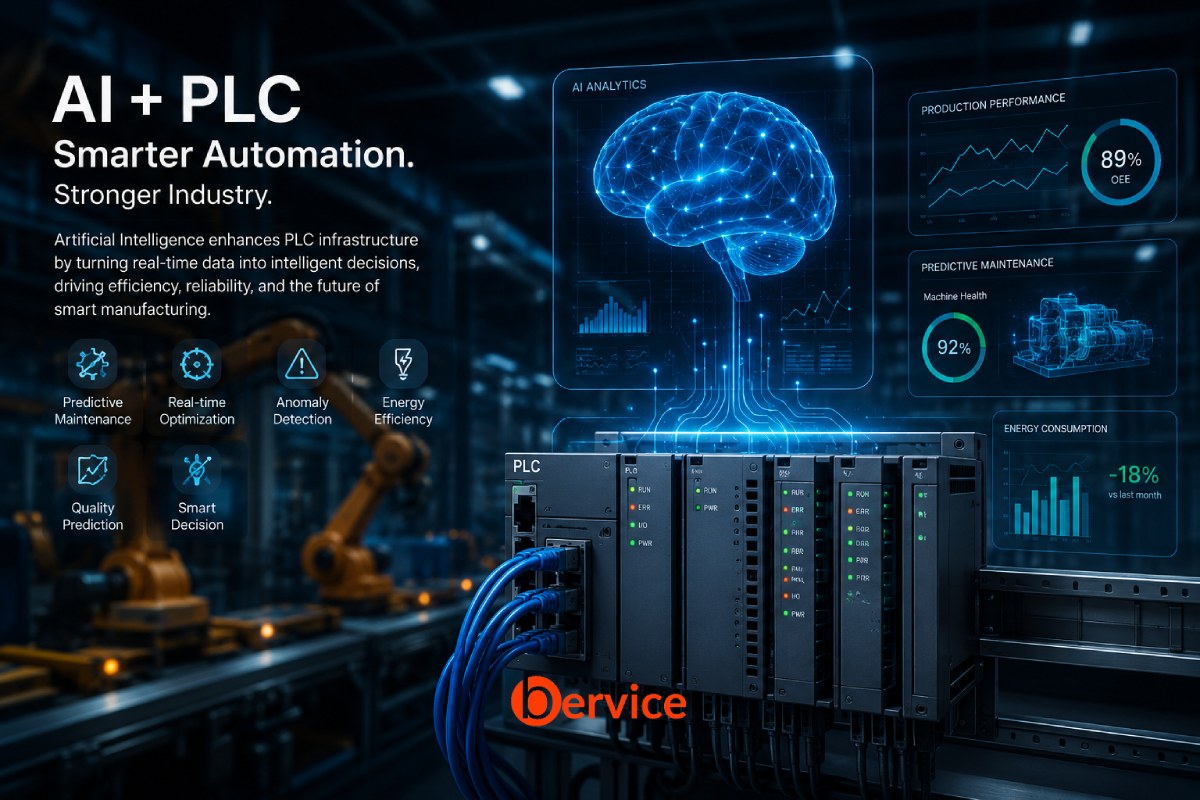
Artificial Intelligence (AI) is introducing a new layer of intelligence above traditional automation systems. Rather than replacing PLCs, AI extends their capabilities by enabling predictive decision-making, adaptive optimization, anomaly detection, and continuous learning.
The future of industrial automation is not PLC versus AI. It is PLC enhanced by AI.
Understanding the Role of PLCs
A PLC is designed to execute predefined control logic.
Its responsibilities include:
- Reading sensor inputs
- Processing logical conditions
- Controlling actuators
- Managing production sequences
- Executing safety procedures
- Maintaining deterministic timing
PLC systems excel because every instruction is predictable.
For example:
- If temperature exceeds 80°C
- Turn on cooling fan
- Wait until temperature falls below 70°C
- Turn fan off
This type of logic has powered industrial systems for over fifty years.
But modern production environments involve challenges that cannot always be solved using fixed rule-based programming.
Examples include:
- Predicting equipment failures
- Detecting abnormal machine behavior
- Optimizing energy consumption
- Forecasting maintenance needs
- Adapting production schedules
- Improving product quality automatically
These challenges require intelligence beyond conventional control logic.
Why AI is Becoming Essential
Modern industrial systems generate enormous volumes of data.
Every second, factories collect information from:
- Temperature sensors
- Pressure transmitters
- Flow meters
- Cameras
- Vibration sensors
- Current sensors
- Torque measurements
- Machine vision systems
- Production counters
- Quality inspection devices
Traditionally, most of this data is either ignored or archived without extracting meaningful insights.
AI transforms raw industrial data into actionable intelligence.
Instead of asking:
“What happened?”
AI answers:
- What is happening?
- Why is it happening?
- What will happen next?
- What should we do now?
This represents a fundamental shift from reactive automation to intelligent automation.
AI Applications in PLC Infrastructure
Predictive Maintenance
One of the most successful AI applications is predictive maintenance.
Instead of replacing components after a fixed number of operating hours, AI continuously monitors machine health.
It analyzes:
- Motor vibration
- Bearing temperature
- Electrical current
- Sound patterns
- Hydraulic pressure
- Operating cycles
Machine learning models identify subtle deviations that humans cannot easily detect.
The AI system can predict:
- Bearing failures
- Motor degradation
- Pump wear
- Conveyor issues
- Gearbox problems
before they cause production downtime.
The PLC continues controlling the equipment while AI provides maintenance recommendations.
Intelligent Fault Detection
Traditional PLC alarms rely on predefined thresholds.
For example:
If pressure > 120 psi
Generate Alarm.
AI introduces contextual understanding.
Instead of evaluating a single sensor, AI analyzes hundreds of variables simultaneously.
It can identify:
- Abnormal production behavior
- Sensor drift
- Hidden process instability
- Unexpected equipment interactions
- False alarms
This dramatically improves operational reliability.
Adaptive Process Optimization
Manufacturing conditions constantly change.
Variables include:
- Ambient temperature
- Material quality
- Machine wear
- Operator behavior
- Production demand
Traditional PLC logic treats every production cycle identically.
AI continuously adjusts process parameters to maximize:
- Productivity
- Energy efficiency
- Product quality
- Machine lifespan
For example:
Instead of operating a motor permanently at one speed, AI recommends the optimal operating point based on real-time production requirements.
Machine Vision Integration
Industrial cameras are becoming increasingly common.
AI-powered vision systems connected to PLC infrastructure can perform:
- Defect detection
- Weld inspection
- Assembly verification
- Barcode reading
- Object recognition
- Worker safety monitoring
The PLC receives high-level decisions rather than processing raw images.
For example:
Camera captures image
↓
AI identifies defective product
↓
PLC removes item from conveyor
↓
Production continues without interruption.
Energy Optimization
Industrial facilities consume enormous amounts of electricity.
AI continuously analyzes:
- Equipment utilization
- Peak demand
- Idle machines
- HVAC systems
- Compressed air consumption
- Production schedules
The system identifies opportunities to reduce energy costs without affecting productivity.
PLCs then execute optimized control commands automatically.
Quality Prediction
Instead of detecting defective products after production is complete, AI predicts quality during manufacturing.
By monitoring:
- Temperature profiles
- Machine speed
- Material properties
- Tool wear
- Environmental conditions
AI estimates product quality before defects occur.
The PLC adjusts machine parameters immediately, reducing waste and increasing consistency.
AI Architecture in Modern PLC Systems
A typical intelligent industrial architecture includes multiple layers.
Layer 1
Physical Equipment
- Sensors
- Motors
- Valves
- Cameras
- Actuators
↓
Layer 2
PLC Control
- Deterministic control
- Safety logic
- Real-time execution
↓
Layer 3
Edge Computing
Industrial PCs or edge AI devices process sensor data locally with minimal latency.
↓
Layer 4
AI Models
Machine learning algorithms perform:
- Prediction
- Classification
- Optimization
- Pattern recognition
↓
Layer 5
SCADA / MES / Cloud
Operational dashboards visualize AI insights while enterprise systems support production planning and long-term analytics.
This layered architecture preserves the reliability of PLCs while adding intelligence without compromising deterministic control.
Edge AI and PLC Infrastructure
Running AI close to industrial equipment is becoming increasingly important.
Benefits include:
- Lower latency
- Faster decisions
- Reduced cloud dependency
- Improved cybersecurity
- Continuous operation during network outages
Edge AI devices communicate directly with PLCs using industrial protocols such as:
- OPC UA
- Modbus TCP
- EtherNet/IP
- PROFINET
- MQTT gateways
This enables real-time collaboration between AI and automation systems.
Cybersecurity Considerations
Introducing AI into industrial environments also creates new security challenges.
Organizations must protect:
- PLC firmware
- Industrial networks
- AI models
- Sensor integrity
- Operational data
- Remote access
Best practices include:
- Network segmentation
- Zero Trust Architecture
- Secure industrial gateways
- Multi-factor authentication
- Continuous anomaly monitoring
- Encrypted communications
- AI model validation
Security must remain a fundamental design principle rather than an afterthought.
Human Operators Remain Essential
AI does not eliminate the need for industrial engineers or automation specialists.
Instead, their responsibilities evolve.
Engineers increasingly focus on:
- AI supervision
- Model validation
- Process optimization
- System integration
- Safety verification
- Strategic decision-making
Human expertise remains essential for understanding production goals, ensuring regulatory compliance, and managing situations that require judgment beyond algorithmic predictions.
The most effective factories combine experienced engineers with intelligent automation rather than replacing one with the other.
Challenges to Adoption
Despite its advantages, integrating AI into PLC infrastructure presents several challenges:
- Legacy PLC systems with limited connectivity
- Data quality and consistency issues
- Limited labeled datasets for training
- Real-time performance requirements
- Cybersecurity risks
- Workforce skill gaps
- Integration costs
- Regulatory compliance
Organizations that address these challenges through phased implementation typically achieve better long-term outcomes than those attempting complete infrastructure replacement.
The Future of AI and PLC Infrastructure
The next decade will redefine industrial automation.
Future PLC ecosystems will increasingly feature:
- Self-optimizing production lines
- Autonomous maintenance scheduling
- AI-assisted programming
- Digital twins synchronized with real-world equipment
- Collaborative industrial robots
- Predictive supply chain integration
- Explainable AI for operational decisions
- Continuous learning from production data
PLCs will continue to execute deterministic control logic, while AI provides intelligence, prediction, and optimization.
Together, they will form the foundation of smart factories and Industry 5.0, where automation becomes not only faster and more efficient but also more adaptive, resilient, and human-centric.
Conclusion
Programmable Logic Controllers have earned their reputation through decades of dependable industrial control. Their deterministic execution remains indispensable for critical operations where precision and safety cannot be compromised.
Artificial Intelligence does not replace this foundation. Instead, it builds upon it by transforming operational data into actionable insights, enabling predictive maintenance, intelligent optimization, adaptive quality control, and real-time decision support.
The future of industrial automation belongs to systems that combine the reliability of PLCs with the intelligence of AI. Organizations that embrace this partnership will benefit from greater efficiency, reduced downtime, improved product quality, enhanced energy management, and stronger resilience in an increasingly complex industrial landscape.
The evolution of PLC infrastructure is no longer solely about automation. It is about creating intelligent industrial ecosystems where machines do more than execute commands. They learn from data, anticipate change, support human expertise, and continuously improve the way industries operate.
Connect with us : https://linktr.ee/bervice
Website : https://bervice.com