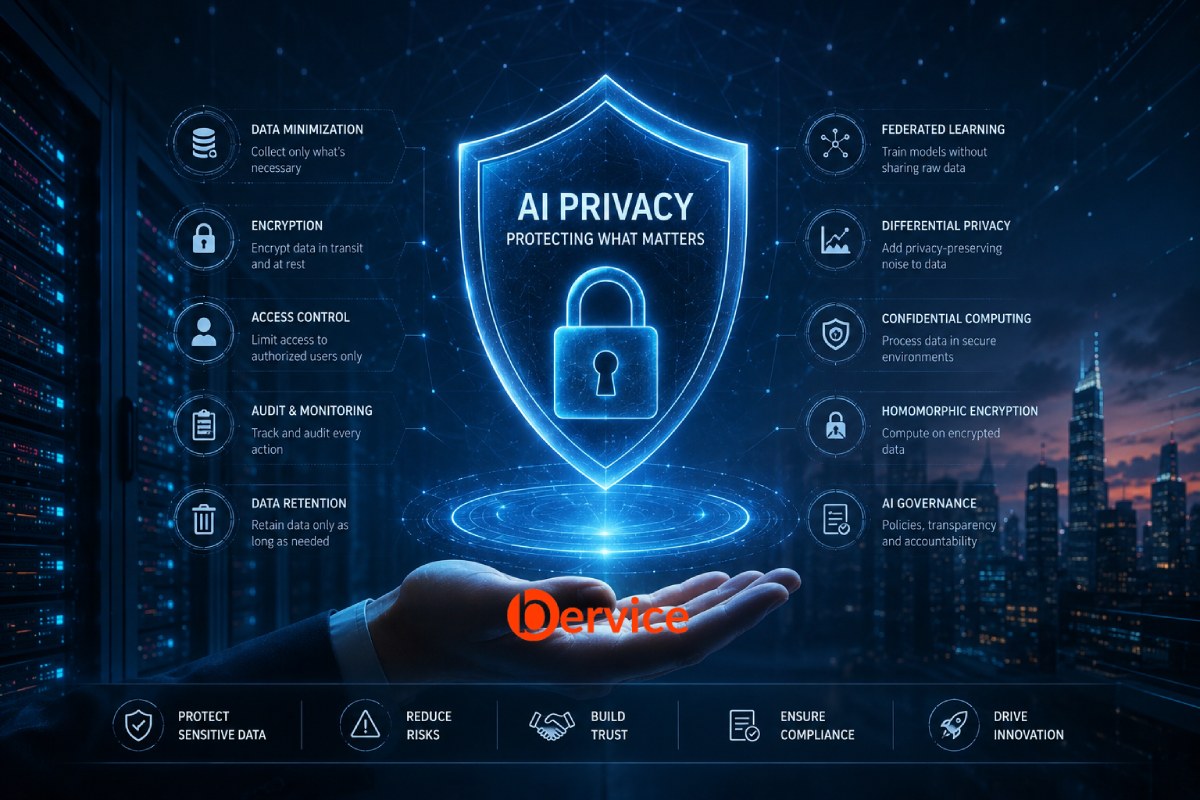
Security Is No Longer Enough. Privacy Is the New Competitive Advantage.
Artificial Intelligence is transforming every industry. Organizations now use AI to write documents, analyze customer behavior, automate workflows, generate software, review legal contracts, and assist medical professionals. Every day, more sensitive information is being shared with intelligent systems.
But a fundamental question remains:
How can we benefit from AI without exposing our most valuable information?
This is becoming one of the most important technological and ethical challenges of our time.
Many organizations focus heavily on cybersecurity, investing in firewalls, encryption, antivirus software, and access control. While these measures are essential, they solve only part of the problem.
The larger concern is different.
What happens after confidential information is intentionally sent to an AI system?
At that point, traditional cybersecurity cannot guarantee complete privacy.
The future of information security depends on designing AI systems that respect privacy by default rather than treating privacy as an afterthought.
Understanding the Difference Between Security and Privacy
People often use these terms interchangeably, but they represent different goals.
Security protects systems against unauthorized access.
Privacy controls how authorized data is collected, processed, stored, and shared.
A company may have world class cybersecurity while still unintentionally exposing confidential information through AI tools.
Imagine an employee uploading:
- Financial forecasts
- Customer databases
- Product designs
- Legal contracts
- Medical records
- Source code
- Internal business strategies
If these documents are processed by an external AI platform without appropriate safeguards, the organization has created a new privacy risk, even if no cyberattack ever occurs.
The threat is no longer only hackers.
Sometimes the risk comes from the tools we voluntarily use.
Why AI Changes Everything
Traditional software follows predefined rules.
AI systems learn patterns from enormous amounts of data.
That creates new privacy questions:
- Is user data stored?
- Is it retained after processing?
- Is it used to improve future models?
- Can employees access submitted information?
- Is the processing isolated for each customer?
- Can outputs unintentionally reveal sensitive information?
- Where is the data physically processed?
These questions matter because AI systems are fundamentally different from conventional applications.
Organizations need clear answers before trusting them with sensitive information.
The Biggest Privacy Risks
1. Sensitive Data Leakage
Employees may unknowingly paste confidential information into public AI services.
Examples include:
- Customer information
- API keys
- Passwords
- Business plans
- Source code
- Employee records
Once shared, organizations may lose control over how that information is handled.
2. Prompt Injection
Attackers can manipulate AI systems through carefully crafted instructions, potentially influencing how information is processed or exposing unintended behavior.
This has become one of the newest security challenges introduced by generative AI.
3. Third Party AI Providers
Many organizations rely on external AI providers.
This means sensitive information may pass through infrastructure that the organization does not directly control.
Trust becomes a critical factor.
4. Human Error
Technology is often not the weakest link.
People are.
Even the strongest AI security policies can fail if employees unknowingly submit confidential documents into unauthorized AI platforms.
Education remains essential.
5. Shadow AI
Employees increasingly use AI tools without approval from their IT departments.
This phenomenon, often called Shadow AI, creates hidden privacy risks because organizations cannot protect information they do not know is being shared.
Building Privacy First AI
Instead of asking how to secure AI after deployment, organizations should ask:
How can privacy be embedded into AI from the beginning?
This philosophy is known as Privacy by Design.
Key principles include:
Data Minimization
Only collect the information that is absolutely necessary.
If AI does not need a customer’s birth date, passport number, or full address, do not provide it.
Less data means lower risk.
Local AI Processing
Whenever possible, process sensitive information on local infrastructure instead of external cloud services.
Running AI models inside a company’s own environment reduces exposure to third parties and helps organizations maintain greater control over their data.
Strong Encryption
Data should remain encrypted:
- During transmission
- During storage
- During backup
Encryption significantly reduces the impact of unauthorized access.
Access Control
Not every employee should access every AI system.
Role based permissions help reduce accidental exposure.
The principle of least privilege remains one of cybersecurity’s strongest defenses.
Audit Logging
Every interaction with AI should be recorded.
Organizations should know:
- Who accessed the system
- What data was processed
- When it happened
- Which AI model was used
- What actions were performed
Visibility enables accountability.
Data Retention Policies
Sensitive information should not remain stored indefinitely.
Organizations should define:
- How long data is retained
- When it is deleted
- Who approves exceptions
Automatic deletion reduces long term exposure.
Privacy Enhancing Technologies
Several emerging technologies are making AI significantly safer.
Differential Privacy
This technique adds carefully designed statistical noise, allowing AI systems to learn useful patterns without revealing information about individual people.
Federated Learning
Instead of moving data to AI, the AI model moves to the data.
Organizations train models locally and share only model updates rather than raw information.
This dramatically reduces privacy risks.
Secure Multi Party Computation
Multiple organizations can collaborate on AI tasks without revealing their private datasets to one another.
Each participant keeps its information confidential while contributing to a shared computation.
Confidential Computing
Sensitive information is processed inside hardware protected secure execution environments.
Even cloud administrators may be unable to view the data while it is being processed.
This adds another layer of protection beyond traditional encryption.
Homomorphic Encryption
One of the most exciting developments in privacy research.
It allows AI systems to perform computations directly on encrypted information without decrypting it first.
Although still computationally expensive for many real world applications, this technology has enormous long term potential.
AI Governance Matters
Technology alone cannot guarantee privacy.
Organizations also need governance.
An effective AI governance framework includes:
- Clear AI usage policies
- Employee training
- Approved AI platforms
- Privacy impact assessments
- Regular audits
- Risk classification
- Incident response procedures
- Vendor security evaluations
Responsible AI is as much about management as technology.
The Role of Regulation
Governments around the world are introducing AI specific regulations.
Organizations increasingly must demonstrate:
- Transparency
- Accountability
- User consent where applicable
- Responsible data processing
- Explainability for high impact decisions
- Risk management
Compliance is becoming a business requirement rather than a legal checkbox.
Companies that invest early in privacy will be better prepared for evolving regulations.
Trust Will Become the Most Valuable Asset
Customers are becoming more aware of how their information is used.
Businesses that can confidently answer questions such as:
- Where is my data processed?
- Who can access it?
- Is it stored?
- Is it deleted?
- Is it used to train AI?
- Can I control my information?
will earn significantly greater trust.
Trust cannot be purchased.
It must be built through transparency, responsible engineering, and consistent privacy practices.
Looking Ahead
Artificial Intelligence will continue to become more capable.
It will automate more decisions, process more information, and integrate deeper into every aspect of society.
The organizations that succeed will not simply build the smartest AI.
They will build the most trustworthy AI.
Privacy should never be viewed as an obstacle to innovation.
It is the foundation that allows innovation to scale safely.
The future belongs to systems that combine intelligence with responsibility, automation with transparency, and technological advancement with unwavering respect for human privacy.
As AI becomes increasingly powerful, protecting information is no longer just an IT responsibility. It is a strategic commitment that defines how much confidence customers, partners, and society place in an organization.
In the age of AI, the companies that protect privacy will ultimately protect their future.
Connect with us : https://linktr.ee/bervice
Website : https://bervice.com