Introduction
Artificial Intelligence (AI) is rapidly reshaping the electronics industry. What once required weeks of manual calculations, repeated simulations, and countless hardware prototypes can now be accelerated with intelligent software capable of learning from millions of previous designs.
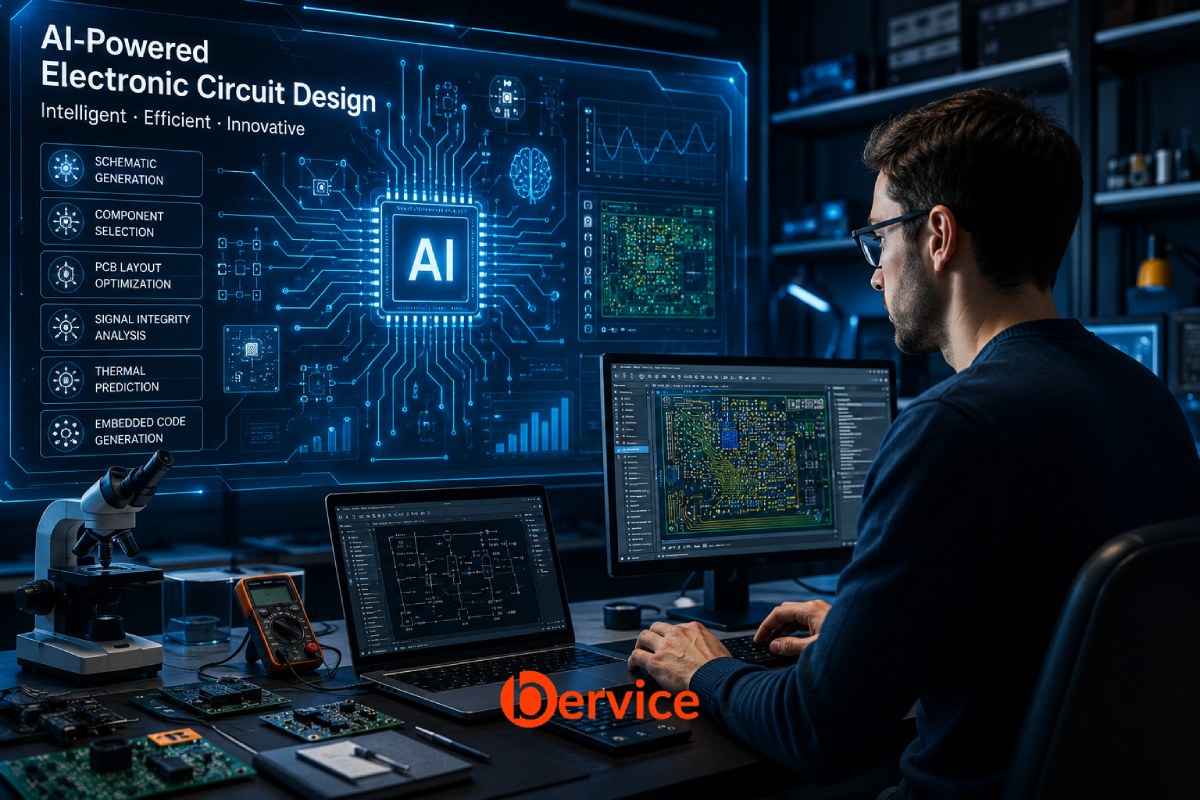
Modern AI tools are no longer limited to automating repetitive tasks. They actively assist engineers by generating circuit topologies, optimizing PCB layouts, predicting failures, selecting components, improving signal integrity, reducing electromagnetic interference (EMI), minimizing power consumption, and even generating embedded software.
As electronics become increasingly complex through the integration of IoT devices, autonomous systems, robotics, wearable technology, electric vehicles, and edge AI, traditional engineering workflows struggle to keep pace. AI introduces a new generation of intelligent design assistants that significantly improve productivity while allowing engineers to focus on creativity and system architecture.
This article explores how AI is revolutionizing electronic circuit design, the most powerful AI tools available today, their advantages and limitations, and what the future holds for AI-assisted electronics engineering.
The Traditional Circuit Design Process
Designing an electronic product traditionally involves multiple stages:
- Defining system requirements
- Selecting components
- Designing the schematic
- Running electrical simulations
- PCB layout
- Signal integrity analysis
- Power integrity verification
- Thermal analysis
- Design Rule Checks (DRC)
- Manufacturing preparation
- Prototype testing
- Debugging
- Hardware revisions
A single PCB revision may require several weeks, and many products require multiple revisions before reaching production.
This process is both time-consuming and expensive.
AI aims to reduce these iterations dramatically.
Where AI Helps Electronic Engineers
1. Intelligent Component Selection
Choosing components is one of the most difficult parts of electronics design.
AI systems can analyze:
- Electrical specifications
- Cost
- Availability
- Supply chain risks
- Manufacturer reliability
- Temperature ratings
- Power consumption
- Lifecycle status
Instead of searching through thousands of datasheets, AI recommends the most suitable parts based on project requirements.
For example:
Rather than manually comparing hundreds of operational amplifiers, an AI assistant can recommend the best option considering bandwidth, noise, power, package size, and price simultaneously.
2. Automatic Schematic Generation
One of the newest capabilities is AI-generated schematics.
Engineers can simply describe a project such as:
“Design a battery-powered ESP32 environmental sensor with USB-C charging and Wi-Fi.”
AI can generate:
- Block diagrams
- Initial schematics
- Suggested components
- Protection circuits
- Voltage regulators
- Battery management
- Communication interfaces
The engineer then reviews and improves the generated design.
This dramatically reduces development time.
3. PCB Layout Optimization
PCB routing is one of the most labor-intensive engineering tasks.
AI can optimize:
- Component placement
- Trace routing
- Power distribution
- Ground planes
- Via placement
- Layer transitions
- Return current paths
- Thermal distribution
Instead of merely following design rules, AI learns from millions of successful PCB layouts to propose more efficient designs.
4. Signal Integrity Optimization
High-speed digital circuits suffer from:
- Reflection
- Crosstalk
- Impedance mismatch
- Timing issues
- EMI
AI can detect potential signal integrity problems before fabrication and recommend layout improvements automatically.
This is especially valuable for:
- DDR memory
- PCIe
- USB 3.x
- HDMI
- Ethernet
- High-speed ADCs
5. Power Optimization
Battery-powered devices require extremely efficient power management.
AI helps optimize:
- Voltage regulator selection
- Sleep modes
- Clock management
- Dynamic voltage scaling
- Battery life prediction
- Current consumption
This is particularly useful for:
- IoT devices
- Wearables
- Drones
- Smart sensors
- Remote monitoring systems
6. Thermal Analysis
Heat is a major cause of electronic failure.
AI predicts:
- Hot spots
- Component overheating
- Airflow efficiency
- Copper plane effectiveness
- Heat sink performance
Design changes can be recommended before manufacturing.
7. Design Rule Checking Beyond Traditional DRC
Traditional DRC verifies spacing and manufacturing constraints.
AI goes much further.
It can detect:
- Weak power architecture
- Poor grounding
- Noise-sensitive routing
- High-risk design patterns
- Manufacturability issues
- Reliability concerns
Essentially, AI acts like an experienced senior engineer reviewing the design.
8. Automatic Simulation
Running simulations often requires expert knowledge.
AI can automatically configure:
- SPICE simulations
- Worst-case analysis
- Monte Carlo analysis
- Frequency response
- Power analysis
- Thermal simulations
It can even explain unexpected simulation results.
9. Failure Prediction
Using data collected from millions of devices, AI predicts:
- Capacitor aging
- Battery degradation
- MOSFET failures
- Connector wear
- Thermal fatigue
- Solder joint cracking
This enables predictive maintenance before failures occur.
10. Embedded Firmware Assistance
AI is becoming increasingly useful for firmware development.
It can generate code for:
- STM32
- Raspberry Pi
- ESP32
- Arduino
- PIC
- AVR
- Nordic nRF
- RP2040
Including:
- Peripheral initialization
- GPIO
- SPI
- I2C
- UART
- ADC
- PWM
- DMA
- RTOS tasks
This allows engineers to move from hardware design to working prototypes much faster.
AI Tools for Electronics Engineers
1. Altium Designer with AI Features
One of the most advanced PCB design platforms.
AI capabilities include:
- Component suggestions
- Layout optimization
- Rule recommendations
- Design assistance
- Documentation generation
Ideal for professional PCB development.
2. Autodesk Fusion Electronics
Provides cloud-based electronic design with growing AI-powered workflows.
Features include:
- PCB design
- Mechanical integration
- Electronics collaboration
- Simulation
Excellent for teams developing complete hardware products.
3. Cadence Allegro X AI
Cadence has introduced AI-driven automation for advanced PCB design.
Capabilities include:
- Intelligent routing
- Signal integrity optimization
- Placement optimization
- High-speed PCB assistance
Widely used in enterprise electronics.
4. Siemens Xpedition AI
Designed for complex electronic systems.
AI improves:
- Design reuse
- Routing efficiency
- Manufacturing readiness
- Multi-board systems
5. NVIDIA Omniverse
Although not a PCB design tool, it is increasingly used to simulate robotic systems, electronic devices, and digital twins.
Useful for:
- Hardware simulation
- Robotics
- Factory automation
- AI-powered testing
6. Keysight PathWave
Combines AI with simulation and electronic testing.
Supports:
- RF analysis
- Signal analysis
- Test automation
- Measurement optimization
7. LTspice with AI Assistants
LTspice remains one of the most popular circuit simulators.
When paired with AI assistants, engineers can:
- Build simulations faster
- Interpret results
- Debug circuits
- Optimize analog designs
8. KiCad + AI
The open-source KiCad ecosystem is increasingly enhanced by AI-powered assistants that help engineers:
- Generate schematics
- Review layouts
- Explain errors
- Produce documentation
- Suggest improvements
This combination is becoming highly attractive for startups and independent hardware developers.
9. GitHub Copilot
Although focused on software, it is highly effective for embedded programming.
Useful for:
- C
- C++
- Python
- Embedded Linux
- Raspberry Pi
- STM32
- Arduino
- ESP-IDF
10. ChatGPT
ChatGPT has become an everyday engineering assistant capable of:
- Explaining datasheets
- Designing circuits
- Reviewing schematics
- Writing firmware
- Debugging hardware
- Calculating component values
- Explaining communication protocols
- Creating documentation
- Assisting with PCB reviews
- Brainstorming design alternatives
When combined with professional EDA software, it significantly accelerates the development process.
Advantages of AI in Electronics
AI provides numerous benefits:
- Faster product development
- Lower engineering costs
- Fewer PCB revisions
- Better signal integrity
- Improved power efficiency
- Reduced EMI
- Higher manufacturing success
- Better documentation
- Faster firmware development
- Improved collaboration
- More reliable products
Current Limitations
Despite rapid progress, AI cannot replace experienced engineers.
Current limitations include:
- Limited understanding of unconventional designs
- Occasional incorrect circuit suggestions
- Incomplete knowledge of proprietary hardware
- Difficulty handling highly specialized analog circuits
- Dependence on accurate input requirements
- Lack of practical manufacturing intuition in some cases
Human review remains essential before production.
The Future of AI in Electronics
Over the next decade, AI is expected to become a true co-engineer rather than just a design assistant.
Future systems may automatically:
- Design complete products from text descriptions
- Optimize schematics and PCBs simultaneously
- Generate firmware and test software
- Simulate real-world operation
- Estimate manufacturing costs
- Predict product reliability
- Create production documentation
- Generate compliance reports
- Validate safety requirements
- Optimize supply chain decisions
Eventually, engineers may spend more time defining product goals while AI handles much of the detailed implementation.
Conclusion
Artificial Intelligence is transforming electronic engineering from a manual, iterative discipline into an intelligent, data-driven process. Rather than replacing engineers, AI amplifies their capabilities by accelerating design, reducing errors, and enabling faster innovation.
From automatic schematic generation and PCB layout optimization to predictive failure analysis and embedded firmware development, AI is becoming an indispensable partner throughout the electronics development lifecycle.
Organizations that successfully combine human engineering expertise with AI-powered design tools will be better positioned to build smarter, more reliable, and more competitive electronic products in the years ahead. As AI technology continues to evolve, electronic design will become faster, more accessible, and increasingly capable of solving challenges that once demanded months of engineering effort.
Connect with us : https://linktr.ee/bervice
Website : https://bervice.com