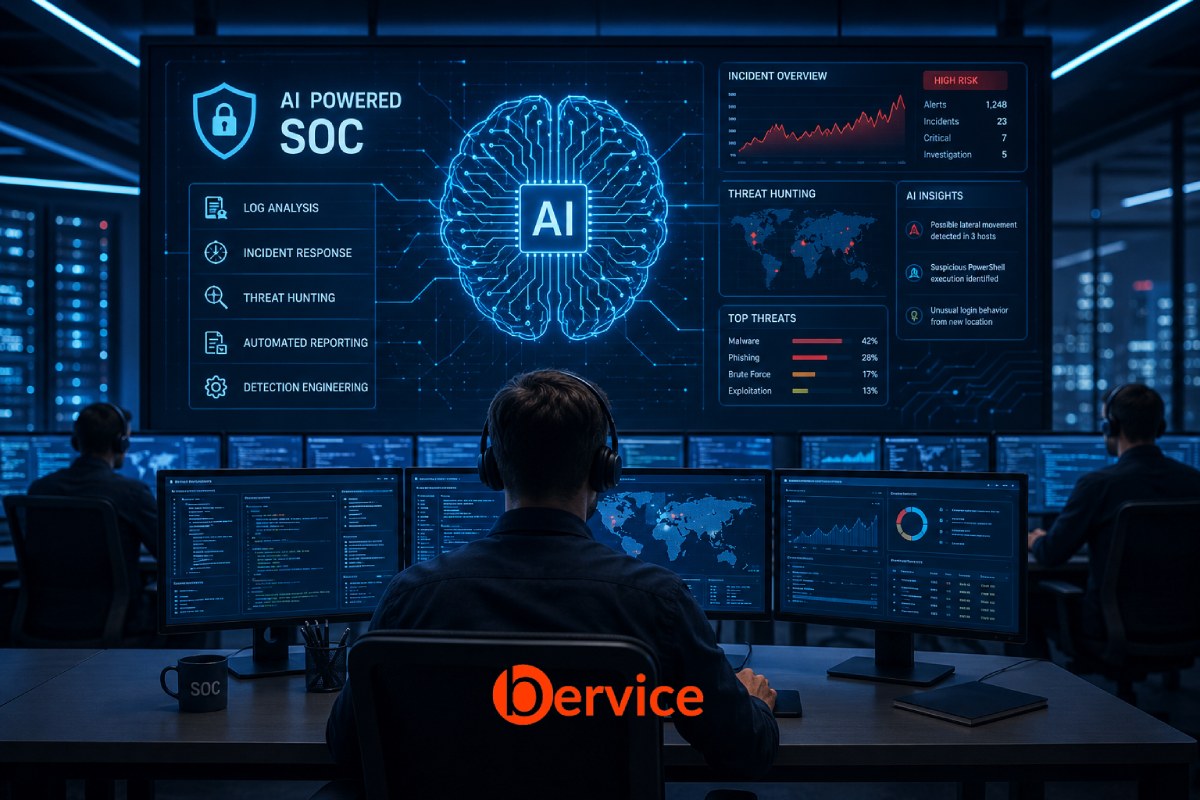
How Large Language Models Are Transforming Log Analysis, Incident Response, and Threat Hunting
Introduction
Modern Security Operations Centers (SOCs) face an overwhelming challenge. Every day, organizations generate millions of security events from firewalls, cloud platforms, identity providers, endpoint protection tools, applications, databases, and network devices. While security technologies have become increasingly sophisticated, the volume and complexity of alerts have grown even faster.
Analysts often spend more time filtering false positives, correlating unrelated events, and writing reports than investigating real threats. This creates alert fatigue, slower response times, and increased operational costs.
Artificial Intelligence, particularly Large Language Models (LLMs), is changing this landscape. Instead of replacing security analysts, LLMs act as intelligent copilots that understand logs, summarize incidents, automate repetitive investigations, generate detection logic, and assist with proactive threat hunting.
The future SOC is no longer built around dashboards alone. It is built around AI that understands security context, reasons across multiple data sources, and helps analysts make faster, more informed decisions.
Why Traditional SOCs Struggle
Security teams today face several major challenges:
- Millions of logs generated every day
- Thousands of security alerts
- Shortage of experienced analysts
- Complex multi-cloud environments
- Increasing ransomware and advanced attacks
- Long Mean Time To Detect (MTTD)
- Long Mean Time To Respond (MTTR)
Most existing SIEM platforms can collect enormous amounts of data but still depend heavily on human expertise to interpret it.
The real bottleneck is no longer data collection.
It is data understanding.
The Rise of AI Powered SOCs
An AI Powered SOC integrates LLMs with traditional security platforms such as:
- SIEM
- SOAR
- EDR
- XDR
- Identity systems
- Cloud security platforms
- Threat intelligence feeds
- Asset inventories
- Knowledge bases
Rather than replacing existing infrastructure, AI becomes an intelligent reasoning layer that sits above the security stack.
Instead of simply answering:
“What happened?”
The AI can answer:
- Why did it happen?
- How serious is it?
- Which systems are affected?
- Is this part of a larger attack?
- What should we do next?
AI Driven Log Analysis
One of the biggest opportunities for LLMs is understanding raw security logs.
Traditional SIEM rules depend on exact matching.
LLMs understand meaning.
For example, an analyst may receive thousands of events like:
- Failed logins
- PowerShell execution
- New administrator creation
- Suspicious DNS requests
- Registry changes
- Endpoint alerts
- VPN authentication
- Cloud API calls
Rather than reviewing each log individually, an LLM can summarize:
“A compromised user account authenticated from an unusual country, executed encoded PowerShell commands, created a new privileged account, disabled Microsoft Defender, and attempted lateral movement across three servers.”
What previously required twenty minutes of manual investigation may now take only seconds.
AI Assisted Incident Response
Incident response follows a structured process:
- Detection
- Investigation
- Containment
- Eradication
- Recovery
- Reporting
LLMs can accelerate every stage.
Detection
The AI enriches alerts with:
- Asset criticality
- User identity
- MITRE ATT&CK techniques
- Historical behavior
- Related alerts
- Threat intelligence
Instead of seeing:
“PowerShell.exe executed”
The analyst sees:
“Suspicious encoded PowerShell execution on a domain controller by a finance employee who normally never uses PowerShell. Similar activity appeared during recent ransomware campaigns.”
Investigation
The AI automatically correlates:
- Windows logs
- Linux logs
- CloudTrail
- Azure logs
- Microsoft 365
- Google Workspace
- Endpoint telemetry
- DNS records
- Firewall logs
It builds a timeline showing how an attacker moved through the environment.
Containment
The AI recommends actions such as:
- Disable compromised accounts
- Isolate infected endpoints
- Block malicious IP addresses
- Revoke active sessions
- Rotate API keys
- Disable suspicious OAuth applications
Human approval can remain part of the workflow for sensitive actions.
Recovery
The AI helps verify:
- Malicious persistence has been removed
- Backdoors no longer exist
- Systems are clean
- Vulnerabilities have been patched
Reporting
One of the most time consuming SOC tasks is documentation.
LLMs automatically generate:
- Executive summaries
- Technical reports
- Customer notifications
- Root cause analysis
- Timeline reports
- Lessons learned
Reports that once required hours can be generated within minutes.
AI Powered Threat Hunting
Traditional threat hunting relies on analysts manually searching for indicators of compromise.
LLMs introduce natural language hunting.
Instead of writing complicated queries, analysts can ask:
“Show endpoints that executed PowerShell after downloading files from newly registered domains.”
Or:
“Find administrator accounts behaving differently from the last six months.”
Or:
“Search for signs of ransomware activity similar to BlackCat.”
The AI translates natural language into SIEM queries such as:
- KQL
- Splunk SPL
- SQL
- Sigma
- Elastic Query DSL
This dramatically lowers the barrier for advanced hunting.
Automated Detection Engineering
Security teams constantly create detection rules.
LLMs can automatically generate:
- Sigma rules
- YARA rules
- Splunk queries
- Microsoft Sentinel KQL
- Elastic queries
- Detection documentation
Example request:
“Create a Sigma rule detecting Base64 encoded PowerShell launched by Office applications.”
The AI produces production ready detection logic with explanations.
Threat Intelligence Summarization
Threat intelligence reports are often dozens of pages long.
LLMs can summarize:
- New malware families
- Indicators of compromise
- MITRE ATT&CK mappings
- Affected industries
- Recommended mitigations
- Detection opportunities
Analysts spend less time reading and more time defending.
AI as a Tier 1 Security Analyst
Many repetitive Tier 1 SOC tasks can be partially automated.
Examples include:
- Alert triage
- Log summarization
- IOC enrichment
- Initial incident classification
- Ticket creation
- Report writing
- Threat intelligence lookup
This allows human analysts to focus on complex investigations that require judgment and creativity.
Multi Agent Security Operations
The next evolution of AI SOCs is not a single LLM but multiple specialized AI agents working together.
For example:
Log Analysis Agent
Continuously interprets incoming logs.
Threat Intelligence Agent
Collects and summarizes emerging threats.
Incident Response Agent
Suggests containment strategies.
Detection Engineering Agent
Creates and improves detection rules.
Compliance Agent
Maps incidents to frameworks such as ISO 27001, NIST, PCI DSS, and SOC 2.
Executive Reporting Agent
Generates business friendly summaries for leadership.
Together, these agents create a collaborative AI security team.
Challenges and Risks
AI powered SOCs also introduce important challenges.
Hallucinations
LLMs may generate inaccurate conclusions if they lack sufficient context.
Security decisions should always be validated against raw evidence.
Data Privacy
Security logs often contain sensitive information.
Organizations should carefully evaluate:
- Data residency
- Model hosting
- Access control
- Encryption
- Prompt logging
- Compliance requirements
Many enterprises choose private or self hosted LLMs to keep data within their environment.
Prompt Injection
Attackers may attempt to manipulate AI systems through crafted inputs.
Security architectures should isolate untrusted data, validate model outputs, and require human approval for high impact actions.
Explainability
Analysts need to understand why an AI reached a particular conclusion.
Transparent reasoning and evidence based recommendations are essential for trust.
Best Practices for Building an AI SOC
Organizations should adopt AI incrementally.
Recommended approach:
- Start with AI assisted log summarization.
- Add alert enrichment.
- Introduce AI generated investigation timelines.
- Automate reporting.
- Deploy natural language threat hunting.
- Integrate with SOAR for controlled response automation.
- Keep humans involved in high risk decisions.
- Continuously evaluate model accuracy and security.
The goal is augmentation, not blind automation.
The Future of Security Operations
Over the next decade, Security Operations Centers will evolve from dashboards and rule engines into intelligent decision support systems.
Instead of manually searching millions of events, analysts will collaborate with AI that understands context, correlates evidence, recommends actions, and continuously learns from past investigations.
Future SOC analysts will spend less time clicking through alerts and more time making strategic security decisions.
Organizations that successfully combine human expertise with trustworthy AI will detect threats faster, reduce operational costs, improve response times, and build more resilient cyber defenses.
The Security Operations Center of the future will not be defined by the number of analysts it employs, but by how effectively humans and AI work together to defend the organization.
Connect with us : https://linktr.ee/bervice
Website : https://bervice.com