Introduction
For decades, global trade has relied on an intricate network of ports, shipping companies, warehouses, railways, trucking fleets, and distribution centers. More than 80% of international trade by volume moves through maritime shipping, making ports one of the most critical infrastructures in the global economy.
Yet despite advances in automation, many ports still suffer from congestion, inefficient scheduling, paperwork delays, labor shortages, unpredictable weather, and poor coordination between stakeholders. A single bottleneck at a major port can ripple across continents, delaying millions of products and costing billions of dollars.
Artificial Intelligence is rapidly becoming the technology capable of transforming this situation.
The question is no longer whether AI can improve supply chains.
The question is whether modern supply chains can remain competitive without AI.
Why Ports Become Bottlenecks
Modern ports are incredibly complex ecosystems.
Every arriving vessel must coordinate with:
- Harbor pilots
- Tugboats
- Berth availability
- Customs authorities
- Crane operators
- Truck scheduling
- Rail logistics
- Warehouse capacity
- Weather conditions
- Security inspections
Each of these variables affects every other.
Even minor disruptions create cascading delays.
For example:
- One delayed vessel postpones unloading.
- Trucks wait longer.
- Warehouses reach capacity.
- Rail schedules shift.
- Export containers miss departure windows.
The entire logistics network becomes less efficient.
Traditional planning systems struggle because they rely heavily on historical rules and manual decision making.
AI Is Already Entering Global Supply Chains
The transformation is no longer theoretical.
Many of the world’s largest logistics companies and ports already use AI for operational decision making.
Artificial Intelligence is now being deployed across:
- Container terminals
- Ocean shipping
- Air freight
- Rail logistics
- Warehouse automation
- Fleet management
- Customs processing
- Inventory forecasting
- Route optimization
- Predictive maintenance
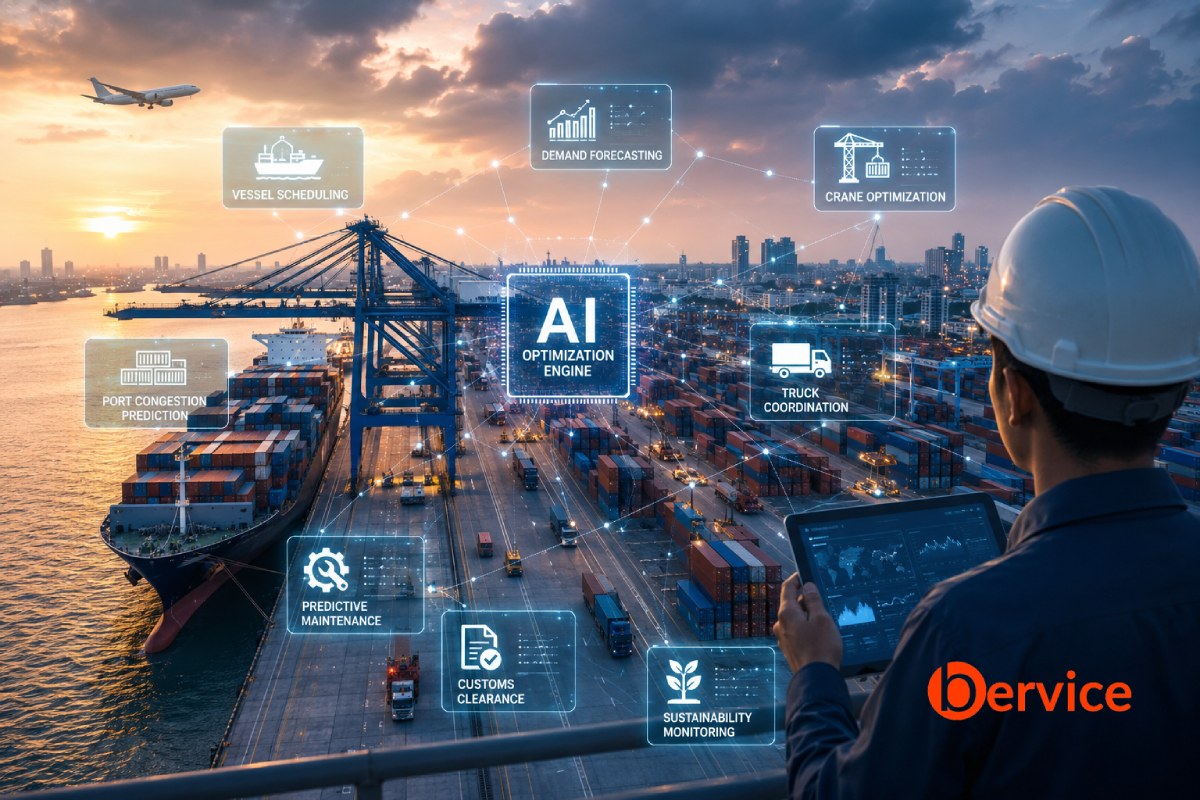
Rather than replacing logistics professionals, AI acts as a real time optimization engine that continuously evaluates thousands of possible decisions.
Predictive Port Congestion
One of AI’s biggest advantages is forecasting congestion before it occurs.
Instead of reacting after queues form, AI analyzes:
- Satellite data
- AIS vessel tracking
- Weather forecasts
- Historical arrival patterns
- Crane productivity
- Container yard occupancy
- Labor availability
The system predicts where congestion will emerge hours or even days in advance.
Port operators can then:
- Reschedule arrivals
- Adjust staffing
- Reassign cranes
- Redirect vessels
- Prepare storage capacity
Small adjustments made early prevent massive delays later.
Smarter Berth Allocation
Assigning ships to berths may appear straightforward.
In reality, it resembles solving thousands of simultaneous optimization problems.
AI evaluates:
- Vessel size
- Cargo type
- Draft limitations
- Crane compatibility
- Expected unloading time
- Connecting transportation schedules
Instead of using static scheduling rules, machine learning continuously updates the optimal assignment as new information arrives.
The result is:
- Higher berth utilization
- Less waiting time
- Faster vessel turnaround
- Increased port capacity without building new infrastructure
AI Powered Crane Scheduling
Container cranes are among the most valuable assets in a port.
Poor scheduling leaves expensive equipment idle while ships wait offshore.
AI dynamically determines:
- Which crane should unload which container
- Loading sequence
- Container destination priority
- Equipment availability
- Operator assignments
The goal is minimizing unnecessary crane movement while maximizing throughput.
Seconds saved per container translate into hours saved per vessel.
Autonomous Yard Operations
Once containers leave a ship, they must move through storage yards efficiently.
AI coordinates:
- Automated Guided Vehicles (AGVs)
- Autonomous trucks
- Robotic container movers
- Smart stacking systems
Instead of following fixed routes, AI recalculates optimal movement in real time.
This reduces:
- Traffic inside ports
- Fuel consumption
- Waiting times
- Equipment idle periods
Predictive Maintenance
Unexpected equipment failures create expensive bottlenecks.
AI continuously monitors:
- Crane motors
- Hydraulic systems
- Conveyor belts
- Refrigerated container systems
- Trucks
- Rail equipment
By analyzing sensor data, AI detects early warning signs long before a component fails.
Maintenance becomes proactive instead of reactive.
Benefits include:
- Less downtime
- Lower repair costs
- Improved safety
- Higher equipment availability
AI in Warehouse Management
Warehouses are becoming increasingly intelligent.
AI predicts:
- Inventory demand
- Product movement
- Seasonal spikes
- Picking routes
- Storage allocation
Rather than storing products wherever space exists, AI places inventory where it minimizes future movement.
This significantly increases warehouse efficiency.
Demand Forecasting Across the Entire Supply Chain
Traditional forecasting relies on historical sales.
Modern AI incorporates far more signals:
- Market trends
- Economic indicators
- Weather
- Consumer behavior
- Social media activity
- Promotions
- Manufacturing output
- Shipping activity
Forecasts become significantly more accurate.
Companies reduce:
- Overstocking
- Stock shortages
- Emergency shipping
- Inventory costs
Customs and Documentation
International shipping generates enormous volumes of paperwork.
AI assists customs authorities by:
- Automatically validating documents
- Detecting inconsistencies
- Identifying fraudulent declarations
- Prioritizing high risk shipments
- Accelerating low risk cargo clearance
Processing that once required hours can often be completed in minutes.
Digital Twins for Entire Ports
One of the most exciting developments is the creation of AI powered digital twins.
A digital twin is a real time virtual model of an entire port.
It simulates:
- Every ship
- Every crane
- Every truck
- Every warehouse
- Every container
- Every weather event
Operators can test thousands of possible scenarios before making real world decisions.
This dramatically improves planning accuracy.
Multi Agent AI Coordination
The next evolution goes beyond individual AI models.
Instead, multiple specialized AI agents collaborate.
One agent manages:
- Vessel arrivals
Another manages:
- Crane scheduling
Another optimizes:
- Truck dispatch
Another forecasts:
- Weather impact
Another predicts:
- Customs delays
Together they continuously negotiate optimal decisions across the entire logistics ecosystem.
This distributed intelligence mirrors how modern supply chains actually operate.
Sustainability Benefits
AI also supports environmental goals.
Better planning means:
- Less vessel idling
- Fewer unnecessary truck trips
- Lower fuel consumption
- Reduced emissions
- Optimized energy usage
- More efficient cargo handling
As environmental regulations tighten, AI becomes an important sustainability tool.
Challenges That Still Remain
Despite impressive progress, AI is not a complete solution.
Several obstacles remain:
Data Quality
AI depends on accurate, real time operational data.
Incomplete or inconsistent data reduces performance.
Legacy Infrastructure
Many ports still operate decades old software systems that are difficult to integrate.
Cybersecurity
As ports become increasingly connected, protecting critical infrastructure becomes essential.
Human Collaboration
AI recommendations still require experienced operators who understand local conditions and unexpected events.
The future is human expertise enhanced by intelligent systems, not human expertise replaced by them.
The Future of Global Logistics
The next generation of supply chains will not simply move goods faster.
They will make smarter decisions continuously.
Artificial Intelligence is transforming ports from reactive transportation hubs into intelligent decision making ecosystems.
Every arriving ship, every container movement, every warehouse operation, and every transportation route becomes part of a continuously optimized network.
Companies that embrace AI will reduce costs, increase resilience, improve sustainability, and deliver products more reliably.
Those that continue relying on traditional planning methods risk falling behind in a world where speed, visibility, and adaptability define competitive advantage.
Conclusion
Artificial Intelligence has already entered the global supply chain, and its influence is expanding rapidly across ports, shipping, warehousing, and logistics. Rather than replacing existing infrastructure, AI enhances it by improving coordination, predicting disruptions, and optimizing decisions at every stage of the journey.
The ports of the future will not necessarily be larger. They will be smarter.
In an increasingly interconnected world, competitive advantage will belong not to the ports that move the most cargo, but to those that can make the best decisions, at the right time, with the help of Artificial Intelligence.
Connect with us : https://linktr.ee/bervice
Website : https://bervice.com