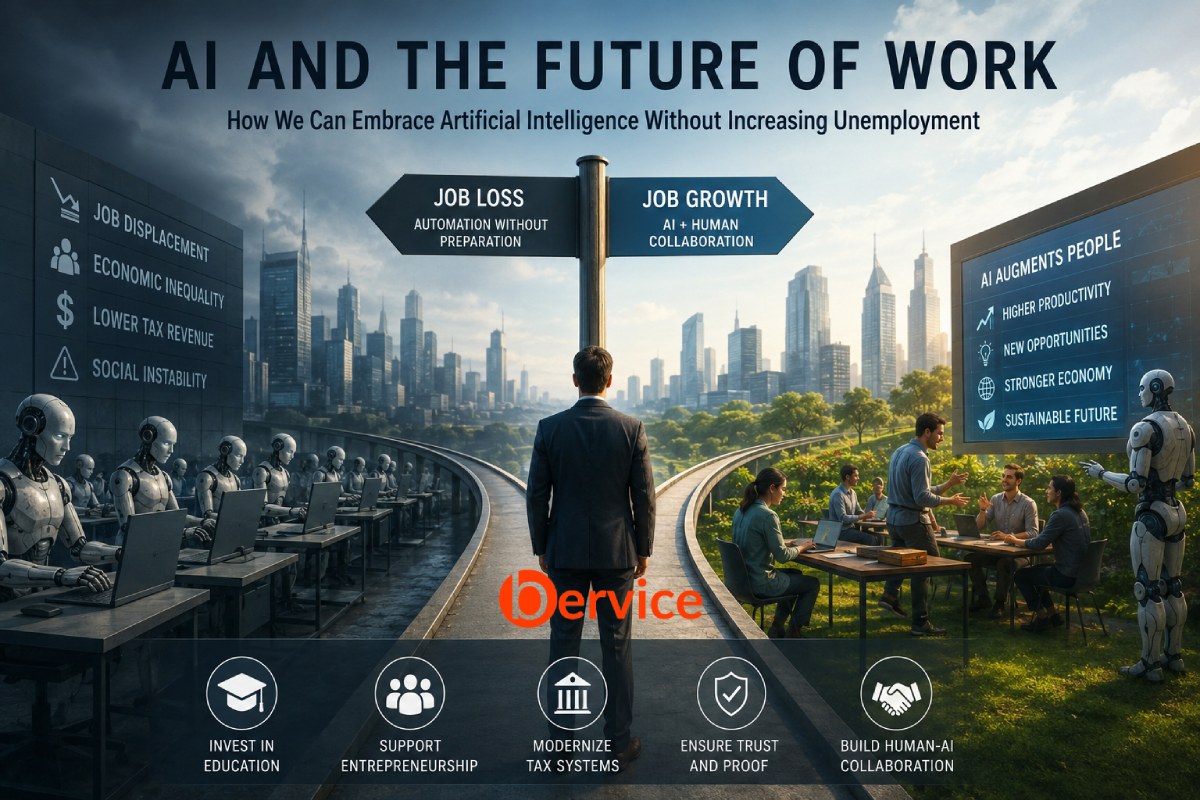
Artificial Intelligence is no longer a future technology. It is rapidly becoming part of everyday business operations, government services, healthcare, education, logistics, software development, manufacturing, and customer support.
This transformation promises extraordinary gains in productivity. Yet it also raises one of the biggest economic questions of the century:
Can society embrace AI without creating widespread unemployment?
The answer is more complex than many headlines suggest.
The real challenge is not whether AI will replace jobs.
It is whether governments, businesses, and workers can redesign the economy quickly enough to keep people economically productive while AI performs an increasing share of routine work.
Why Governments Are More Concerned Than Ever
When discussions focus on AI replacing employees, the conversation usually centers on workers.
Governments, however, worry about something much larger.
Modern governments rely heavily on employment because employment generates taxes.
When millions of people work, governments receive revenue from:
- Personal income tax
- Payroll taxes
- Employer contributions
- Consumption taxes driven by salaries
- Corporate taxes supported by consumer spending
If AI dramatically reduces the number of human workers, every part of this cycle weakens.
Lower employment can mean:
- Reduced tax revenue
- Lower consumer spending
- Greater demand for welfare programs
- Increased income inequality
- Slower economic growth
In other words, employment is not only a social issue.
It is the financial engine of modern governments.
Is Mass Unemployment Inevitable?
History provides reasons for both optimism and caution.
The Industrial Revolution eliminated many manual jobs but created entirely new industries.
The internet automated countless tasks while generating software, cybersecurity, digital marketing, cloud computing, and e-commerce.
However, AI differs in one important way.
Previous technologies mainly replaced physical labor.
AI increasingly replaces cognitive work.
It can now write reports, generate software, analyze legal documents, diagnose diseases, create videos, translate languages, design products, and assist scientific research.
This means AI competes with both blue-collar and white-collar professions simultaneously.
The speed of change may exceed society’s ability to adapt if no action is taken.
The Bigger Risk Is Not Job Loss
Ironically, unemployment itself may not become the biggest problem.
The larger issue could be economic concentration.
AI systems are expensive to build, requiring enormous computing infrastructure, data, specialized talent, and capital.
If only a handful of organizations own the world’s most powerful AI systems, productivity gains may become concentrated among very few companies.
That creates several risks:
- Wealth concentration
- Reduced competition
- Smaller tax bases
- Less entrepreneurial opportunity
- Greater dependence on AI monopolies
The challenge is therefore not only protecting jobs.
It is ensuring that AI creates opportunity rather than concentrating economic power.
Can AI Increase Employment Instead?
Yes.
But only if society changes how it introduces AI.
Instead of replacing people, AI should first augment people.
This means using AI to make workers significantly more productive rather than eliminating their positions.
Examples include:
- A software engineer completing projects twice as fast.
- A doctor diagnosing patients more accurately.
- A teacher providing personalized education.
- A factory technician monitoring hundreds of machines simultaneously.
- A lawyer reviewing thousands of contracts within minutes.
In these cases, AI becomes a productivity multiplier rather than a human replacement.
The Next Economy Needs Human-AI Collaboration
The future workforce may consist of three categories:
Humans
Providing creativity, judgment, ethics, leadership, empathy, negotiation, and accountability.
AI Agents
Handling repetitive analysis, automation, optimization, and information processing.
Human-AI Teams
Where people supervise multiple AI systems that complete specialized tasks.
Rather than one employee doing all the work, one professional may coordinate several AI assistants.
This shifts work from execution toward decision making.
Governments Must Modernize Their Tax Systems
If AI dramatically changes labor markets, taxation must evolve as well.
Potential approaches being discussed worldwide include:
Taxing Higher Corporate Productivity
Companies benefiting enormously from AI-driven efficiency could contribute more through corporate taxation rather than payroll taxes alone.
Encouraging AI Adoption Without Penalizing Hiring
Governments can reward organizations that use AI to increase employee productivity instead of reducing headcount.
Investing in Lifelong Education
Continuous reskilling may become as important as traditional education.
Workers will likely need multiple career transitions throughout their lives.
Supporting Entrepreneurship
Lower barriers for starting businesses can help workers become AI-powered creators rather than displaced employees.
The New Jobs AI Will Create
While some occupations decline, entirely new categories are emerging.
Examples include:
- AI Operations Managers
- Prompt Engineers
- AI Safety Specialists
- AI Auditors
- AI Governance Consultants
- AI Ethics Officers
- Human-AI Workflow Designers
- AI Trainers
- Synthetic Data Engineers
- AI Compliance Experts
- Digital Identity Specialists
- Proof Verification Professionals
Many of these roles barely existed a few years ago.
The challenge is helping today’s workforce transition toward tomorrow’s opportunities.
Proof Will Become More Valuable Than Labor Alone
As AI becomes capable of generating text, code, images, music, and even scientific research, proving human expertise becomes increasingly important.
Future hiring may depend less on degrees and resumes.
Instead, employers may seek verifiable evidence of real skills, authentic experience, trustworthy identity, and measurable achievements.
This shift could create entirely new industries around digital trust, verification, and proof based credentials.
Ironically, one of AI’s greatest economic contributions may be increasing the value of verified human capability.
Businesses Have a Responsibility
Organizations should not measure AI success solely by reducing payroll.
A healthier metric is:
“How much more value can every employee create using AI?”
Companies that invest in people alongside AI are more likely to build resilient cultures, retain institutional knowledge, and sustain long-term innovation.
Technology succeeds when it amplifies human potential rather than simply replacing it.
Conclusion
Artificial Intelligence does not automatically lead to mass unemployment.
Neither does it automatically create prosperity.
The outcome depends on decisions made today by governments, businesses, educators, and society.
If AI is introduced primarily as a cost-cutting tool, unemployment, inequality, and declining tax revenues may become serious challenges.
If AI is introduced as a productivity partner while education, taxation, entrepreneurship, and verification systems evolve alongside it, society can unlock unprecedented economic growth without leaving millions behind.
The future is not a choice between humans and AI.
It is a choice between an economy that replaces people and one that empowers them.
The countries that understand this distinction first will not only lead the AI revolution but will define the economic model of the twenty first century.
Connect with us : https://linktr.ee/bervice
Website : https://bervice.com