Introduction
The digital world is experiencing exponential growth in both data generation and the demand for trust. Traditional centralized systems for storing and sharing information often face challenges such as single points of failure, censorship risks, and escalating costs. To address these issues, three powerful technologies—Blockchain, InterPlanetary File System (IPFS), and Advanced Cryptography—are converging to create a secure, decentralized, and future-proof digital infrastructure.
Blockchain: The Foundation of Trust
Blockchain is a distributed ledger technology that ensures transparency, immutability, and consensus without the need for centralized intermediaries. Each transaction or data entry is recorded on a tamper-resistant chain of blocks, validated by nodes within the network. This decentralized trust model has already transformed industries such as finance, supply chains, and governance. When combined with other technologies, blockchain becomes more than a transactional system—it becomes the backbone for secure digital ecosystems.
IPFS: Redefining Data Storage and Access
While blockchain secures transactions, it is not efficient for storing large volumes of data. This is where IPFS (InterPlanetary File System) steps in. IPFS is a peer-to-peer protocol that distributes files across a network, using content-based addressing instead of traditional location-based URLs. Instead of relying on a centralized server, users retrieve data from multiple peers simultaneously, ensuring redundancy, censorship resistance, and higher efficiency. When integrated with blockchain, IPFS allows immutable records to point to decentralized storage, combining permanent trust with scalable data handling.
Advanced Cryptography: The Security Layer
To ensure privacy, authenticity, and resilience, advanced cryptographic techniques play a central role. From zero-knowledge proofs (ZKPs), which allow verification without revealing sensitive information, to post-quantum cryptography (PQC), which safeguards data against future quantum threats, these innovations ensure that both blockchain and IPFS remain robust against evolving cyber risks. Cryptographic tools also enable encrypted file sharing on IPFS, secure key management, and smart contracts with privacy-preserving features.
The Power of Integration
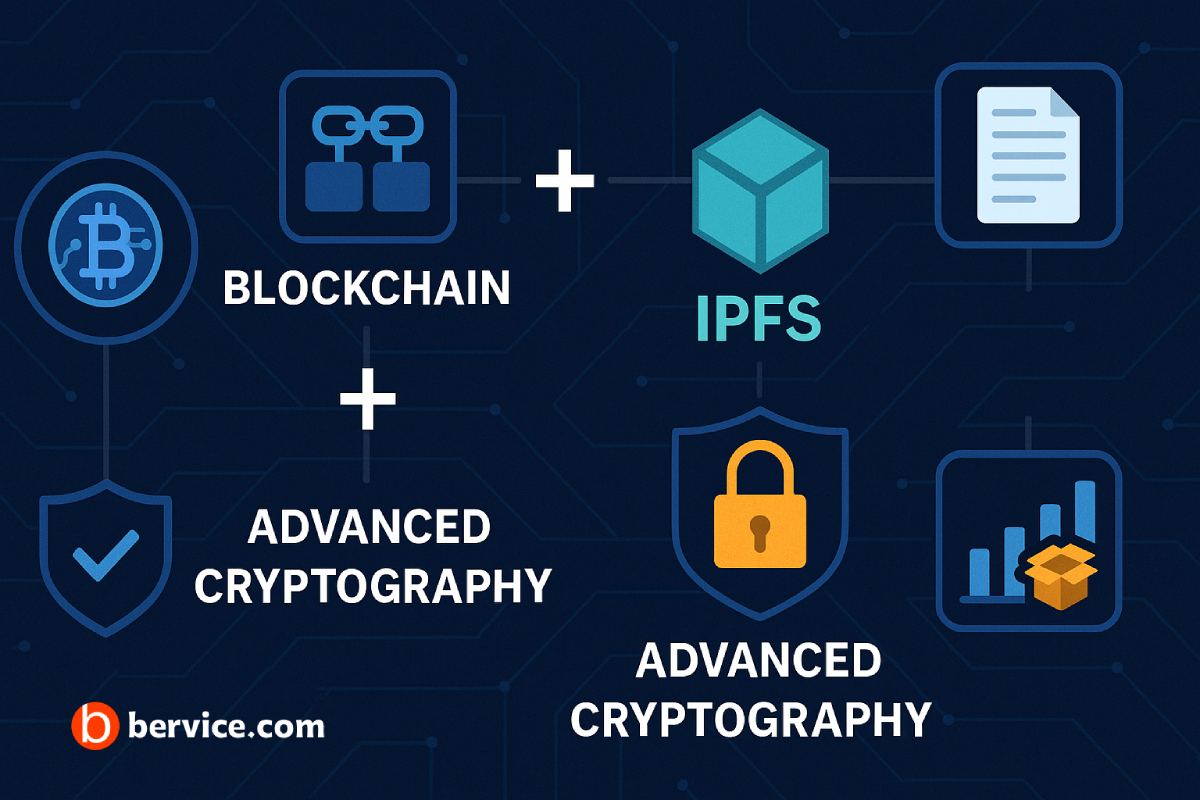
When blockchain, IPFS, and advanced cryptography converge, they create a synergistic ecosystem:
- Blockchain provides the immutable ledger of events and transactions.
- IPFS handles decentralized, efficient, and censorship-resistant data storage.
- Advanced cryptography ensures privacy, secure access, and long-term protection against quantum computing risks.
This triad can power use cases such as decentralized identity systems, tamper-proof archives, secure communication platforms, and even the foundation of a “quantum-safe internet.”
Real-World Applications
- Healthcare – Secure storage of medical records on IPFS with access logs verified by blockchain, protected with encryption.
- Supply Chain – Immutable blockchain records link to verifiable documents stored on IPFS, ensuring product authenticity.
- Decentralized Cloud Storage – Users can store files across a global network with encryption and access control, avoiding vendor lock-in.
- Digital Governance – Transparent voting systems where ballots are stored on IPFS, validated by blockchain, and encrypted for voter privacy.
Future Outlook
As adoption grows, the convergence of these technologies could lead to a new era of decentralized internet infrastructure. By addressing the challenges of centralization, data security, and trust, the blockchain–IPFS–cryptography triad paves the way for resilient digital economies, privacy-first communication, and long-term data preservation. With the rise of quantum computing and the growing demand for sovereignty over data, this integration will likely form the foundation of the next-generation web.
Conclusion
The combination of blockchain, IPFS, and advanced cryptography is not just a technological innovation—it is a paradigm shift. Together, they offer a path toward a secure, decentralized, and censorship-resistant digital ecosystem. As organizations and individuals increasingly seek trustworthy solutions in an uncertain digital landscape, this convergence stands as a blueprint for building the future of digital infrastructure.
Connect with us : https://linktr.ee/bervice