Introduction
Modern organizations face an increasingly complex challenge: managing teams, projects, deadlines, and workflows efficiently. As businesses grow and remote work becomes more common, coordinating tasks across multiple team members can quickly become overwhelming. Traditional project management methods often rely heavily on manual planning, status updates, and human oversight, which can lead to delays, communication gaps, and reduced productivity.
Artificial Intelligence (AI) is transforming this landscape by introducing automation, intelligent decision making, predictive analytics, and real time collaboration support. Rather than replacing project managers or team leaders, AI acts as a powerful assistant that enhances efficiency and enables teams to focus on high value work.
This article explores how AI is accelerating teamwork task management and reshaping the future of collaboration.
1. Intelligent Task Creation and Assignment
One of the most time consuming aspects of project management is creating and assigning tasks. AI can automatically analyze project requirements, meeting notes, emails, and conversations to generate tasks without manual input.
For example, after a project meeting, AI can:
- Identify action items
- Create tasks automatically
- Assign responsibilities to appropriate team members
- Set deadlines based on project timelines
By reducing administrative work, teams can begin executing tasks immediately instead of spending valuable time organizing them.
2. Smart Prioritization of Work
Not all tasks are equally important. Many teams struggle with prioritization, leading to wasted effort on low impact activities.
AI can evaluate:
- Project urgency
- Business impact
- Team workload
- Dependencies between tasks
- Historical project data
Using these factors, AI can recommend which tasks should be completed first and which can be postponed.
This helps organizations focus resources on activities that deliver the greatest value.
3. Automated Progress Tracking
Project managers often spend hours collecting updates from team members and generating reports.
AI can continuously monitor:
- Task completion status
- Team activity
- Project milestones
- Communication channels
- Code repositories
- Documentation updates
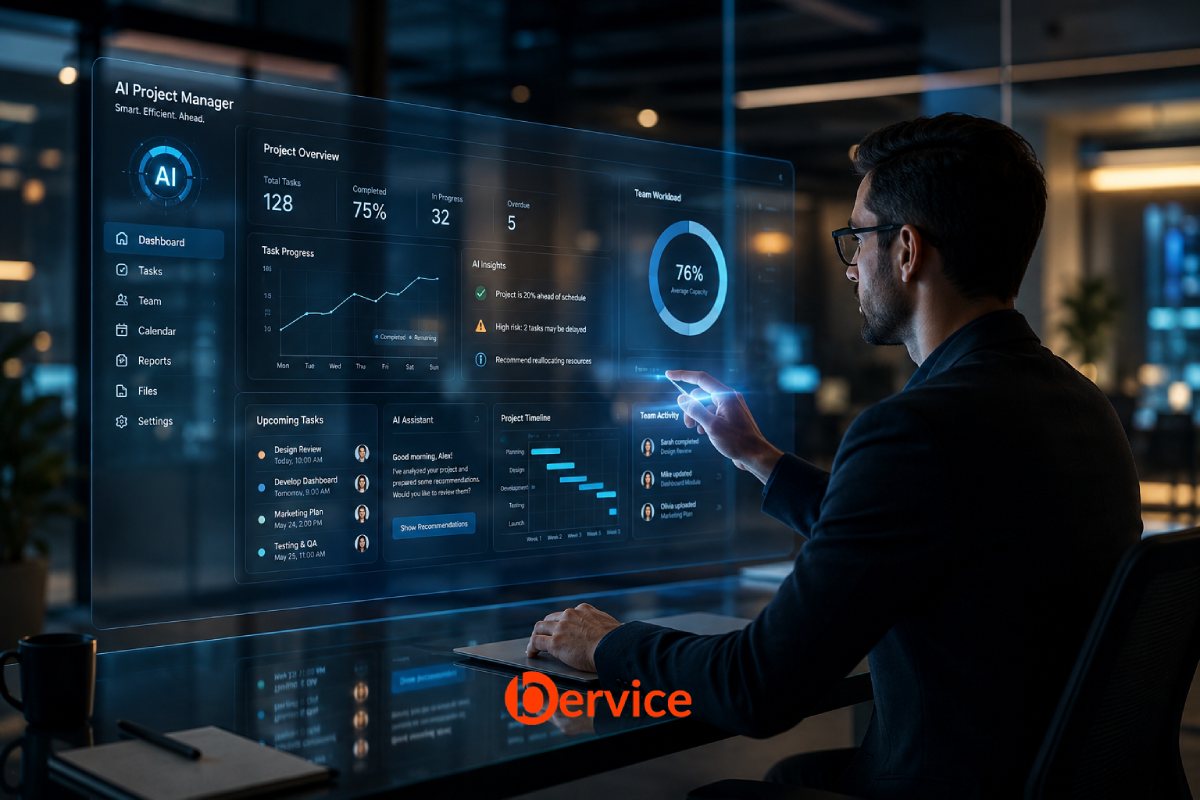
Instead of requesting manual reports, AI can provide real time dashboards and progress summaries, ensuring everyone stays informed without additional administrative burden.
4. Predictive Project Planning
Traditional project planning is largely based on estimation and experience. AI introduces data driven forecasting.
By analyzing previous projects, AI can predict:
- Expected completion dates
- Potential bottlenecks
- Resource shortages
- Budget risks
- Team performance trends
This predictive capability allows managers to identify problems before they occur and take corrective action proactively.
5. Enhanced Team Communication
Communication issues are among the most common causes of project delays.
AI powered collaboration tools can:
- Summarize meetings automatically
- Generate action items
- Translate conversations between languages
- Highlight important discussions
- Detect unanswered messages
- Suggest relevant information
As a result, teams spend less time searching for information and more time executing tasks.
6. Workload Balancing and Resource Optimization
Uneven workload distribution can lead to employee burnout while other team members remain underutilized.
AI can analyze:
- Individual capacity
- Current workload
- Skills and expertise
- Availability
- Performance history
Based on these insights, tasks can be redistributed automatically to ensure optimal utilization across the team.
This improves both productivity and employee satisfaction.
7. Risk Detection and Early Warning Systems
Many projects fail because risks are discovered too late.
AI systems can continuously monitor project indicators and identify warning signs such as:
- Delayed task completion
- Increased error rates
- Missed milestones
- Resource conflicts
- Communication breakdowns
Managers receive alerts before these issues escalate into major problems.
This proactive approach significantly improves project success rates.
8. Knowledge Management and Information Retrieval
Large organizations generate vast amounts of knowledge that often becomes difficult to access.
AI powered knowledge systems can instantly retrieve:
- Previous project documentation
- Technical specifications
- Team discussions
- Best practices
- Company policies
Instead of spending hours searching through documents, team members can receive precise answers within seconds.
This dramatically accelerates decision making and execution.
9. AI Powered Personal Assistants for Team Members
Modern AI assistants can function as digital teammates.
They can:
- Schedule meetings
- Manage calendars
- Send reminders
- Draft emails
- Generate reports
- Answer project related questions
- Track deadlines
This reduces repetitive work and allows employees to focus on strategic and creative activities.
10. Continuous Improvement Through Learning
Unlike traditional management systems, AI continuously improves over time.
As it observes team behavior, project outcomes, and workflow patterns, it learns:
- Which processes are most effective
- Which bottlenecks occur frequently
- Which team structures perform best
This enables organizations to optimize operations continuously and become more efficient with every project.
The Future of AI Driven Teamwork
The next generation of project management platforms will evolve from simple task tracking tools into intelligent collaboration ecosystems.
Future AI systems will be capable of:
- Predicting project outcomes with high accuracy
- Automatically adjusting project plans
- Coordinating multi team initiatives
- Managing resources dynamically
- Acting as virtual project managers
Human leaders will focus on strategy, innovation, and relationship building while AI handles operational complexity.
Conclusion
Artificial Intelligence is revolutionizing teamwork task management by automating routine processes, improving decision making, enhancing communication, and providing predictive insights. Organizations that embrace AI driven collaboration tools gain significant advantages in productivity, efficiency, and project success.
Rather than replacing human teams, AI empowers them to work smarter, collaborate more effectively, and achieve goals faster than ever before. As AI technology continues to evolve, its role in task management will become increasingly central to the future of work, enabling organizations to operate at levels of speed and coordination that were previously impossible.
Connect with us : https://linktr.ee/bervice
Website : https://bervice.com