The Biggest Shift Since Cloud Computing
For the past two decades, Software as a Service (SaaS) has dominated the software industry.
Every business function became a separate application.
CRM.
ERP.
HR.
Accounting.
Project Management.
Marketing.
Customer Support.
Whenever a company needed a new capability, it purchased another SaaS subscription.
This model created trillion dollar companies and transformed how organizations operate.
But a new question is emerging.
What happens when software no longer needs humans as the primary user?
The rise of autonomous AI agents is forcing the software industry to rethink one of its oldest assumptions.
Perhaps the future is not people using software.
Perhaps the future is software using software.
And that changes everything.
SaaS Was Built Around Human Interfaces
Traditional SaaS products are designed for people.
Humans log in.
Humans click buttons.
Humans search.
Humans fill forms.
Humans copy information between systems.
Humans make decisions.
Every improvement in SaaS over the last twenty years has focused on making these interactions faster and more intuitive.
Better dashboards.
Cleaner interfaces.
Simpler workflows.
Mobile apps.
Dark mode.
Custom reports.
But an AI agent doesn’t care about beautiful dashboards.
It doesn’t need animations.
It doesn’t need menus.
It doesn’t need onboarding tutorials.
It only needs access to capabilities.
The graphical interface that humans love may become irrelevant for software operated primarily by software.
The Real Product Is No Longer the Interface
Imagine asking your AI assistant:
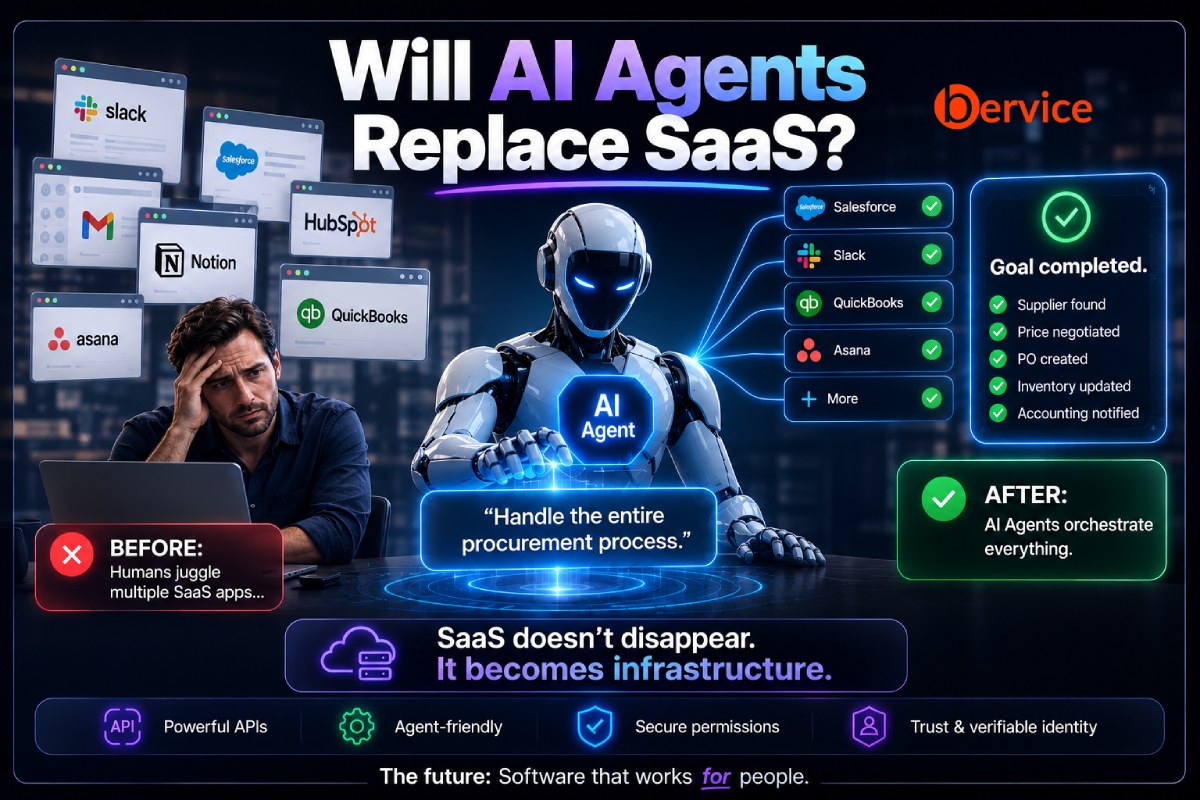
“Find the best supplier, negotiate pricing, prepare the purchase order, send it for approval, update inventory, and notify accounting.”
Today this workflow might involve:
- Procurement software
- Excel
- ERP
- Slack
- Accounting software
- Inventory software
A human manually moves between every application.
In the future, an AI agent could orchestrate every step automatically.
The human simply defines the goal.
The agent executes the workflow.
Notice something important.
The user never opens most of those applications.
The applications still exist.
But they disappear behind the agent.
SaaS Doesn’t Disappear
It Becomes Infrastructure.
This distinction is critical.
Many headlines claim:
“AI will kill SaaS.”
That is probably the wrong conclusion.
Electricity didn’t eliminate factories.
The internet didn’t eliminate businesses.
Cloud computing didn’t eliminate software.
Each became infrastructure.
SaaS may follow the same path.
Instead of being the destination, SaaS becomes the engine underneath intelligent agents.
Companies will still need:
- Databases
- Payment processing
- Inventory management
- Authentication
- Compliance
- Analytics
- Storage
The difference is who interacts with them.
Humans less.
Agents more.
APIs Become More Valuable Than Interfaces
For years companies competed on user experience.
Tomorrow they may compete on machine experience.
Questions will change from:
“Is the dashboard beautiful?”
to
“Can an agent complete every workflow using the API?”
This means the quality of an API becomes more important than the quality of the UI.
Fast APIs.
Reliable APIs.
Well documented APIs.
Permission management.
Machine readable semantics.
Secure authentication.
The companies that expose the best capabilities to agents may gain a significant competitive advantage.
Every SaaS Application Becomes a Tool
Think about how humans use tools.
A carpenter doesn’t admire a hammer.
He uses it to complete a larger task.
Agents will treat SaaS products the same way.
CRM becomes a customer data tool.
Accounting software becomes a financial execution tool.
Email becomes a communication tool.
Calendar becomes a scheduling tool.
Maps become a navigation tool.
Translation becomes a language tool.
Image generation becomes a creative tool.
Each application becomes one capability inside a much larger autonomous workflow.
The Rise of Agent Operating Systems
Today’s operating systems organize files and applications.
Future operating systems may organize intelligent agents.
Instead of launching software manually, users may launch specialized agents.
- A Sales Agent.
- A Research Agent.
- A Finance Agent.
- A Legal Agent.
- A Marketing Agent.
Each agent dynamically selects whichever SaaS platforms provide the required capabilities.
The user no longer thinks about software vendors.
They think about outcomes.
SaaS Vendors Face a New Challenge
Historically, SaaS companies optimized for customer acquisition.
Now they must optimize for agent adoption.
Questions every software company should ask include:
- Can an AI discover our capabilities automatically?
- Can an AI authenticate securely?
- Can an AI understand our documentation?
- Can an AI recover from errors?
- Can an AI chain multiple operations together?
- Can an AI explain results back to humans?
Companies that ignore these questions risk becoming invisible, even if their products remain technically excellent.
The New Competitive Battlefield
- Traditionally, software competed on features.
- Tomorrow software may compete on how well agents can use those features.
- This creates entirely new performance metrics.
- Agent compatibility.
- Task completion rate.
- Workflow automation score.
- Machine readability.
- Semantic interoperability.
- Autonomous reliability.
- Human usability will remain important.
- But it may no longer be sufficient.
The Winners Will Be Invisible
The most successful software companies of the next decade may not have the most attractive interfaces.
They may have the most dependable infrastructure.
Think about cloud providers today.
Millions of users never directly interact with them.
Yet they power much of the digital economy.
Future SaaS platforms may evolve similarly.
Invisible.
Reliable.
Programmable.
Always available.
A New Business Model Emerges
If agents become the primary users of software, pricing models could also change.
Instead of charging per human seat, vendors may charge for:
Task executions.
API calls.
Autonomous workflows.
Business outcomes.
Verified transactions.
Completed negotiations.
Generated revenue.
The shift from seat based pricing to outcome based pricing could fundamentally reshape software economics.
What Happens to Employees?
This transition is not about replacing people with software.
It is about replacing repetitive coordination with autonomous execution.
Employees spend countless hours:
Moving data.
Updating systems.
Searching information.
Copying documents.
Sending reminders.
Following up.
Checking status.
Most of this work creates little strategic value.
AI agents can absorb much of this operational overhead, allowing humans to focus on creativity, leadership, relationships, judgment, ethics, and innovation.
Organizations become leaner, faster, and more adaptive.
Trust Will Become the Missing Layer
As agents gain authority to purchase, negotiate, approve, transfer funds, or access sensitive systems, trust becomes essential.
Organizations will need answers to questions such as:
Which agent initiated this action?
Who authorized it?
Was the decision within policy?
Was the identity verified?
Can every action be audited?
Can responsibility be assigned?
Without trustworthy identity, authorization, and auditability, autonomous businesses cannot scale safely.
This is where verifiable digital identity, cryptographic proof, secure authorization, and transparent governance become foundational components of the future software ecosystem.
The next generation of software will not only need to be intelligent.
It will also need to be trustworthy.
The Future Is Not “No SaaS”
The future is “SaaS Without Friction.”
Applications do not disappear.
They become building blocks.
Interfaces become optional.
APIs become primary.
Humans become supervisors.
Agents become operators.
Software shifts from being something we use to something that works on our behalf.
The companies that recognize this transition early will not merely survive the AI era.
They will define it.
Conclusion
Will AI agents destroy SaaS?
Probably not.
But they will radically transform it.
The software industry has experienced several major evolutions:
Mainframes.
Personal computers.
The internet.
Cloud computing.
Mobile applications.
Autonomous agents may represent the next great platform shift.
The question is no longer whether SaaS will continue to exist.
The real question is whether SaaS companies are prepared for a world where their most important customers are no longer humans, but intelligent agents acting on behalf of humans.
In that future, the winners will not simply build better software.
They will build software that other intelligent software wants to use.
Connect with us : https://linktr.ee/bervice
Website : https://bervice.com