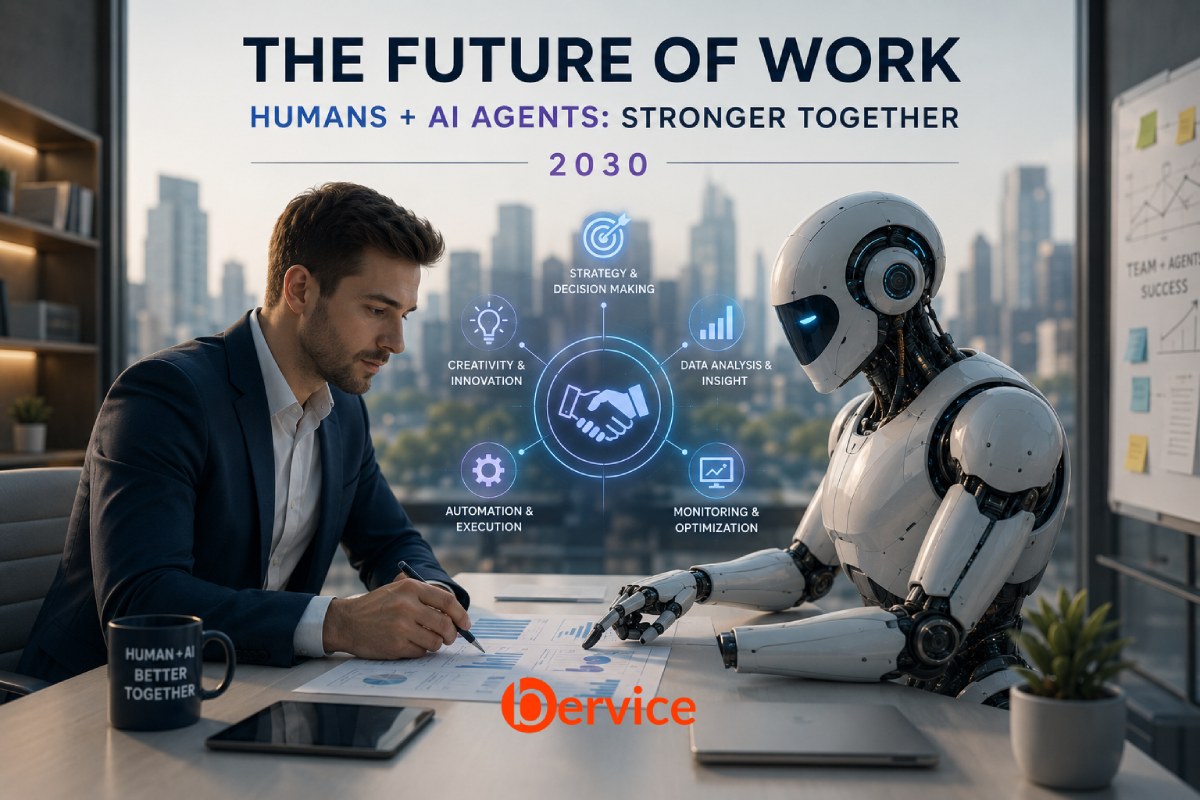
Rethinking the Organization of 2030
For years, headlines have predicted the same future:
” AI will replace workers.”
“Companies won’t need employees anymore.”
“One founder will build a billion-dollar company with AI.”
These predictions generate attention, but they oversimplify what is actually happening.
The companies that will dominate the next decade are unlikely to eliminate humans. Instead, they will redesign work around a new kind of workforce where people and intelligent AI agents collaborate continuously.
The future of organizations is not human versus AI.
It is human plus AI.
Welcome to the organizational model of 2030.
The Biggest Shift Since the Internet
The internet transformed communication.
Cloud computing transformed infrastructure.
Smartphones transformed accessibility.
Artificial intelligence is transforming execution.
For the first time in history, companies can assign meaningful operational tasks to digital entities capable of reasoning, planning, learning, communicating, and acting with minimal supervision.
These digital coworkers are becoming AI Agents.
Unlike traditional software, agents are not passive tools waiting for commands.
They actively:
- plan tasks
- gather information
- communicate with systems
- make recommendations
- coordinate workflows
- monitor outcomes
- improve over time
They become participants in work rather than applications.
Employees Are No Longer Working Alone
Today’s organizations are structured around human teams.
Marketing teams.
Engineering teams.
Finance teams.
Support teams.
By 2030, every department is likely to include AI teammates operating alongside humans.
Imagine a product manager.
Instead of manually coordinating ten people, that manager may supervise:
- a research agent
- a customer feedback agent
- a market intelligence agent
- a competitor monitoring agent
- a roadmap planning agent
- a reporting agent
The human remains responsible for vision, priorities, judgment, and accountability.
The agents handle continuous execution.
The Rise of Hybrid Teams
The future organization will not distinguish work by job title alone.
Instead, work will be distributed between humans and agents according to their strengths.
Humans excel at:
- creativity
- leadership
- empathy
- ethics
- negotiation
- innovation
- relationship building
- strategic thinking
- handling ambiguity
AI Agents excel at:
- speed
- repetition
- monitoring
- data synthesis
- documentation
- searching
- analysis
- process automation
- operating 24/7
Neither replaces the other.
Together, they create capabilities neither could achieve independently.
Every Employee May Become a Team Leader
One of the biggest organizational changes is that every knowledge worker may eventually supervise multiple AI agents.
An engineer might manage:
- a code review agent
- a testing agent
- a documentation agent
- a deployment agent
A lawyer might work with:
- a contract analysis agent
- a compliance monitoring agent
- a legal research agent
A salesperson could direct:
- a prospecting agent
- a CRM updating agent
- a proposal generation agent
- a meeting preparation agent
Managing agents may become as fundamental a professional skill as managing email is today.
New Departments Will Emerge
Organizations in 2030 may introduce roles that barely exist today.
Examples include:
Chief Agent Officer (CAO)
Responsible for the organization’s AI workforce, governance, and performance.
Agent Operations Team
Designs, deploys, and monitors internal AI agents.
Agent Security Team
Protects agents against prompt injection, manipulation, data leakage, and unauthorized actions.
Agent Training Specialists
Improve agent behavior using company knowledge and operational feedback.
Human-Agent Experience Designers
Optimize collaboration between employees and intelligent systems.
Entire operational functions may be dedicated to managing digital workers.
Organizational Charts Will Change Forever
Traditional organizational charts are built around people.
CEO
↓
Vice Presidents
↓
Managers
↓
Employees
The 2030 organizational chart may look very different.
CEO
↓
Human Leadership
↓
Hybrid Teams
↓
Human Specialists + AI Agent Networks
↓
Autonomous Operational Agents
Instead of hierarchy alone, organizations will become intelligent networks where humans orchestrate thousands of specialized digital workers.
Measuring Productivity Will Be Redefined
Today’s performance metrics focus on individual output.
Tomorrow’s metrics may evaluate something entirely different.
Instead of asking:
“How productive is this employee?”
Organizations may ask:
- How effectively does this employee manage AI agents?
- How efficiently do their agents collaborate?
- How reliable are agent outcomes?
- How much value is created per human decision?
- How quickly can human and agent teams solve new problems?
The best professionals may not be those who work the hardest.
They may be those who build the most effective human-agent systems.
Leadership Will Evolve
Managers today coordinate people.
Managers tomorrow will coordinate ecosystems.
Leadership will increasingly involve:
- assigning work between humans and agents
- validating AI decisions
- balancing automation with human oversight
- resolving conflicts between agent recommendations
- ensuring ethical decision making
- protecting customer trust
Leadership becomes less about controlling work and more about designing intelligent collaboration.
Trust Becomes the Foundation
As organizations delegate more responsibility to AI agents, trust becomes a competitive advantage.
Companies must answer difficult questions.
Who approved an AI decision?
Which agent generated this recommendation?
Can the reasoning be audited?
Who is accountable if an autonomous process fails?
Transparency, governance, and verification will become essential parts of every AI-enabled organization.
The most successful companies will not simply deploy more AI.
They will deploy AI that people trust.
Skills That Matter in 2030
Technical expertise will remain valuable.
But a new category of skills will become equally important.
Professionals who thrive in hybrid organizations will know how to:
- design AI workflows
- supervise intelligent agents
- verify AI outputs
- communicate with AI effectively
- audit automated decisions
- combine human creativity with machine execution
The future workforce is not just AI literate.
It is AI collaborative.
The Companies That Win
History suggests that major technological shifts rarely eliminate people.
Instead, they change how people create value.
Factories did not remove managers.
Computers did not eliminate accountants.
The internet did not eliminate marketers.
Likewise, AI agents are unlikely to eliminate organizations built around human expertise.
Instead, they will transform those organizations into faster, more adaptive, and more intelligent systems.
The companies that succeed will not be those with the fewest employees.
They will be those where every employee is amplified by an ecosystem of capable AI agents.
Final Thoughts
The future is not a world where humans disappear from work.
It is a world where every professional works alongside intelligent digital teammates.
By 2030, the most valuable organizations may no longer measure success by the size of their workforce.
Instead, they will measure how effectively humans and AI agents collaborate to create innovation, solve complex problems, and deliver trusted outcomes.
The next generation of companies will not be human organizations.
Nor will they be AI organizations.
They will be Human-Agent Organizations, where intelligence is shared, execution is accelerated, and the greatest competitive advantage comes not from replacing people, but from empowering them with intelligent partners.
Connect with us : https://linktr.ee/bervice
Website : https://bervice.com