Introduction
Artificial intelligence systems are rapidly moving from simple chat interfaces into infrastructure that makes decisions, analyzes documents, generates reports, searches corporate knowledge, writes software, communicates with customers, and operates autonomous agents.
This transition creates a fundamental engineering problem:
How can we determine whether an AI-generated statement is actually supported by evidence before allowing it to reach the user or another system?
Large Language Models do not operate like traditional databases. They generate sequences of tokens based on learned probability distributions. As a result, a response can be grammatically perfect, logically convincing, and completely wrong.
These failures are generally called hallucinations.
Importantly, hallucination should not be treated merely as a model problem. In production systems, it should be treated as a systems engineering problem.
The objective should therefore not be:
“Make the model never hallucinate.”
A more realistic objective is:
Build an architecture in which unsupported claims are automatically detected, verified, corrected, rejected, or clearly marked before they are trusted.
Research continues to show that hallucinations remain a fundamental challenge even as models improve. OpenAI, for example, has argued that evaluation systems themselves can encourage guessing when confident answers are rewarded more than appropriate uncertainty.
The future of reliable AI will therefore depend increasingly on what happens around the model, not only inside it.
1. First Principle: Treat AI Output as Untrusted Data
One of the most important architectural changes is conceptual.
Do not treat:
LLM Response
as:
Final Answer
Treat it as:
Candidate Answer
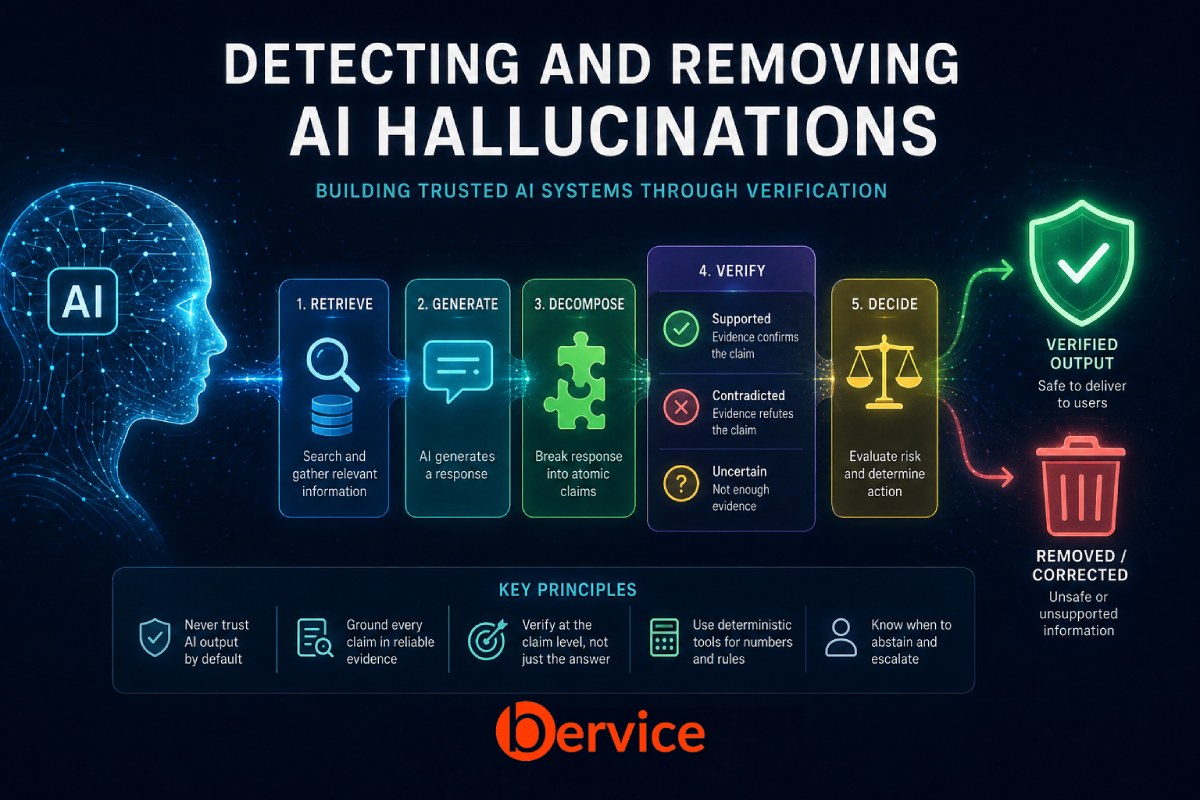
The architecture becomes:
User Request
      ↓
Information Retrieval
      ↓
LLM Generation
      ↓
Claim Extraction
      ↓
Verification
      ↓
Confidence / Risk Evaluation
      ↓
Correction or Rejection
      ↓
Final Answer
This creates a trust boundary between generation and publication.
The model generates language.
The system determines whether that language deserves to be trusted.
2. Hallucination Is Not One Problem
Before building a detector, we need to distinguish different failure modes.
Factual hallucination
The model invents a fact.
Example:
“Company X was founded in 2014.”
The correct year might be 2017.
Source hallucination
The model invents a source, URL, paper, regulation, document section, or citation.
This is particularly dangerous because citations make incorrect information appear more credible.
Recent research evaluating academic-style generations found that reference hallucinations can persist even when systems are explicitly instructed to provide citations, demonstrating why references themselves must be programmatically verified.
Context hallucination
The model provides information that might be generally correct but is unsupported by the context supplied to it.
This is especially important for enterprise RAG systems.
Reasoning hallucination
The input facts are correct, but the model reaches an invalid conclusion.
Temporal hallucination
The model presents outdated information as current.
Examples include prices, regulations, company executives, software versions, market information, or political positions.
Entity hallucination
The model invents a person, product, API endpoint, database column, software function, or organization.
Numerical hallucination
The model incorrectly calculates or combines numbers.
Different hallucination classes require different verification mechanisms.
There is no universal hallucination detector that can reliably solve every category.
3. The Core Architecture: Generate, Verify, Then Publish
A robust AI architecture can use three logical layers.
GENERATION LAYER
       ↓
VERIFICATION LAYER
       ↓
DECISION LAYER
The generation layer produces candidate information.
The verification layer determines whether individual claims have evidence.
The decision layer determines what happens to unsupported claims.
This separation is critical because asking the same model:
“Are you sure?”
is not a strong verification strategy.
The model may simply confirm its original mistake.
More recent research is exploring deliberately separated verifier architectures. For example, MARCH uses different agents to generate, decompose, and independently check claims, specifically attempting to reduce self-confirmation effects.
4. Atomic Claim Extraction
The first technical step after generation should often be claim decomposition.
Suppose the AI generates:
“Tesla was founded in 2003, is headquartered in Austin, and delivered more than 1.8 million vehicles in 2023.”
This sentence contains multiple independently verifiable claims.
The system should convert it into something like:
[
  {
    "claim": "Tesla was founded in 2003",
    "type": "historical_fact"
  },
  {
    "claim": "Tesla is headquartered in Austin",
    "type": "company_fact"
  },
  {
    "claim": "Tesla delivered more than 1.8 million vehicles in 2023",
    "type": "numerical_fact"
  }
]
Each claim can now be independently verified.
This matters because sentence-level verification can hide partial errors.
A sentence containing four correct facts and one fabricated fact is still unsafe.
5. Evidence Retrieval
Once claims have been extracted, the system must locate evidence.
Possible evidence sources include:
- internal databases
- company documents
- knowledge graphs
- APIs
- search engines
- scientific databases
- regulatory databases
- verified web sources
- vector databases
- structured datasets
This is where Retrieval-Augmented Generation, or RAG, becomes important.
Instead of asking:
LLM → What is the answer?
we move toward:
Question
   ↓
Retrieve Evidence
   ↓
LLM
   ↓
Evidence-Grounded Answer
But RAG alone does not eliminate hallucinations.
The model can still misunderstand retrieved documents, combine unrelated passages, extrapolate beyond the evidence, or fabricate details that were never retrieved.
Therefore retrieval must be followed by verification.
6. Claim-to-Evidence Verification
For every atomic claim, the system asks:
Does the retrieved evidence actually support this claim?
A verifier can classify claims as:
SUPPORTED
CONTRADICTED
INSUFFICIENT_EVIDENCE
For example:
{
  "claim": "Product X supports 48V input",
  "status": "SUPPORTED",
  "evidence": "datasheet_page_17",
  "confidence": 0.97
}
Another claim might produce:
{
  "claim": "Product X supports 60V input",
  "status": "CONTRADICTED",
  "confidence": 0.99
}
Or:
{
  "claim": "Product X has military certification",
  "status": "INSUFFICIENT_EVIDENCE",
  "confidence": 0.91
}
The last category is extremely important.
Absence of evidence should not automatically become evidence of truth or falsehood.
7. Evidence Entailment
A stronger verifier should not merely check whether a source contains similar words.
It should determine whether the evidence entails the claim.
Suppose the evidence says:
“The battery normally operates for approximately eight hours.”
The AI claims:
“The battery is guaranteed to operate for eight hours.”
Keyword similarity is extremely high.
But the claims are not equivalent.
A semantic verifier should recognize the difference between:
approximately
and:
guaranteed
This is why simple embedding similarity cannot serve as a hallucination detector by itself.
8. Citation Verification
If the system generates citations, every citation should itself be treated as data requiring verification.
The system can automatically check:
Does the document exist?

Does the URL exist?

Does the cited page exist?

Does the cited paragraph contain the information?

Does the source actually support the claim?

Is the publication metadata correct?
For academic systems, references can additionally be checked against databases such as Crossref, OpenAlex, PubMed, DOI registries, or arXiv.
Automated cross-database verification has already been used experimentally to identify invalid LLM-generated references.
A citation should therefore not automatically increase trust.
A verified citation should.
9. Cross-Model Verification
Another technique is to separate generation and verification across different models.
For example:
Model A
Generator

      ↓

Model B
Claim Extractor

      ↓

Model C
Evidence Verifier
The verifier should preferably receive:
Claim + Evidence
rather than the generator’s entire reasoning process.
This reduces the possibility that the verifier simply follows the generator’s framing.
Different model families can also be used when independence is important.
10. Multi-Sample Consistency
Another useful signal is response consistency.
Ask the model the same factual question several times using controlled sampling.
Suppose five outputs produce:
Answer 1 → 1987
Answer 2 → 1987
Answer 3 → 1991
Answer 4 → 1987
Answer 5 → 2002
The disagreement is itself useful information.
SelfCheckGPT demonstrated this general principle: hallucinated or weakly known facts tend to show greater inconsistency across sampled generations than well-supported knowledge.
However:
Consistency does not prove truth.
A model can consistently repeat the same misconception.
Consistency should therefore be a risk signal, not final verification.
11. Uncertainty Detection
The system can combine several signals to estimate hallucination risk.
Possible signals include:
Retrieval relevance
Evidence entailment
Cross-model agreement
Sampling consistency
Citation validity
Source reliability
Numerical validation
Schema validation
Model confidence signals
Domain-specific rules
Conceptually:
HallucinationRisk =
    f(
      EvidenceSupport,
      RetrievalQuality,
      ModelAgreement,
      SourceQuality,
      Consistency,
      RuleValidation
    )
This produces something more useful than a vague “AI confidence score.”
12. Build a Hallucination Risk Score
Imagine assigning every claim a score between 0 and 1.
0.00 = strongly verified
1.00 = extremely likely unsupported
For example:
Claim A → 0.03
Claim B → 0.12
Claim C → 0.74
Claim D → 0.96
The application can establish policies.
0.00 - 0.20
Automatically publish

0.20 - 0.50
Additional verification

0.50 - 0.80
Regenerate using evidence

0.80 - 1.00
Reject or escalate
The exact thresholds cannot safely be universal. They should be calibrated against the application’s own evaluation dataset and the cost of false acceptance versus false rejection.
A medical system should clearly have different acceptance criteria from a movie recommendation system.
13. The Verification Cascade
Running expensive verification on every sentence can become costly.
A more scalable design uses a cascade.
LLM Output
    ↓
Cheap Checks
    ↓
Suspicious?
   /      \
 NO       YES
 ↓         ↓
Pass    Evidence Search
           ↓
       Still uncertain?
          /      \
        NO       YES
        ↓         ↓
      Pass    Strong Verifier
                  ↓
              Final Decision
Cheap verification might include:
- schema validation
- URL validation
- database lookup
- numerical constraints
- retrieval similarity
- duplicate detection
Expensive verification can then be reserved for suspicious claims.
This architecture reduces latency and inference cost.
14. Structured Outputs Make Hallucinations Easier to Detect
Free-form text is difficult to validate.
Structured output is significantly easier.
Instead of:
The customer probably qualifies for the premium plan.
generate:
{
  "decision": "eligible",
  "evidence_ids": [
    "policy_18",
    "customer_record_772"
  ],
  "confidence": 0.93
}
The application can validate:
Is "eligible" an allowed value?

Does policy_18 exist?

Does customer_record_772 exist?

Do those records support eligibility?
Structured generation transforms hallucination detection from a purely linguistic problem into a partially deterministic software-validation problem.
15. Deterministic Tools Should Override Generative Knowledge
LLMs should not perform tasks that deterministic systems can perform more reliably.
Examples:
Calculation → calculator

Currency conversion → exchange-rate API

Customer balance → database

Weather → weather API

Inventory → inventory database

Current regulation → authoritative source

Software version → package registry

Date calculation → deterministic code
The principle is simple:
Use generation for language. Use authoritative systems for facts whenever possible.
The fewer factual decisions delegated entirely to the model, the smaller the hallucination surface becomes.
16. Source Trust Scoring
Not all retrieved evidence deserves equal weight.
Imagine two sources:
Official government database
Random anonymous forum post
Semantic similarity alone might rank the forum result higher.
A production verifier should therefore consider:
authority
freshness
provenance
document version
domain
publication date
source independence
The architecture becomes:
Claim
 ↓
Evidence Search
 ↓
Evidence Ranking
 ↓
Source Trust Evaluation
 ↓
Entailment Verification
This is particularly important when web retrieval is enabled.
Retrieval can reduce hallucinations, but malicious or unreliable retrieved content introduces a different problem: the model can become confidently grounded in bad evidence.
17. Numerical Verification
Numbers deserve their own verification pipeline.
Suppose the model says:
“Revenue increased from $8.2M to $10.1M, representing a 28.4% increase.”
The system should not trust the percentage simply because the model generated it.
Extract:
{
  "old_value": 8.2,
  "new_value": 10.1,
  "claimed_growth": 28.4
}
Then calculate the growth deterministically.
If the generated number disagrees with the calculated result, reject or correct the claim.
Financial, engineering, analytics, and scientific AI systems benefit enormously from this approach.
18. Knowledge Graph Verification
For domains with structured knowledge, knowledge graphs provide another powerful verification layer.
Suppose the model generates:
Person A → CEO_OF → Company B
The system can query a trusted graph.
If the relationship does not exist, the claim receives additional scrutiny.
Knowledge graphs are especially useful for:
- organizational relationships
- products
- medical ontologies
- scientific entities
- supply chains
- regulatory relationships
19. Constraint-Based Verification
Many hallucinations violate known system constraints.
For example:
battery_capacity > physical_maximum

employee_start_date < company_creation_date

invoice_total != sum(line_items)

temperature < absolute_zero

API_function not in allowed_function_registry
These do not require another LLM.
They require rules.
Production AI should combine:
Probabilistic Verification
+
Deterministic Verification
The second category is frequently cheaper and more reliable.
20. Automatic Regeneration
Detecting hallucination is only half the problem.
The system needs a recovery mechanism.
Instead of deleting the entire answer immediately:
Generate
 ↓
Verify
 ↓
Unsupported Claim
 ↓
Retrieve Better Evidence
 ↓
Regenerate Claim
 ↓
Verify Again
For example:
Generation attempt #1
Evidence support = 0.42

Retrieve additional documents

Generation attempt #2
Evidence support = 0.89

Verification

Publish
This creates a self-correcting generation loop.
21. Selective Removal
Sometimes regeneration is unnecessary.
Suppose an answer contains ten claims:
9 verified
1 unsupported
The system can remove only the unsupported sentence.
This produces:
Original Answer
      ↓
Claim Extraction
      ↓
Verification
      ↓
Unsupported Claim Removal
      ↓
Coherence Rewrite
      ↓
Final Answer
However, the final rewrite should itself be checked to ensure that it did not introduce new claims.
22. Abstention Is a Feature
One of the strongest anti-hallucination mechanisms is allowing the system to refuse to guess.
Instead of forcing an answer:
No evidence
     ↓
Guess
use:
No evidence
     ↓
Abstain
Possible responses include:
“The available sources do not contain enough information to answer this reliably.”
or:
“I could not verify this claim.”
This principle aligns with recent work arguing that AI evaluation should penalize confident errors more strongly and reward appropriate uncertainty rather than forcing models to guess.
23. A Production Architecture
A mature system might therefore look like this:
                 USER
                   ↓
            Query Analyzer
                   ↓
             Risk Classifier
                   ↓
           Evidence Retriever
                   ↓
             Reranker
                   ↓
              Generator
                   ↓
          Claim Decomposer
                   ↓
        ┌──────────┼──────────┐
        ↓          ↓          ↓
     Source     Numerical   Semantic
     Checker     Checker    Verifier
        ↓          ↓          ↓
        └──────────┼──────────┘
                   ↓
          Hallucination Scorer
                   ↓
              Policy Engine
                   ↓
        ┌──────────┼──────────┐
        ↓          ↓          ↓
      PASS       RETRY      REJECT
                   ↓
            Better Retrieval
                   ↓
             Regeneration
This is substantially safer than:
User → LLM → User
24. High-Risk Systems Need Verification Gates
Not every AI application needs the same level of verification.
For creative writing, hallucination may not even be relevant.
For systems involving:
medicine
finance
law
industrial control
engineering
security
regulation
scientific research
the verification threshold should be significantly higher.
A high-risk architecture might enforce:
No verified evidence
=
No factual answer
This is a hard verification gate.
25. Human Review Should Be Risk-Based
Human review remains valuable, but sending everything to humans destroys scalability.
Instead:
Low Risk
→ automatic publication

Medium Risk
→ additional automated verification

High Risk
→ human review

Critical Risk
→ block
Humans become the final escalation layer rather than the first verification mechanism.
26. Monitor Hallucinations in Production
Hallucination detection should not end when the system launches.
Every production response can generate telemetry such as:
{
  "request_id": "req_9281",
  "claims": 12,
  "verified_claims": 10,
  "unsupported_claims": 2,
  "retrieval_quality": 0.81,
  "hallucination_risk": 0.19,
  "regeneration_attempts": 1
}
Teams can monitor:
Hallucination Rate

Unsupported Claim Rate

Citation Failure Rate

Retrieval Failure Rate

Verifier False Positive Rate

Verifier False Negative Rate

Abstention Rate

Regeneration Success Rate

Human Escalation Rate
This turns hallucination from an anecdotal complaint into an observable engineering metric.
27. Build a Hallucination Evaluation Dataset
One of the most important investments is creating a domain-specific benchmark.
Collect real questions from your application and label outputs:
SUPPORTED

PARTIALLY_SUPPORTED

UNSUPPORTED

CONTRADICTED

UNVERIFIABLE
Include difficult examples deliberately:
missing information
ambiguous questions
outdated documents
conflicting documents
fake citations
numerical traps
similar entity names
incorrect assumptions
adversarial prompts
Then measure every architecture change against the same benchmark.
Without such a benchmark, teams often believe hallucination improved when they merely changed its form.
28. Do Not Use One LLM Judge as Ground Truth
LLM-as-a-judge systems are useful, but they should not become the sole authority.
A verifier model can hallucinate too.
Therefore:
Generator ≠ Truth

Verifier ≠ Truth
Truth should ideally come from evidence.
The strongest architecture is closer to:
Generator
   ↓
Verifier
   ↓
Evidence
   ↓
Deterministic Checks
   ↓
Policy
Research increasingly explores multi-stage verification precisely because a single evaluator can inherit or reproduce model errors.
29. Pre-Generation Detection
An emerging direction goes even further.
Instead of asking:
“Did the model hallucinate?”
systems attempt to estimate:
“Is the model likely to hallucinate if we let it answer this question?”
If risk is high, the system can retrieve additional information before generation.
Recent work such as FACTCHECKMATE has explored detecting hallucination risk from internal model representations before generation finishes, reporting improvements in factuality after intervention.
This leads toward:
Question
 ↓
Hallucination Risk Prediction
 ↓
Low Risk ─────────→ Generate
 ↓
High Risk
 ↓
Retrieve Evidence
 ↓
Constrained Generation
This could eventually be more efficient than always correcting hallucinations after they occur.
30. The Ideal Architecture: Evidence-First Generation
Ultimately, the safest architecture may invert the conventional process.
Traditional AI:
Question
 ↓
Generate Answer
 ↓
Try to Verify
Evidence-first AI:
Question
 ↓
Identify Required Claims
 ↓
Find Evidence
 ↓
Determine What Can Be Known
 ↓
Generate Only From Verified Evidence
 ↓
Verify Again
 ↓
Answer
This dramatically changes the model’s role.
The LLM is no longer the source of truth.
It becomes an interface between verified information and humans.
31. Why “Eliminating” Hallucinations Completely Is the Wrong Goal
No general-purpose probabilistic language model should currently be assumed to have a guaranteed zero hallucination rate.
Research and industry experience continue to show that hallucinations can be reduced substantially, but not reliably eliminated across arbitrary open-ended tasks.
Therefore, engineering around hallucination is more realistic than expecting a perfect model.
The objective becomes:
Detect
↓
Verify
↓
Correct
↓
Abstain
↓
Escalate
rather than:
Trust
32. From AI Models to AI Trust Infrastructure
The larger lesson extends beyond hallucination.
Future AI systems will likely consist of two major infrastructures:
Generation Infrastructure
+
Trust Infrastructure
Generation infrastructure answers:
“What should the AI produce?”
Trust infrastructure answers:
“Why should anyone believe it?”
Trust infrastructure can include:
provenance
evidence
citations
verification
confidence calibration
policy enforcement
audit trails
human escalation
This distinction will become increasingly important as AI agents gain access to financial systems, databases, infrastructure, corporate software, and real-world actions.
Conclusion
Hallucination cannot be solved reliably with a single prompt such as:
“Do not hallucinate.”
Nor should a production system depend entirely on asking the model to double-check itself.
The stronger approach is architectural.
Build systems where AI output is treated as an untrusted candidate until it passes verification.
A robust pipeline looks like:
Retrieve
   ↓
Generate
   ↓
Decompose into Claims
   ↓
Retrieve Evidence
   ↓
Verify Each Claim
   ↓
Check Sources
   ↓
Validate Numbers and Rules
   ↓
Calculate Risk
   ↓
Correct / Regenerate / Abstain
   ↓
Publish
The most important shift is therefore not simply from smaller models to larger models or from less capable AI to more capable AI.
It is the transition from:
AI that produces answers
to:
AI systems that can produce evidence for why their answers should be trusted.
In the next generation of AI products, generation quality alone will not be enough.
The competitive advantage will increasingly come from the verification layer surrounding the model.
Because the most valuable AI system will not necessarily be the one that always has an answer.
It will be the one that knows which answers are safe to trust.
Connect with us : https://linktr.ee/bervice
Website : https://bervice.com