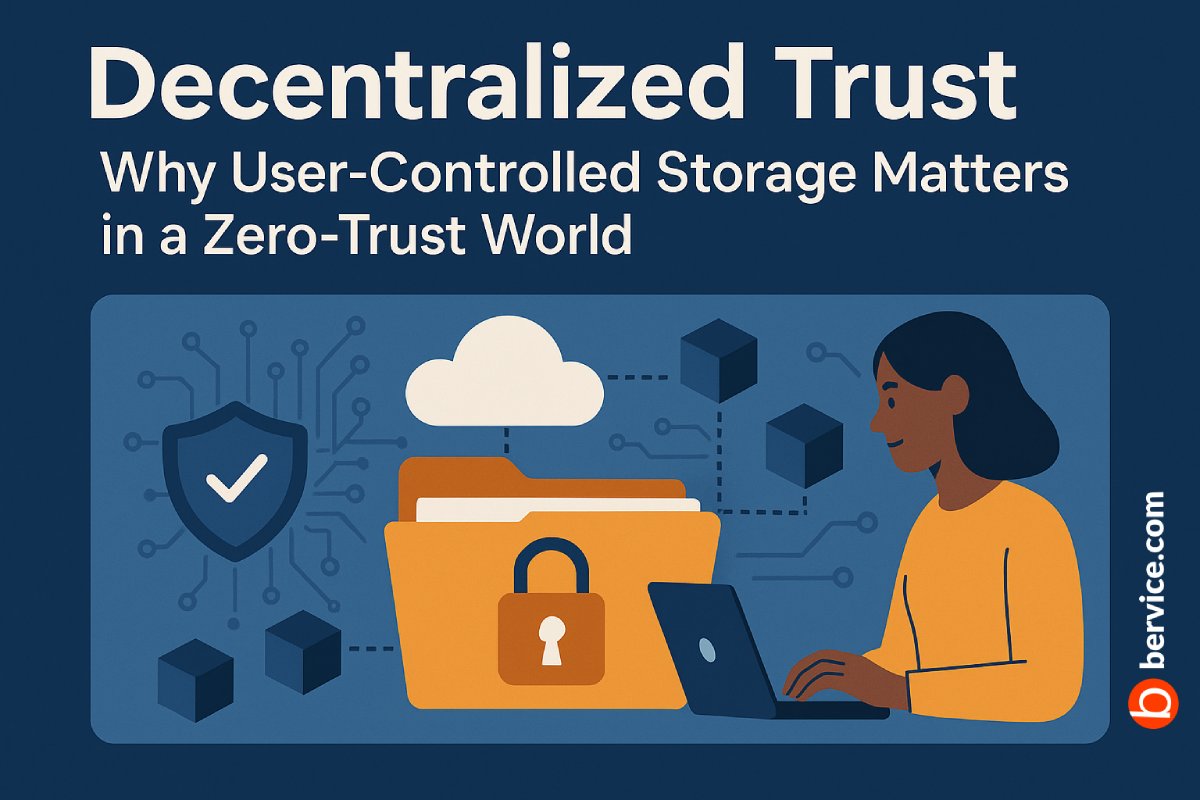
Introduction: The End of Implicit Trust
The digital world is undergoing a fundamental shift in how security is perceived. For decades, centralized platforms have acted as guardians of data, requiring users to place blind trust in corporate servers and opaque security models. However, repeated data breaches, surveillance scandals, and the looming threat of quantum computing have eroded this confidence. In this environment, the principle of Zero-Trust Architecture (ZTA) has gained traction—where no system, network, or actor is inherently trusted. Within this context, user-controlled and decentralized storage is no longer a luxury; it is a necessity.
The Flaws of Centralized Trust Models
Traditional storage solutions rely on centralized providers. Whether through cloud services or enterprise servers, these systems assume that once inside a protected perimeter, actors can be trusted. Unfortunately, this “castle-and-moat” model fails against modern threats. Insider risks, weak encryption standards, and jurisdictional vulnerabilities have proven that no centralized authority can guarantee absolute security. When trust is concentrated, it becomes a single point of failure—an irresistible target for cybercriminals and state-level attackers alike.
Zero-Trust and the Rise of Decentralization
Zero-Trust shifts the paradigm by assuming that every actor—inside or outside a system—must be verified continuously. Applied to data storage, this philosophy aligns seamlessly with decentralization. Instead of placing trust in a central server, data is distributed across multiple nodes, each independently verified and cryptographically secured. In this framework, trust is shifted away from institutions and redirected toward mathematics, protocols, and user ownership.
Why User-Controlled Storage Matters
At the heart of decentralization lies a simple but powerful principle: control must remain in the hands of the user. User-controlled storage ensures that encryption keys, access rights, and data governance never leave the individual’s control. Unlike traditional models where service providers can access, revoke, or expose data, decentralized architectures empower users to determine when, how, and with whom information is shared. This is especially critical in a Zero-Trust world, where the default assumption is that no external actor deserves implicit access.
Practical Advantages of User Sovereignty
User-controlled, decentralized storage offers multiple advantages that directly address modern risks:
- Resilience against breaches – Distributed data is far harder to compromise than centralized repositories.
- Quantum-resistant encryption – Forward-looking systems integrate cryptography that anticipates future threats.
- Censorship resistance – No single authority can unilaterally block or revoke access to user data.
- Interoperability – Decentralized protocols enable seamless movement of data across ecosystems without reliance on proprietary platforms.
- Auditability and transparency – Open, cryptographic verification replaces opaque trust in corporate promises.
The Road Ahead: From Centralization to User Sovereignty
The global shift toward Zero-Trust frameworks signals a broader recognition that digital trust must be redefined. The future belongs to systems where users hold their own keys, data is distributed across decentralized networks, and cryptographic proof replaces institutional trust. This transformation is not merely technical—it represents a cultural and philosophical movement toward digital sovereignty. As individuals reclaim control over their most valuable asset—data—society moves closer to a trustless, yet more trustworthy digital ecosystem.
Connect with us : https://linktr.ee/bervice