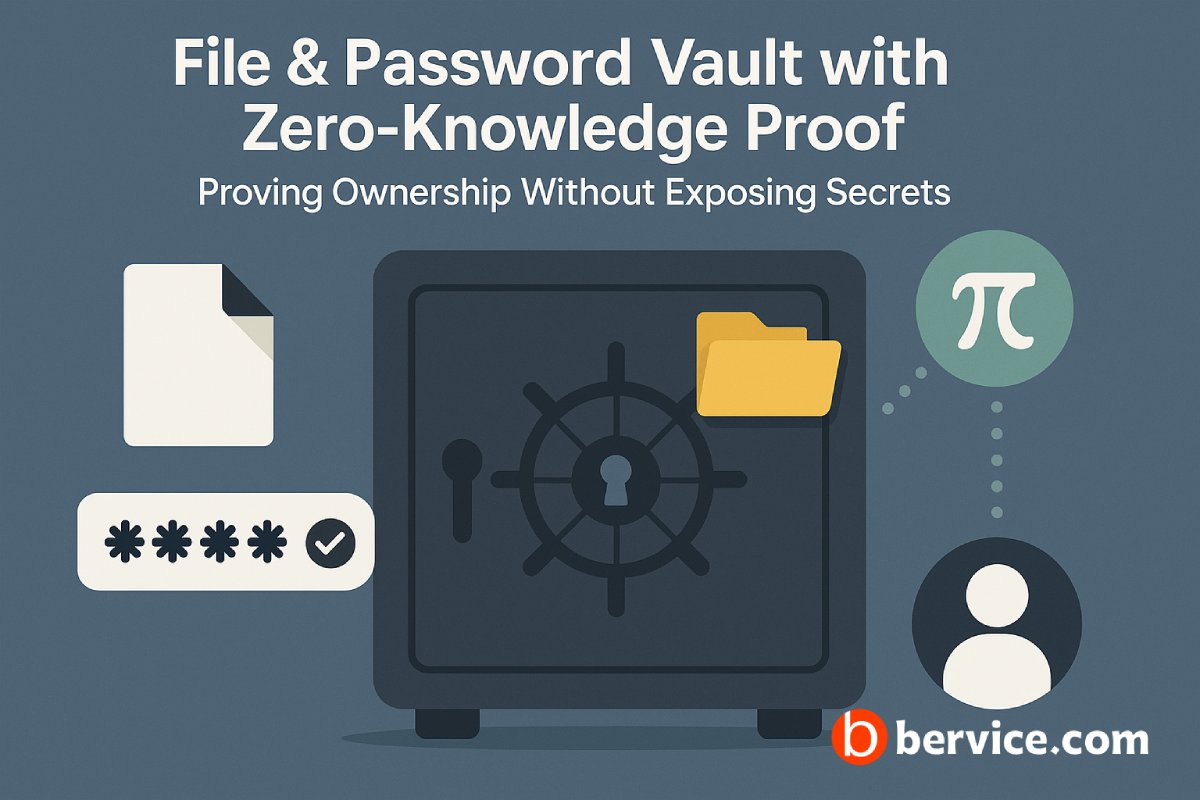
In the modern digital landscape, trust is a liability. Every time users share sensitive data to “prove” ownership, they open the door to risk — data leaks, surveillance, insider threats, and future exploitation. The traditional security model assumes “trust and verify.” But the world has changed. The next wave of security infrastructure is “don’t trust — prove.”
That’s exactly where Zero-Knowledge Proof (ZKP) integrated with decentralized storage and post-quantum encryption becomes a game-changer.
🧠 Why Ownership Without Disclosure Matters
Traditional authentication models rely on revealing something:
- A password to prove identity
- A file or document to prove ownership
- A secret key to access services
That model is fundamentally flawed. Once revealed, even to a trusted third party, the data can be stored, leaked, or intercepted. This is why modern cryptography is shifting to “proof without exposure.”
With ZKP, a user can prove they know or own a specific piece of information without ever revealing the information itself.
- You can prove ownership of a contract without sending the file.
- You can prove a password without exposing it to a server.
- You can verify a document’s authenticity without revealing its contents.
🧬 How It Works in Bervice
Bervice isn’t another encrypted drive. It’s a trustless vault built on a decentralized and quantum-resistant architecture.
- File Fingerprinting
Each file or password is transformed into a unique cryptographic commitment. This commitment is stored on decentralized infrastructure like IPFS Kubo without ever uploading the raw file. - Zero-Knowledge Proof Generation
When ownership needs to be proven, the system uses ZKP protocols (e.g., zk-SNARKs or Bulletproofs) to generate a proof derived from the secret — but not the secret itself. - Post-Quantum Encryption Layer
The secret itself is encrypted using Kyber + AES-GCM, ensuring the data remains secure even against future quantum computers. - Verification
A verifier can confirm that the proof is valid without ever learning the underlying file, password, or key. - Revocable & Portable Proofs
Unlike centralized attestations, ZK proofs are portable. A user can prove ownership across multiple platforms without relying on a single gatekeeper.
⚔️ Why Traditional Vaults Can’t Compete
Most “secure vaults” on the market:
- Store files in centralized servers.
- Use outdated encryption vulnerable to quantum attacks.
- Require exposure of secrets during verification.
This means the moment trust is broken, everything collapses.
ZKP-based systems don’t have that weak link. Even if the network is compromised, there’s nothing valuable to steal.
🌍 Real-World Applications
This technology isn’t just theoretical. It can reshape how trust is handled in:
- Legal & Contract Management: Prove you own a contract without sending it.
- Passwordless Authentication: Authenticate without revealing secrets to any server.
- Web3 Identity: Bind on-chain identities to off-chain encrypted proofs.
- Digital Ownership & IP: Prove file authorship or creation date without exposing content.
The combination of decentralized storage, ZKP, and post-quantum cryptography creates a new security primitive that traditional vault providers simply cannot replicate without tearing down their own centralized architectures.
🚀 Bervice’s Strategic Edge
The Bervice architecture is built to be:
- Serverless: No central point of failure.
- Zero-trust: No entity ever touches your raw data.
- Quantum-resistant: Future-proof cryptography baked in.
- Proof-first: Ownership is verifiable — but never revealed.
This isn’t just a better password manager or file locker.
This is a trust infrastructure for the post-trust internet.
🧭 Final Thought
In the future, ownership won’t be proven by handing over data.
It will be mathematically proven — and cryptographically unforgeable.
Bervice is not just following that future.
It’s building it.
Connect with us : https://linktr.ee/bervice