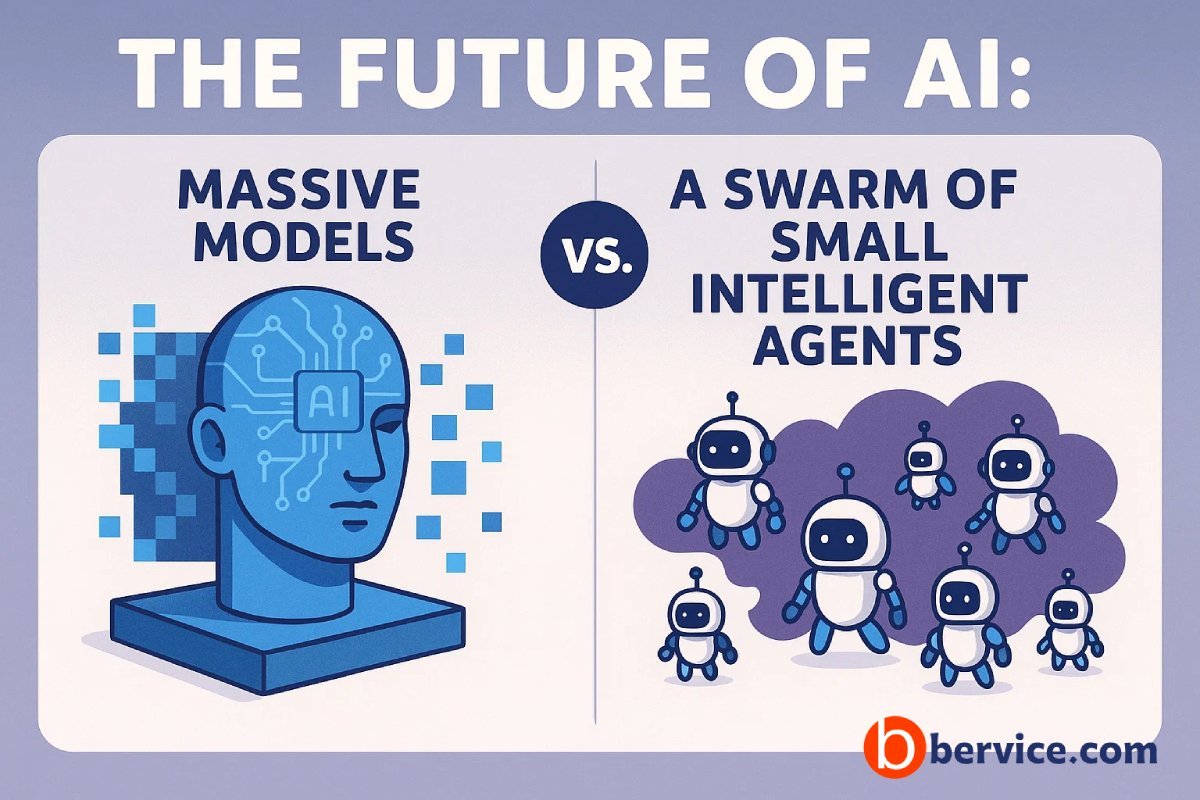
Over the past decade, artificial intelligence has experienced a seismic shift from narrow, task-specific systems to powerful general-purpose models. The rapid rise of large language models (LLMs) like GPT-4 and Claude 3 has convinced many that the future of AI belongs to a handful of massive, centralized models. But this vision is being challenged by another force: the emergence of micro-models — smaller, specialized AI systems designed to work together like an intelligent swarm.
1. The Case for Large Models: Power Through Scale
The current dominance of large language models is no accident. These systems benefit from scale effects: as the model gets bigger and is trained on more data, its ability to generalize and reason improves dramatically. A single massive model can handle translation, coding, summarization, reasoning, and even emotional interaction — all without switching contexts.
Enterprises and governments are drawn to LLMs because they:
- Centralize capabilities in a single system.
- Offer universal APIs that integrate easily.
- Provide a consistent reasoning layer across multiple domains.
However, this centralized power comes with massive costs: training and running such models requires huge amounts of compute, energy, and infrastructure. Moreover, control tends to concentrate in a few hands — raising geopolitical, economic, and ethical concerns.
2. The Micro-Model Revolution: Intelligence in the Swarm
In parallel, a different vision is emerging. Instead of one giant model, imagine millions of smaller, specialized models — each trained for a narrow task, but collectively forming a network of intelligent agents. This “micro-model” approach resembles biological systems: individual cells are simple, but together, they create complex organisms.
Advantages of micro-models include:
- Efficiency: They are cheaper to train, deploy, and update.
- Privacy & security: Can run locally on personal devices, reducing dependency on the cloud.
- Specialization: Each model can be fine-tuned to excel in its specific role.
- Resilience: A failure in one node doesn’t collapse the entire system.
This trend is visible in the growing adoption of on-device AI, agentic frameworks, and open-weight specialized models.
3. The Hybrid Future: Coordination vs. Centralization
The question isn’t “big or small” — it’s how they will coexist. LLMs are powerful generalists, but they’re not efficient for every task. Micro-models are excellent specialists, but they lack broad reasoning and context retention.
The most likely scenario is a hybrid architecture:
- A central LLM acts as an orchestrator.
- A network of micro-models executes specialized subtasks.
- Local devices handle private, low-latency actions.
- Cloud systems provide global reasoning and coordination.
This architecture mirrors how the human brain and societal systems work: centralized planning combined with distributed execution.
4. Strategic Implications: Power, Privacy, and Innovation
The shift toward micro-models has profound implications:
- Decentralization of power: Individuals and small teams can own intelligence, not just corporations.
- Edge computing growth: AI will increasingly run on smartphones, wearables, and embedded devices.
- Regulatory pressure: Governments may favor distributed systems to avoid monopolization of intelligence.
- Innovation velocity: Smaller models can be developed and iterated on faster, driving niche applications and open-source ecosystems.
At the same time, large models will remain dominant in areas requiring deep reasoning, cross-domain synthesis, and global coordination.
5. Conclusion: Intelligence Will Be Distributed
The future of AI won’t be defined by a single giant brain. It will be defined by an ecosystem of intelligence — where large models act as powerful hubs, and micro-models swarm around them, performing specialized roles.
Just as the internet evolved from a few centralized servers to a global, decentralized mesh of devices, AI will become more distributed, adaptive, and personalized. The real winners won’t be those who build the biggest model, but those who master the coordination between many intelligent agents.