Understanding the Next Evolution of Artificial Intelligence
Artificial Intelligence is rapidly transforming the way humans interact with technology. As AI systems become more capable, two terms are increasingly appearing in discussions across technology, business, and academia: Large Language Models (LLMs) and AI Agents.
Although many people use these terms interchangeably, they represent fundamentally different concepts. Understanding the distinction between them is crucial because AI is moving from systems that merely generate information to systems that can actively perform tasks, make decisions, and interact with the world.
This transition marks one of the most important shifts in the history of artificial intelligence.
What Is a Large Language Model (LLM)?
A Large Language Model is an AI system trained on massive amounts of text data to understand and generate human language.
Examples include:
- GPT models
- Claude
- Gemini
- Llama
- Mistral
An LLM’s primary purpose is prediction. Given a prompt, it predicts the most likely next word, sentence, or sequence of text.
Modern LLMs can:
- Answer questions
- Write articles
- Generate code
- Summarize documents
- Translate languages
- Explain concepts
- Analyze information
Despite their impressive capabilities, LLMs are fundamentally reactive systems.
They wait for instructions.
They do not independently pursue goals.
They do not take actions unless explicitly prompted.
In simple terms:
An LLM is a powerful reasoning and language engine, but it is not inherently an actor.
What Is an AI Agent?
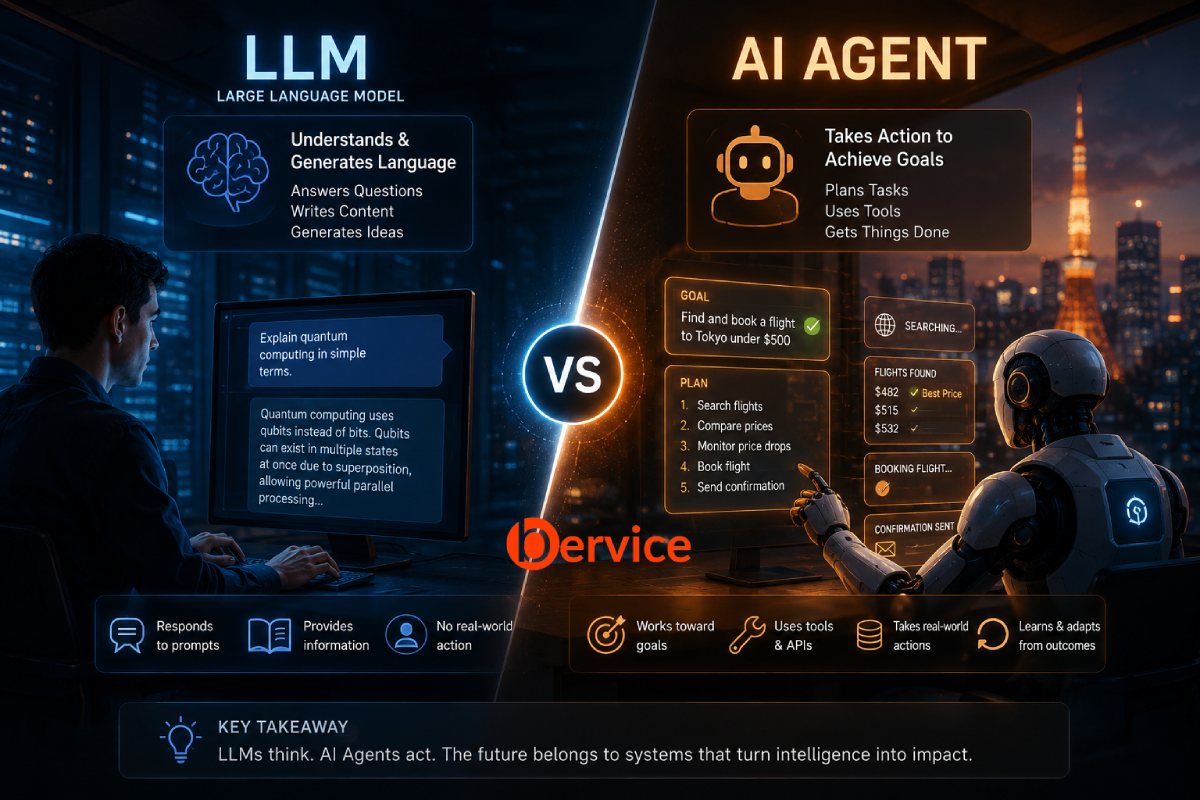
An AI Agent is a system that uses AI models, including LLMs, to achieve goals through actions.
Instead of simply responding to prompts, agents can:
- Plan tasks
- Make decisions
- Use tools
- Access databases
- Search the internet
- Execute software
- Interact with APIs
- Monitor events
- Adapt based on outcomes
An agent is designed around objectives rather than conversations.
For example:
A user may say:
“Find the cheapest flight to Tokyo next month and book it if the price drops below $500.”
An LLM alone might explain how to search for flights.
An AI Agent could:
- Search flight websites.
- Compare prices.
- Monitor changes daily.
- Notify the user.
- Complete the booking automatically.
The difference is not intelligence alone.
The difference is action.
The Core Analogy
Imagine a human expert and a human employee.
An LLM is similar to an expert consultant.
You ask a question.
The consultant provides knowledge and recommendations.
An AI Agent is similar to an employee.
You give a goal.
The employee figures out the steps and performs the work.
One provides information.
The other pursues outcomes.
Architecture Differences
LLM Architecture
A typical LLM consists of:
- Neural network
- Training data
- Prompt processing
- Text generation
The workflow is relatively simple:
Input → Reasoning → Output
Once the answer is generated, the process ends.
Agent Architecture
An AI Agent often includes:
- One or more LLMs
- Memory systems
- Planning modules
- Tool integrations
- External APIs
- Feedback loops
- Decision mechanisms
The workflow becomes:
Goal → Planning → Action → Observation → Evaluation → Next Action
This cycle can continue until the objective is achieved.
Memory: A Critical Difference
Most LLM interactions are stateless.
They focus on the current conversation context.
AI Agents frequently use persistent memory.
They can remember:
- Previous tasks
- User preferences
- Historical actions
- Long-term objectives
For example:
An LLM may forget a conversation after it ends.
An AI Agent managing your business operations may remember:
- Preferred suppliers
- Budget limits
- Customer requirements
- Project timelines
This enables continuity and long-term optimization.
Tool Usage
One of the most important differences is tool access.
An LLM can generate text describing how to use a tool.
An AI Agent can actually use the tool.
Examples include:
- Sending emails
- Running code
- Accessing databases
- Managing calendars
- Processing files
- Executing transactions
- Creating reports
Without tools, an LLM remains largely confined to language.
With tools, agents become capable of interacting with real-world systems.
Autonomy Levels
LLM
Low autonomy.
Requires constant user prompts.
Example:
“Write a report.”
The LLM writes the report.
Task complete.
AI Agent
Higher autonomy.
Can determine what needs to happen next.
Example:
“Prepare a market analysis.”
The agent may:
- Gather data
- Analyze competitors
- Create charts
- Draft conclusions
- Deliver the final report
All with minimal human intervention.
Why Agents Are Becoming So Important
The next phase of AI is not about generating better answers.
It is about generating better outcomes.
Businesses rarely need more information.
They need completed tasks.
This is why companies are increasingly investing in:
- Autonomous customer support
- AI sales assistants
- AI research agents
- AI software developers
- AI operations managers
- AI cybersecurity systems
The value shifts from intelligence to execution.
Can an Agent Exist Without an LLM?
Yes.
Historically, many software agents existed before modern LLMs.
Examples include:
- Trading bots
- Search crawlers
- Game AI
- Automation workflows
However, LLMs dramatically increase agent capabilities because they provide:
- Natural language understanding
- General reasoning
- Flexible planning
- Human-like communication
Today, most advanced AI agents use LLMs as their cognitive engine.
The Future: Multi-Agent Systems
The next frontier is not a single AI Agent.
It is teams of agents.
Imagine:
- A research agent gathers information.
- An analyst agent evaluates data.
- A writer agent creates reports.
- A reviewer agent checks accuracy.
- A manager agent coordinates the workflow.
Together, these agents form an autonomous digital workforce.
Many experts believe this will become a dominant model of AI deployment during the next decade.
The Real Difference
The simplest way to understand the distinction is this:
- An LLM thinks.
- An AI Agent acts.
- An LLM is a powerful source of intelligence.
- An AI Agent is a system that applies intelligence toward achieving goals.
The future of artificial intelligence will likely combine both.
LLMs will provide reasoning, creativity, and communication.
Agents will provide execution, coordination, and autonomy.
The organizations that understand this distinction earliest will be best positioned to benefit from the next generation of AI systems.
Conclusion
Large Language Models revolutionized how machines understand and generate language. They gave computers the ability to communicate, reason, and create content at unprecedented levels.
AI Agents represent the next step in this evolution. They transform intelligence into action by combining reasoning with planning, memory, tools, and autonomous decision-making.
If LLMs are the brains of modern AI, agents are the hands.
And as these systems continue to evolve, the future will belong not only to machines that can think, but to machines that can act.
Connect with us : https://linktr.ee/bervice
Website : https://bervice.com