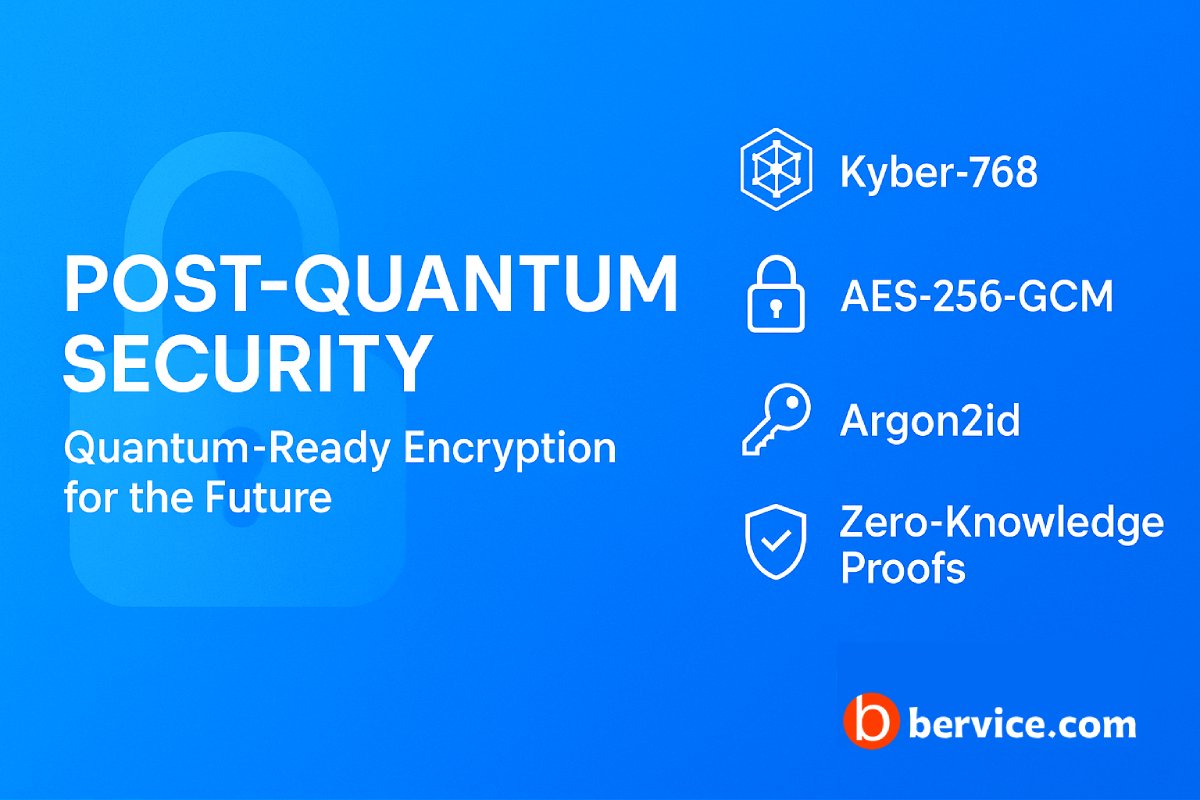
Introduction: The Quantum Threat to Today’s Encryption
For decades, digital security has relied on mathematical problems so complex that even the fastest classical computers struggle to solve them. But quantum computing changes everything. Algorithms like Shor’s and Grover’s can, in theory, break RSA, ECC, and other public-key systems that form the backbone of modern encryption.
In this new era, quantum-resistant cryptography isn’t optional — it’s the foundation for trust in the digital world. That’s exactly what Bervice was designed for.
1. The Post-Quantum Security Paradigm
Post-Quantum Cryptography (PQC) refers to cryptographic algorithms built to withstand attacks from quantum computers. Unlike traditional systems that rely on factoring large primes or discrete logarithms, PQC algorithms are based on lattice-based, hash-based, or code-based problems — all of which remain resistant to both classical and quantum computation.
Bervice embraces this shift at its core. Its architecture combines Kyber-768, a lattice-based key encapsulation mechanism recommended by NIST, with AES-256-GCM for authenticated symmetric encryption. Together, they create a hybrid cryptographic layer capable of protecting data even against future quantum adversaries.
2. How Bervice Resists Quantum Attacks
The strength of Bervice lies in its multi-layered defense model:
- 🔐 Quantum-Resistant Key Exchange:
Bervice replaces RSA/ECC with Kyber-768, ensuring that even if quantum computers become practical, intercepted keys remain mathematically unbreakable. - 🧬 Hybrid Encryption Framework:
Each file and password stored within Bervice is encrypted individually using AES-GCM, with unique nonces and memory-locked keys. This ensures data compartmentalization — even if one file’s key is compromised, the rest remain safe. - 🧠 Argon2-Based Key Derivation:
Bervice employs Argon2id, the winner of the Password Hashing Competition (PHC), to resist brute-force and side-channel attacks, including those accelerated by quantum parallelism. - 💾 In-Memory Security:
Decryption happens only within protected memory spaces using Rust’s zeroize and mlockall mechanisms, preventing keys from leaking to disk or swap memory.
Together, these mechanisms form a quantum-secure architecture that is already protecting user data today — not waiting for tomorrow’s quantum threat.
3. Why Today’s Encryption Isn’t Enough
Most “secure” systems in 2025 still rely on traditional cryptography such as RSA-2048 or ECDSA-P256. These algorithms are computationally secure, not mathematically unbreakable. The problem? Once a functional quantum computer reaches sufficient qubit stability and error correction, these systems could be broken in hours or minutes.
That’s what makes post-quantum readiness essential today. Data encrypted now may still be valuable 10 or 20 years later — think of medical records, financial data, intellectual property, or government archives. Attackers can “harvest now, decrypt later”, storing encrypted data until quantum capabilities emerge.
Bervice eliminates that risk by ensuring all data is encrypted with quantum-safe primitives from day one.
4. The Role of Zero-Knowledge Proofs: Trust Without Exposure
Beyond encryption, Bervice introduces Zero-Knowledge Proofs (ZKPs) to enable secure verification without revealing the data itself.
For example:
- You can prove ownership of an encrypted vault without exposing its contents.
- You can verify identity or signature validity without revealing private keys.
- You can share access rights through smart contracts without disclosing the actual decryption key.
This transforms the concept of digital trust — it’s no longer about who controls the server, but who can mathematically prove authenticity.
5. Bervice’s Vision for the Quantum-Secure Future
Bervice isn’t merely adapting to a post-quantum world; it’s building for it.
By fusing Kyber, AES-GCM, Argon2, and ZKPs into a seamless desktop experience, it offers:
- Data Immortality: Your encrypted files remain safe even after quantum breakthroughs.
- User Sovereignty: You own your encryption keys — not a central server.
- Trustless Collaboration: You can share, verify, and synchronize data securely across devices without intermediaries.
The post-quantum transition will redefine what security means — and Bervice is already there, protecting users against threats most haven’t even imagined yet.
Conclusion: Protecting Tomorrow’s Privacy, Today
The age of quantum computing will be both revolutionary and disruptive.
While it promises breakthroughs in science, it also threatens the very cryptographic foundations of the internet.
Bervice stands at the intersection of innovation and resilience, ensuring your digital life remains untouchable — not just today, but in the quantum decades ahead.
🔒 Bervice: Quantum-Ready Security. Trustless. Immutable. Immortal.
Connect with us : https://linktr.ee/bervice