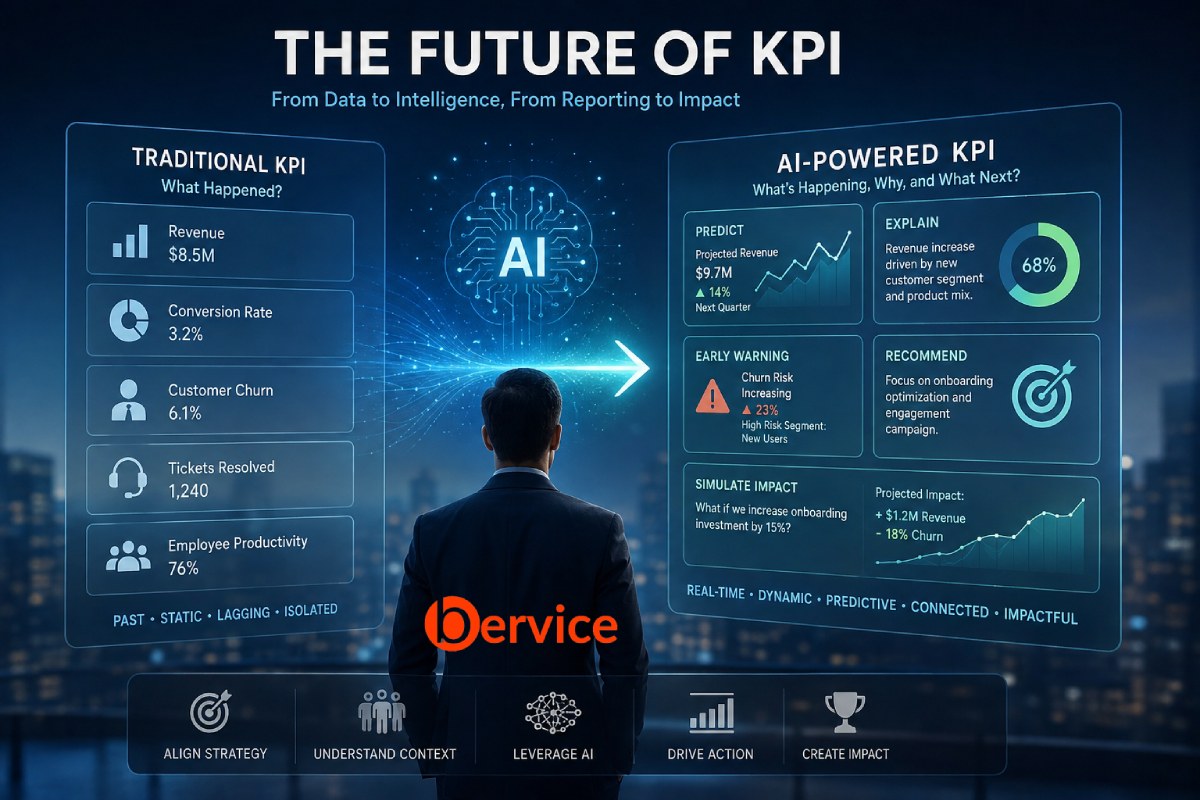
From Measuring Performance to Understanding Impact
For decades, organizations have relied on Key Performance Indicators, or KPIs, to answer a seemingly simple question:
Are we performing well?
Revenue growth, conversion rates, customer acquisition costs, employee productivity, churn, delivery times, sales quotas, and countless other metrics have become the language of modern management.
But there is a fundamental limitation in the traditional KPI model.
Most KPIs measure what has already happened.
They tell us how many products were sold, how many customers left, how many tasks were completed, or whether a quarterly target was achieved. They are useful, but they are largely retrospective.
Artificial intelligence is beginning to change that model.
The next generation of performance measurement will not simply use AI to calculate existing KPIs faster. AI has the potential to change what organizations measure, how frequently they measure it, how performance is interpreted, and ultimately what a KPI actually represents.
We may be moving from Key Performance Indicators toward something closer to Key Performance Intelligence.
The Problem With Traditional KPIs
Traditional KPIs were designed for a world where information was relatively expensive to collect and analyze.
Organizations therefore selected a limited number of measurable signals.
A sales department might track:
- Revenue
- Number of calls
- Conversion rate
- Average deal size
A customer support department might measure:
- Tickets resolved
- Average response time
- Customer satisfaction
A software team might track:
- Features delivered
- Bugs resolved
- Deployment frequency
- Project completion
These indicators provide useful visibility, but they can also create an important problem:
People begin optimizing the metric instead of the outcome.
A support agent measured primarily by ticket resolution speed may close tickets quickly without solving customer problems properly.
A salesperson measured by meetings booked may generate large numbers of low-quality meetings.
A software team measured by features shipped may produce more functionality while making the product increasingly complicated.
The KPI can improve while the underlying system becomes worse.
This is one of the oldest problems in performance management.
AI could make it possible to measure the system behind the metric.
1. From Static KPIs to Dynamic KPIs
Traditional KPIs are usually predefined.
Management decides what should be measured, establishes targets, and reviews performance periodically.
AI introduces the possibility of dynamic KPIs.
Instead of assuming that the same indicators remain equally important throughout the year, AI systems could continuously analyze operational data and identify which indicators currently have the strongest relationship with business outcomes.
Imagine a company with 40 operational metrics.
Traditional management might select five of them as KPIs.
An AI system could continuously analyze relationships between those metrics and outcomes such as revenue, retention, profitability, customer satisfaction, or operational risk.
It might discover that a metric considered relatively unimportant six months ago has suddenly become one of the strongest predictors of customer churn.
The KPI framework could therefore evolve with the business.
The question changes from:
“What KPIs did management define?”
to:
“What signals currently matter most?”
2. From Lagging Indicators to Predictive Indicators
Many traditional KPIs are lagging indicators.
They describe consequences.
Revenue declined.
Customers churned.
A project missed its deadline.
Employee turnover increased.
Inventory became insufficient.
AI can increasingly introduce predictive indicators that estimate what is likely to happen before the final outcome appears.
Instead of reporting:
Customer churn: 8%
an AI-enabled performance system might report:
Projected churn next month: 11%, with the increase primarily associated with declining product engagement among a specific customer segment.
This is a very different management tool.
The KPI is no longer simply a score.
It becomes an early-warning system.
Organizations can potentially intervene before performance deteriorates rather than analyzing the failure afterward.
3. From Universal KPIs to Contextual KPIs
Traditional KPI systems often apply the same measurement framework across very different situations.
But performance is contextual.
Two employees can produce identical numerical results while operating under completely different conditions.
Two stores can generate the same revenue while facing completely different customer traffic.
Two project teams can deliver the same number of tasks while solving problems of dramatically different complexity.
Traditional measurement systems struggle to represent this context.
AI can process much larger combinations of variables.
Future performance systems could evaluate not only:
What was achieved?
but also:
Under what conditions was it achieved?
This could create contextual performance measurement.
For example, instead of measuring a salesperson only by revenue, an AI system could consider territory difficulty, customer quality, market conditions, sales-cycle complexity, retention of acquired customers, discount levels, and long-term account value.
The result could be a much richer interpretation of performance.
4. From Activity Metrics to Outcome Metrics
Organizations frequently measure activity because activity is easy to count.
Calls made.
Emails sent.
Hours worked.
Tickets closed.
Documents produced.
Code written.
Meetings attended.
But activity is not necessarily value.
Generative AI makes this distinction even more important.
An employee using AI may produce ten times more documents, presentations, emails, reports, or software code than before.
If the organization continues measuring output volume, AI-assisted workers may appear dramatically more productive.
But the important question is not:
How much did they produce?
It is:
What changed because of what they produced?
The next generation of KPIs will therefore need to move from measuring production toward measuring impact.
Instead of:
Reports produced per month
organizations may measure:
Decisions improved by analysis.
Instead of:
Features shipped
they may measure:
User problems successfully resolved.
Instead of:
Customer interactions completed
they may measure:
Customer outcomes improved.
AI makes output cheaper.
That means output itself becomes less meaningful as a measure of performance.
5. AI Will Create Multi-Dimensional KPIs
Traditional KPIs usually reduce performance to individual numbers.
But real performance rarely exists in one dimension.
Consider customer support.
A support interaction could simultaneously be evaluated across:
- Resolution quality
- Response speed
- Customer sentiment
- Accuracy
- Communication clarity
- Compliance
- Escalation risk
- Long-term customer retention
Historically, analyzing all of these dimensions across millions of interactions would have been extremely expensive.
AI makes this increasingly feasible.
Future KPIs may therefore behave less like individual metrics and more like performance models.
Instead of saying:
Support performance score: 87
a system could explain:
Resolution quality is improving, response speed is stable, but customer frustration is increasing in billing-related conversations and is likely to affect retention.
Performance measurement becomes diagnostic rather than purely numerical.
6. KPIs Could Become Personalized
Another major transformation will be the personalization of performance indicators.
Traditional organizations often measure hundreds or thousands of employees using identical scorecards.
AI could allow KPI frameworks to adapt to roles, responsibilities, experience levels, working conditions, and objectives.
A junior engineer and a senior architect should not necessarily be evaluated using identical indicators.
A salesperson developing a new territory should not necessarily be measured in exactly the same way as someone managing established enterprise accounts.
AI systems could create personalized performance frameworks while maintaining organization-wide objectives.
This could produce an important shift:
Company goals remain standardized, while the paths used to measure contribution become contextual.
7. The Rise of Real-Time Performance Intelligence
Traditional KPI reporting often happens weekly, monthly, or quarterly.
AI systems can analyze operational signals continuously.
This could eventually make the traditional KPI dashboard feel surprisingly static.
Instead of opening a dashboard and interpreting charts manually, executives may interact with an AI performance layer.
They might ask:
Why did conversion decline this week?
The system could analyze thousands of signals and identify the most likely drivers.
Then they could ask:
Which problem should we solve first?
The system could estimate the expected impact of each intervention.
Then:
What happens if we do nothing?
The system could simulate potential outcomes.
At that point, performance management is no longer simply dashboard analytics.
It becomes an intelligent decision-support system.
8. KPIs Will Become More Causal
One of the biggest weaknesses of traditional analytics is the confusion between correlation and causation.
A metric may move alongside revenue without actually causing revenue to change.
AI will not magically solve causality, and organizations must be careful not to treat AI-generated explanations as proof.
However, combining AI with experimentation, causal inference, historical data, and controlled interventions could significantly improve how organizations understand performance.
Future systems may increasingly distinguish between:
What changed
and
What actually contributed to the change.
This distinction matters enormously.
Managers do not only need to know that performance improved.
They need to know why.
Without that knowledge, successful outcomes are difficult to reproduce.
9. AI Could Detect Bad KPIs
Perhaps one of the most interesting applications of AI will be identifying when a KPI itself is harmful.
Organizations frequently continue measuring metrics because they have always measured them.
AI systems could potentially detect situations where employees are optimizing a metric while damaging broader outcomes.
For example:
Ticket closure speed improves while customer satisfaction falls.
Sales volume increases while customer lifetime value decreases.
Production increases while defect rates rise.
Website engagement increases while conversion falls.
AI could identify these contradictions and warn management:
This KPI is producing behavior that conflicts with the organization’s actual objective.
That would represent a major evolution in management systems.
Instead of employees simply being evaluated by KPIs, the KPIs themselves would also be evaluated.
10. Human Performance Will Need New Metrics
AI creates another difficult question:
How should human performance be measured when humans increasingly work through AI?
Imagine two analysts.
Analyst A manually spends eight hours producing a report.
Analyst B uses AI and produces a better report in one hour.
Traditional productivity measurement may reward Analyst B.
But now imagine Analyst C builds an AI workflow that automatically produces similar reports for the entire organization.
How should Analyst C’s contribution be measured?
Hours worked become almost meaningless.
Documents produced become misleading.
Individual output becomes difficult to separate from automated output.
The value increasingly comes from:
- Problem selection
- Judgment
- Decision quality
- System design
- Verification
- Creativity
- Coordination
- Responsibility
- Ability to use AI effectively
The human contribution moves higher in the decision chain.
This means performance systems will increasingly need to measure leverage, not just labor.
11. From Individual Performance to Human-AI Performance
The traditional organization evaluates employees.
The AI-enabled organization may increasingly evaluate human-AI systems.
Consider a marketing professional using multiple AI agents for research, content generation, experimentation, analytics, and campaign optimization.
Where does the employee’s performance end and the AI system’s performance begin?
The distinction becomes increasingly difficult.
Organizations may therefore begin measuring the combined system:
Human judgment + AI capability + workflow quality + business outcome
This could create entirely new performance categories.
For example:
AI Leverage Ratio
How much additional valuable output does an employee generate through AI?
Human Intervention Value
Where does human judgment significantly improve AI-generated outcomes?
Verification Accuracy
How effectively does the employee detect AI mistakes?
Automation Quality
How reliably do the workflows created by the employee operate?
Decision Impact
How much measurable value results from decisions made using AI-supported analysis?
These metrics could become increasingly important as AI agents become integrated into everyday work.
12. KPIs Could Become Forward-Looking Simulations
The most advanced version of AI-driven performance management may move beyond prediction.
It could become simulation.
Imagine a company considering three strategies.
Instead of simply reviewing historical KPIs, management could ask:
What happens to our major performance indicators under Strategy A, B, or C?
AI systems could simulate potential consequences across revenue, workforce capacity, customer retention, operational risk, and capital requirements.
KPIs would no longer describe only the current organization.
They would describe possible future organizations.
This transforms performance measurement into strategic navigation.
The New KPI Architecture
The future KPI system may contain several layers.
Layer 1: Traditional Metrics
Basic measurable facts such as revenue, cost, conversion, retention, productivity, and delivery time.
Layer 2: Context
Market conditions, task difficulty, customer characteristics, resource constraints, and operational environment.
Layer 3: Relationships
AI identifies patterns connecting different metrics and outcomes.
Layer 4: Prediction
Models estimate future performance and emerging risks.
Layer 5: Explanation
The system identifies likely drivers behind changes.
Layer 6: Recommendation
AI suggests potential interventions.
Layer 7: Simulation
Management explores the probable consequences of different decisions.
At this point, the KPI system has evolved from a measurement system into an organizational intelligence layer.
The Risk: AI Can Make KPIs More Dangerous Too
AI-driven performance measurement is not automatically better.
It introduces serious risks.
If an AI system analyzes employees continuously, performance management could become excessive workplace surveillance.
If models contain bias, automated performance scores could reproduce or amplify unfairness.
If organizations trust AI-generated explanations too much, correlation could be mistaken for causation.
And if increasingly complex models determine performance scores, employees may no longer understand how they are being evaluated.
That creates a fundamental governance requirement:
The more intelligent performance measurement becomes, the more transparent and accountable it must become.
Organizations will need clear rules defining what data can be collected, how AI-generated evaluations are used, which decisions require human review, and how individuals can challenge incorrect assessments.
AI should improve management visibility without turning work into invisible algorithmic judgment.
From KPI Dashboards to AI Performance Agents
Today’s managers open dashboards.
Tomorrow’s managers may speak with performance agents.
Instead of manually navigating dozens of charts, a manager might ask:
What are the three biggest threats to our quarterly target?
The AI could analyze operational systems and answer.
Then:
Which one can we influence fastest?
Then:
What action would have the highest expected impact?
Then:
Show me the evidence behind that recommendation.
The interface to organizational performance could fundamentally change.
Dashboards will still exist, but the intelligence layer above them may become more important than the visualization itself.
The KPI of the Future May Not Be a Number
This may ultimately be the biggest transformation.
For decades, management systems have attempted to compress complex organizational reality into numbers.
AI allows us to reverse that process.
Instead of merely turning reality into metrics, AI can interpret the relationships between thousands of signals and reconstruct a richer explanation of what is happening.
The future KPI might therefore look less like:
Conversion Rate: 4.7%
and more like:
Conversion is currently 4.7%, down 0.6 percentage points. Approximately half of the decline appears concentrated among mobile visitors arriving through paid acquisition. If the current pattern continues, quarterly revenue is projected to finish 3% below target. Improving mobile checkout completion is currently the highest-impact intervention identified by the model.
That is not simply a metric.
It is performance intelligence.
The New Management Question
The industrial era taught organizations to measure labor.
The digital era taught organizations to measure activity.
The AI era may force organizations to measure something much harder:
impact.
When AI can generate emails, reports, designs, software, analysis, presentations, and strategies almost instantly, counting output becomes increasingly meaningless.
The important questions become:
- Did the work solve the problem?
- Did the decision improve the outcome?
- Did the human recognize what the AI could not?
- Did the system create measurable value?
Can the result be verified?
And can the organization understand why it happened?
These questions point toward a new generation of KPIs.
Not simply indicators of performance.
But systems for understanding performance.
Conclusion: From Key Performance Indicators to Key Performance Intelligence
AI will not eliminate KPIs.
It will expand them.
The traditional KPI was designed to answer:
“What happened?”
The AI-powered KPI will increasingly attempt to answer:
What is happening?
Why is it happening?
What is likely to happen next?
What should we do about it?
What will probably happen if we do?
That is a profound shift.
The organizations that benefit most from AI may not be those that simply automate the most work.
They may be the organizations that become better at understanding what valuable work actually looks like.
Because in an economy where machines can produce almost unlimited output, the ability to measure real impact may become more valuable than the ability to measure productivity.
Connect with us : https://linktr.ee/bervice
Website : https://bervice.com