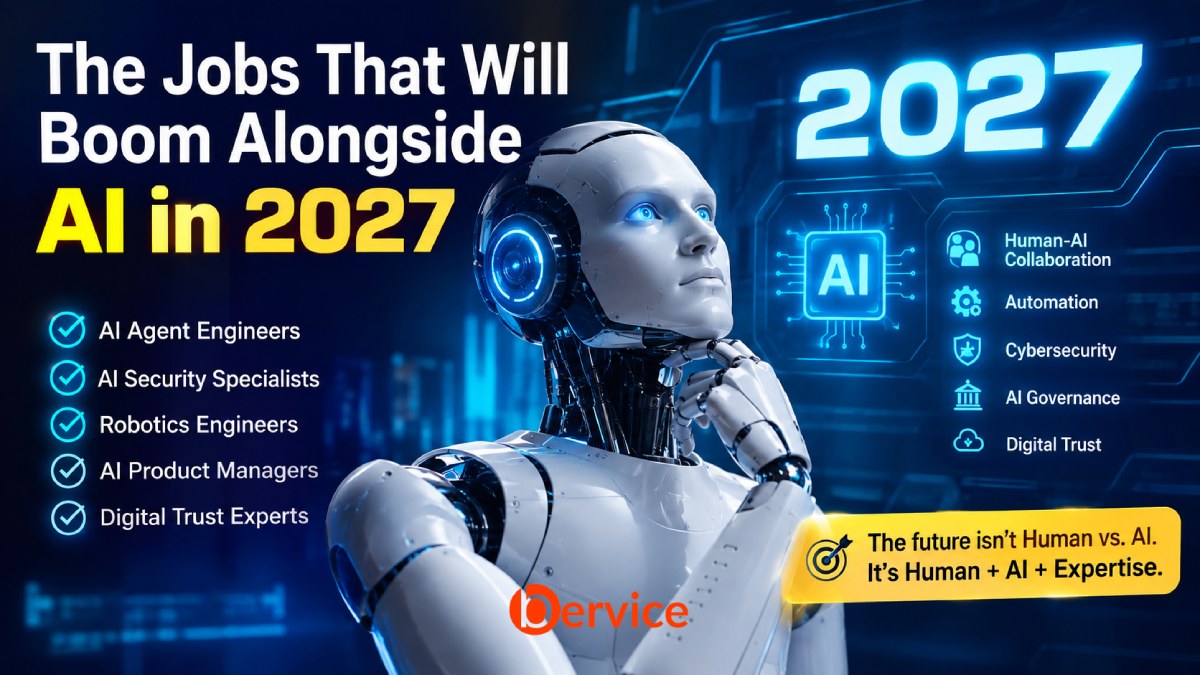
The Future of Work Is Not Human vs. AI. It Is Human + AI.
For years, the conversation around artificial intelligence has been dominated by one question:
Which jobs will AI replace?
But as we move toward 2027, a more useful question is emerging:
Which jobs will become more valuable because AI exists?
Artificial intelligence is not simply removing work. It is changing the structure of work itself.
According to the World Economic Forum’s Future of Jobs Report 2025, global labor-market transformation could create approximately 170 million new jobs while displacing 92 million by 2030, resulting in a net increase of 78 million roles. AI, big data and cybersecurity are among the areas expected to experience particularly strong demand.
At the same time, the International Labour Organization estimates that one in four workers globally is employed in an occupation with some degree of exposure to generative AI. Its research suggests that transformation, rather than complete replacement, is the more likely outcome for most occupations.
This creates an important shift.
The most valuable workers of 2027 may not necessarily be the people who can compete with AI.
They may be the people who know how to direct it, verify it, integrate it, secure it and turn its capabilities into real-world results.
1. AI Agent Engineers
The first generation of generative AI was largely about asking models questions.
The next generation is about giving AI systems work.
AI agents can increasingly interact with software, retrieve information, generate documents, analyze data, write code and execute multi-step workflows.
That creates demand for a new type of engineer: the AI Agent Engineer.
These professionals will build systems in which AI models can interact with APIs, databases, enterprise software and other agents while operating within defined permissions and constraints.
The valuable skill will not simply be knowing how to call an AI model.
It will be knowing how to build a reliable system around it.
That requires understanding orchestration, memory, tool use, authentication, permissions, observability, failure recovery and human approval mechanisms.
In 2027, companies may have hundreds or thousands of AI-driven processes.
Someone will have to design them.
2. AI Automation Architects
Many organizations already have automation.
But traditional automation usually follows deterministic rules:
If X happens, perform Y.
AI changes this model.
Future workflows will combine traditional software, APIs, robotic process automation, AI agents and human decision makers.
This creates an emerging role:
AI Automation Architect.
These professionals will examine how organizations operate and determine which activities should be automated, which should remain human-controlled and how information should move between the two.
A company might have AI handling customer inquiries, analyzing documents, preparing reports, identifying anomalies and creating recommendations.
But those systems still need architecture.
The automation architect becomes the person who designs the organization’s human-machine operating system.
3. AI Security Engineers
Every new technological layer creates a new security layer.
AI will be no exception.
Organizations deploying AI agents face risks that traditional cybersecurity systems were not originally designed to manage.
An AI system may have access to emails, customer records, source code, financial systems, cloud infrastructure or internal documents.
That creates entirely new attack surfaces.
AI security engineers will increasingly focus on areas such as:
- prompt injection
- agent permission management
- model access control
- AI supply-chain security
- data leakage
- adversarial inputs
- model manipulation
- autonomous-agent monitoring
- secure AI infrastructure
Cybersecurity itself is already expected to experience increasing demand as digital systems expand. The World Economic Forum identifies networks and cybersecurity among the fastest-growing skill categories through 2030.
AI will make that challenge considerably more complex.
4. AI Auditors and Verification Specialists
AI can produce answers extremely quickly.
But speed does not guarantee truth.
As organizations delegate more analysis and decision support to AI, verifying AI-generated output becomes increasingly important.
This creates opportunities for AI auditors, verification specialists and model-risk professionals.
Their responsibility will not necessarily be to create the AI.
Their responsibility will be to determine whether it can be trusted.
They may evaluate:
accuracy, bias, traceability, compliance, security, reliability and decision quality.
This becomes especially important in industries such as healthcare, finance, insurance, engineering, law and government, where an incorrect AI-generated answer can have significant consequences.
The more AI produces, the more valuable reliable verification becomes.
5. Robotics and Autonomous Systems Engineers
AI is currently strongest in the digital world.
Robotics brings AI into the physical world.
Warehouses, construction sites, farms, factories, hospitals, logistics networks and eventually homes will increasingly use intelligent machines capable of perceiving and interacting with their environments.
That means growing demand for professionals who understand the intersection of:
AI + electronics + mechanical systems + sensors + control systems + software.
These include robotics engineers, computer-vision engineers, embedded engineers, autonomous-systems developers and field robotics technicians.
The World Economic Forum identifies robotics and automation as one of the major technologies expected to reshape employment through 2030.
The next major AI revolution may therefore happen outside the computer screen.
6. AI Product Managers
Building AI technology and building a useful AI product are very different problems.
Companies need people capable of translating business problems into AI-powered products.
That makes the AI Product Manager increasingly important.
These professionals need enough technical understanding to recognize what AI can and cannot do, while also understanding customers, economics, product design and business strategy.
They must answer questions such as:
Should this feature use AI?
How reliable does it need to be?
Where should humans remain involved?
How much will inference cost?
What happens when the model is wrong?
How do we measure whether the AI actually creates value?
The ability to answer these questions will become increasingly valuable as almost every software category begins incorporating AI.
7. Human-AI Interaction Designers
Traditional user experience design assumes that software behaves predictably.
Click a button and something specific happens.
AI systems are probabilistic.
The same request can generate different outcomes.
This fundamentally changes interface design.
Future designers will need to determine how humans communicate intentions to AI, understand AI decisions, correct mistakes, provide context and take control when necessary.
This creates a new design discipline:
Human-AI Interaction Design.
The challenge is no longer simply making software easy to use.
It is making intelligent systems understandable, controllable and trustworthy.
8. AI Infrastructure and Data Engineers
AI appears magical at the interface.
Behind that interface is enormous infrastructure.
Models require data pipelines, storage, accelerators, networking, monitoring, retrieval systems, vector databases, inference infrastructure and cloud resources.
As AI becomes embedded throughout organizations, the engineers maintaining this infrastructure become increasingly important.
Demand is therefore likely to remain strong for roles including:
AI infrastructure engineers, data engineers, MLOps engineers, platform engineers and distributed-systems specialists.
The World Economic Forum currently ranks Big Data Specialists and AI and Machine Learning Specialists among the fastest-growing occupations through 2030.
AI cannot scale without infrastructure.
9. Domain Experts Who Master AI
Some of the biggest winners from AI may not have “AI” anywhere in their job titles.
Consider:
Doctor + AI
Lawyer + AI
Architect + AI
Engineer + AI
Accountant + AI
Researcher + AI
Construction Manager + AI
Financial Analyst + AI
A domain expert who understands both their profession and how to use AI effectively can potentially accomplish far more than someone relying exclusively on traditional workflows.
But expertise remains important.
AI can generate possibilities.
Experienced professionals understand context, consequences and constraints.
This combination may become one of the most valuable professional profiles of the next decade:
deep domain expertise + AI leverage.
10. Skilled Trades and Physical-World Specialists
One of the interesting consequences of AI may be renewed appreciation for jobs requiring physical presence and real-world dexterity.
Electricians, technicians, mechanics, installers, equipment operators and specialized construction workers perform tasks in environments that are difficult to fully automate.
AI may still transform these professions.
An electrician might use AI for diagnostics.
A mechanic might use computer vision to identify problems.
A construction technician might use augmented reality and AI-generated instructions.
But a human may still perform much of the physical work.
This means many trades may become AI-augmented rather than AI-replaced.
11. Healthcare and Care Professionals
Healthcare represents another major category where AI and human labor are likely to grow together.
AI can analyze medical information, summarize records, assist diagnosis, automate administrative tasks and support clinical decision making.
But healthcare also requires physical examination, responsibility, communication, empathy and trust.
Demographic changes are simultaneously increasing demand for healthcare and care workers in many countries.
The World Economic Forum expects care-related professions, including nursing and social work roles, to experience significant growth through 2030.
The healthcare professional of the future may therefore work with AI constantly without being replaced by it.
12. AI Governance and Compliance Specialists
Governments are beginning to regulate artificial intelligence.
Companies deploying AI increasingly need to answer difficult questions.
Who is responsible when an AI system makes a mistake?
Which data was used?
Can the decision be explained?
Was personal information protected?
Was human oversight available?
Does the system comply with applicable regulations?
These questions create demand for professionals working at the intersection of:
technology + law + risk + policy.
AI governance specialists, compliance professionals, AI risk managers and responsible-AI specialists could become increasingly important as organizations move from experimental AI deployments into production systems.
13. AI Operations Managers
There may also be an entirely new category of management.
Traditional managers manage people.
Future managers may manage combinations of:
people + software + AI agents.
Imagine a marketing department containing six employees and 40 specialized AI agents.
Someone must determine what the agents can access, what tasks they perform, when humans review their work and how performance is measured.
This could create roles similar to:
AI Operations Manager
or
Human-AI Workforce Manager.
Managing machines will increasingly become part of managing organizations.
14. AI Educators and Workforce Transformation Specialists
AI is changing faster than traditional education systems can update curricula.
Companies cannot wait several years for universities to produce workers trained for every new AI capability.
They will need continuous internal education.
This creates opportunities for AI trainers, corporate educators, implementation consultants and workforce transformation specialists.
Their role will be to help existing professionals redesign the way they work.
This matters because the skills themselves are changing rapidly.
LinkedIn’s 2025 Work Change Report estimated that approximately 70% of the skills used in most jobs could change by 2030, with AI acting as a major catalyst.
The ability to learn may therefore become more important than the ability to memorize.
15. Trust, Identity and Digital Verification Specialists
There is another less obvious category that could become increasingly important.
AI makes generating digital content extremely cheap.
Documents, images, voices, profiles, portfolios, applications, reviews and even entire identities can increasingly be generated or manipulated.
When creation becomes cheap, verification becomes valuable.
Organizations will need stronger mechanisms for determining:
Who is this person?
Did they actually perform this work?
Does this credential belong to them?
Was this content created or approved by the claimed person?
Can this professional capability be independently verified?
This creates opportunities around digital identity, credential verification, provenance, reputation systems and trust infrastructure.
AI increases the world’s ability to generate information.
It simultaneously increases the economic value of proving which information is authentic.
The Bigger Pattern
Look carefully at these professions and a pattern appears.
The future job market can roughly be divided into several layers:
- People who build AI.
- People who connect AI to businesses.
- People who control and secure AI.
- People who verify AI.
- People who use AI to amplify specialized expertise.
- People who perform physical or deeply human work that AI cannot easily execute.
That distinction is important.
The winners of the AI economy will not necessarily be AI researchers.
- A construction manager who understands AI automation could become extraordinarily productive.
- A doctor who understands AI-assisted diagnostics could serve patients differently.
- A cybersecurity engineer who understands autonomous agents could protect infrastructure that did not previously exist.
The opportunity is much larger than the AI industry itself.
The Most Valuable Skill of 2027
The most important skill may ultimately be AI orchestration.
Not prompting.
Not simply using ChatGPT.
Orchestration means understanding how to combine:
AI models, agents, software, data, APIs, automation and human expertise
into systems capable of producing reliable outcomes.
The professional who can accomplish ten times more with AI without sacrificing quality, security or accountability becomes extremely valuable.
This changes the traditional definition of productivity.
In the industrial economy, machines amplified physical strength.
In the computer economy, software amplified information processing.
In the AI economy, intelligent systems may amplify individual capability.
One person may eventually operate workflows that previously required an entire department.
Human Skills Are Not Disappearing
Ironically, the rise of AI may make certain human abilities more valuable.
The World Economic Forum expects technological capabilities such as AI, big data and cybersecurity to grow rapidly, but it also emphasizes continued demand for analytical thinking, creative thinking, resilience, leadership and collaboration.
This makes sense.
- When producing an answer becomes easy, determining the right question becomes valuable.
- When generating content becomes easy, judgment becomes valuable.
- When information becomes abundant, credibility becomes valuable.
- When automation becomes powerful, responsibility becomes valuable.
And when machines become capable of performing more work, distinctly human capabilities become easier to recognize.
From Job Titles to Capability Stacks
Perhaps the biggest transformation will be that careers themselves become less defined by job titles.
Instead of saying:
“I am a software engineer.”
Professionals may increasingly be defined by combinations of capabilities:
Software Engineering + AI Agents + Cybersecurity
Architecture + BIM + AI Automation
Medicine + AI Diagnostics + Patient Communication
Finance + AI Analysis + Risk Management
This can be called a Capability Stack.
The stronger and more unusual the combination, the harder the professional becomes to replace.
This may explain why learning AI alone is not necessarily enough.
Millions of people can learn the same AI tools.
The competitive advantage comes from combining AI with something difficult to acquire:
experience, technical expertise, relationships, physical capability, professional licensing, judgment, reputation or verified achievements.
Conclusion: Don’t Compete With AI. Build Around It.
The defining career question of 2027 may not be:
“Will AI replace my job?”
A better question is:
“What becomes possible in my profession now that intelligence itself is becoming programmable?”
AI will automate tasks.
It will eliminate some roles.
It will transform many more.
But it will also create entirely new layers of infrastructure, security, governance, verification, robotics, education and human-machine collaboration.
The strongest careers will probably not sit completely outside AI.
They will sit beside it.
- The engineer who controls AI.
- The doctor who works with AI.
- The technician who uses AI.
- The auditor who verifies AI.
- The security specialist who protects AI.
- The manager who coordinates AI agents.
And the professional whose expertise becomes dramatically more powerful because AI is working beside them.
The future of work is therefore unlikely to be simply humans versus machines.
It will increasingly be:
Humans who know how to work with intelligent machines versus humans who do not.
And by 2027, that difference may become one of the most important competitive advantages in the global labor market.
Connect with us : https://linktr.ee/bervice
Website : https://bervice.com